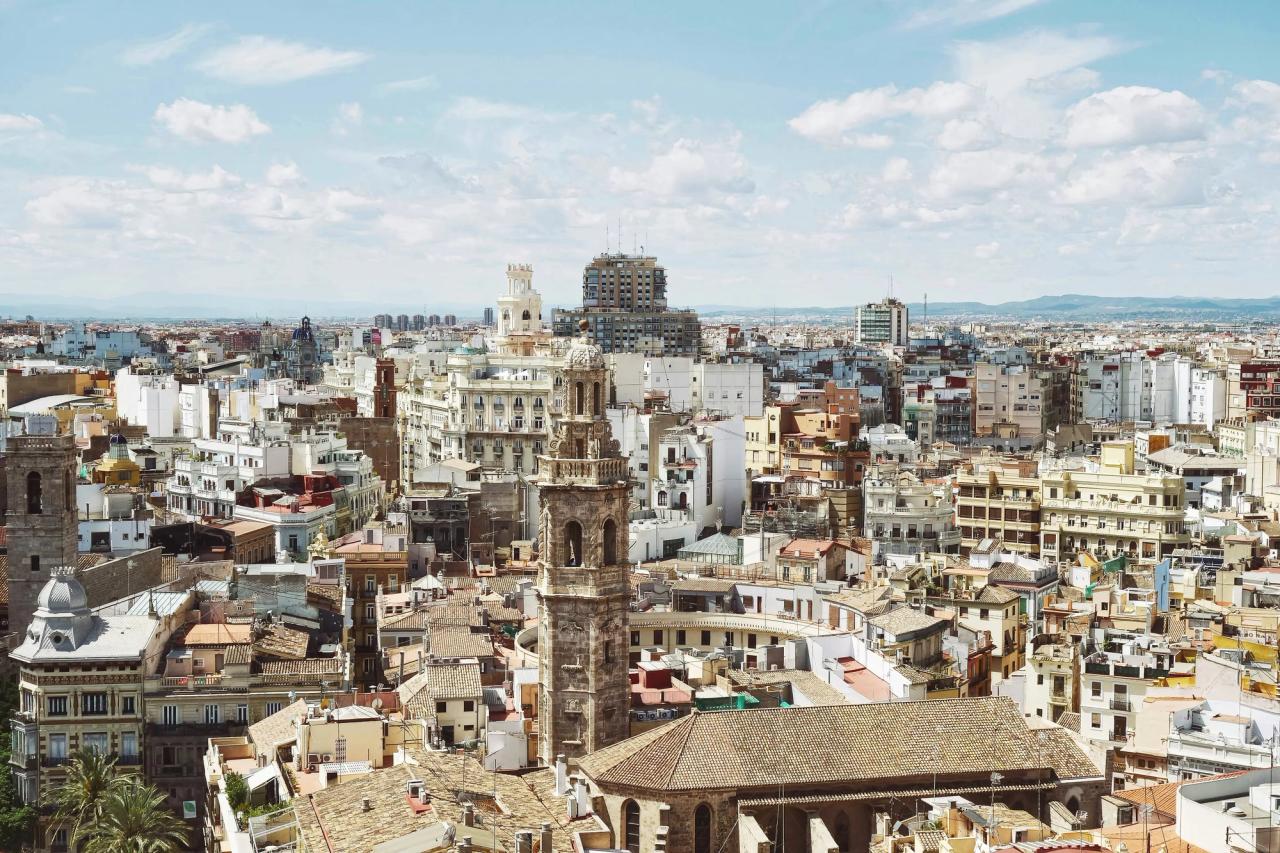

Valencia is Spain's third-largest city, sitting on the Mediterranean coast with a blend of futuristic architecture, sandy beaches, and a famously relaxed pace of life. Known as the birthplace of paella, Valencia offers expats a lower cost of living than Madrid or Barcelona without sacrificing culture, sunshine, or quality of life.
Valencia at a Glance

- Population
- 800,000 (city) / 1.8 million (metro area)
- Region
- Valencian Community, eastern Spain
- Known For
- Paella, City of Arts and Sciences, Las Fallas festival
- Average Rent (1BR)
- €650–€950 per month
- Average Salary
- €1,500–€1,900 net per month
- Expat Community
- Growing rapidly — strong British, German, and Latin American presence
- Language
- Spanish and Valencian (both co-official)
- Climate
- Mediterranean — mild winters, hot summers, 2,238 sunshine hours
Why Move to Valencia
- Affordability: Rent is 30–40% lower than Madrid or Barcelona, making it one of the best-value cities on the Mediterranean coast.
- Beach and city in one: Malvarrosa and Cabanyal beaches are minutes from the center; the Turia riverbed park runs through the entire city like a green spine.
- Quality of life: 2,238 hours of sunshine per year, excellent public transport, and a famously relaxed Mediterranean pace that prioritizes wellbeing over hustle.
- Cultural scene: From the City of Arts and Sciences to the UNESCO-listed Silk Exchange, Valencia punches well above its weight for a city its size.
- Startup ecosystem: A growing tech and creative hub attracting remote workers and entrepreneurs from across Europe — co-working spaces are multiplying.
- Food culture: As the birthplace of paella, Valencia takes its gastronomy seriously. Fresh markets, beachside restaurants, and innovative chefs create a vibrant food scene.
Finding Housing in Valencia
Average Rents
| Neighborhood | 1-Bedroom | 3-Bedroom | Character |
|---|---|---|---|
| Ciutat Vella | €700–€950 | €1,200–€1,700 | Historic center, walkable, tourist-heavy |
| Ruzafa | €750–€1,000 | €1,300–€1,800 | Trendy, nightlife, international restaurants |
| Eixample | €700–€950 | €1,200–€1,700 | Grid streets, modernist buildings, central |
| El Cabanyal | €550–€800 | €950–€1,400 | Beachside, bohemian, up-and-coming |
| Benimaclet | €550–€750 | €900–€1,300 | Student-friendly, village feel, affordable |
| Patraix | €500–€700 | €850–€1,200 | Quiet residential, local markets, good value |
How to Find Housing
- Idealista: The go-to rental portal — filter by price, size, and neighborhood. Most landlords list here first.
- Fotocasa: Strong Valencia listings with detailed photos, floor plans, and neighborhood data.
- Milanuncios: Private landlord listings — often cheaper but less standardized.
- Local agencies: Expect a one-month agency fee plus 21% VAT. Agencies are common for Eixample and Ciutat Vella.
- Facebook groups: "Pisos en Valencia" and "Valencia Expats Housing" groups have direct listings — always verify before paying.
Tips for Expats
- Deposits are typically 1–2 months. Some landlords request a Spanish guarantor (avalista).
- Utilities run €100–€140 per month and are almost always extra.
- Ruzafa and Ciutat Vella fill fast — act quickly when you find a good listing.
- El Cabanyal is gentrifying rapidly — still affordable but prices are climbing year over year.
- Air conditioning is essential from June through September — verify the unit before signing.
Neighborhoods Guide
- Ciutat Vella: The historic heart — Mercado Central (one of Europe's largest fresh markets), the Cathedral, and Plaza de la Virgen. Lively but noisy on weekends. Best for those who want to be in the middle of everything.
- Ruzafa: Valencia's coolest neighborhood. Packed with brunch spots, vintage shops, cocktail bars, and a mixed expat-local crowd. Rents have risen but remain below Eixample levels. The place to be for young professionals.
- Eixample: A spacious grid district with wide avenues, modernist facades, and the main shopping street (Colón). Quiet residential pockets coexist with upscale restaurants and the Mercado de Colón food hall.
- El Cabanyal: Formerly neglected fishing quarter near the beach. Gentrifying fast with renovated townhouses, new cafés, and a growing art scene. Still affordable but prices are climbing — get in early.
- Benimaclet: A former village with its own plaza, street art, and a strong student presence thanks to nearby universities. Budget-friendly, community-oriented, and a farmers' market on Saturdays.
- Patraix: A purely residential neighborhood south of the center. Low-key, affordable, with good local markets and metro access. Ideal for families and long-term residents who want quiet streets and value for money.
Cost of Living in Valencia
Monthly Budget Breakdown
| Category | Budget Range |
|---|---|
| Rent (1BR, center) | €700–€950 |
| Utilities (electricity, water, gas) | €100–€140 |
| Internet (fiber 300 Mbps+) | €30–€40 |
| Groceries | €200–€300 |
| Transport (Bonobus monthly) | €35–€45 |
| Dining out (4x/month) | €60–€100 |
| Leisure/Gym | €25–€45 |
| Mobile phone plan | €10–€20 |
| Total | €1,160–€1,640 |
Day-to-Day Costs
- Coffee (café con leche): €1.30–€1.80
- Lunch (menú del día): €9–€13
- Monthly transport pass (Bonobus unlimited): €37.50
- Beer (bar, caña): €2.00–€3.00
- Cinema ticket: €7–€9
- Gym monthly membership: €25–€45
- Loaf of bread: €0.90–€1.30
Visa & Residency for Valencia
Spain offers several visa pathways for non-EU/EEA citizens:
- Work Visa: Requires a job offer from a Spanish employer. The employer initiates the process. Processing takes 1–3 months.
- Student Visa: For enrolled students at Valencian institutions. Allows part-time work up to 20 hours/week.
- Non-Lucrative Visa: For retirees or those with sufficient savings. No work allowed. Requires proof of ~€2,400+/month income.
- Digital Nomad Visa (Ley de Startups): For remote workers. Valencia has become one of the most popular cities for this visa thanks to its low cost of living and quality of life. Offers a 24% flat tax rate for up to five years.
- EU Blue Card: For highly qualified professionals. Requires a degree and above-average salary.
Once in Spain, you'll need a NIE (Número de Identificación de Extranjero) for virtually all official transactions. Apply at the local police station or Extranjería office with your passport and reason for application.
Tax Obligations
Tax residents (183+ days/year) are taxed on worldwide income. IRPF ranges from 19% to 47%. The Valencian Community has its own regional tax brackets — rates are moderate compared to Catalonia.
| Tax Component | Description | Rate |
|---|---|---|
| Income Tax (IRPF) | On worldwide income | 19%–47% progressive |
| Social Security | Mandatory contributions | ~6.35% employee / ~30% employer |
| VAT (IVA) | On goods and services | 21% standard |
| Wealth Tax | On net assets above €500,000 | 0.25%–3.5% |
Getting Around Valencia
- Public transport: Metro (10 lines across 5 zones) and bus network cover the city well. The Bonobus card (€37.50/month) provides unlimited travel on buses and metro within the city zone.
- Cycling: Valencia is flat and extremely bike-friendly — one of Spain's best cities for cycling. Valenbisi public bike-share costs ~€30/year with over 275 stations across the city.
- Driving: The city is compact and parking is limited. A car is only useful for weekend trips to the mountains, Albufera lagoon, or nearby coastal towns.
- Airport: Valencia Airport (VLC), 8 km west. Metro Lines 3 and 5 connect to the center in 20 minutes (€4.90 supplement). Budget airlines connect to most European cities.
- Intercity: AVE to Madrid (1.5 hrs), regional trains to Alicante (1.5 hrs) and Castellón (30 min), and long-distance buses from the central station to Barcelona, Granada, and beyond.
Healthcare in Valencia
- Hospitals/Clinics: Hospital La Fe (one of Spain's largest public hospitals), Hospital General Universitario de Valencia, Hospital Clínico. Private options include Hospital Quirónsalud Valencia and Hospital Vithas Nisa.
- English-speaking doctors: Available in private clinics and hospitals, particularly those catering to international patients. Public system has fewer English speakers.
- Pharmacies: Widely available, recognizable by green cross. Pharmacists are knowledgeable and can advise on minor ailments without appointment.
- Emergency number: 112 (pan-European), 061 for medical emergencies.
- Private insurance: Sanitas, Adeslas, and MAPFRE are popular. Costs range from €50–€120/month. Many expats use private insurance for faster specialist access.
Get a personalised relocation plan
Drop your email and we'll send a tailored checklist plus three quotes from vetted movers.
Culture & Lifestyle
- Las Fallas: Valencia's world-famous March festival — enormous papier-mâché sculptures (fallas) are paraded through the streets and spectacularly burned in a week-long celebration of art, fire, and community.
- City of Arts and Sciences: Santiago Calatrava's futuristic complex houses the Oceanogràfic (Europe's largest aquarium), Museu de les Ciències, Hemisfèric (IMAX), and Palau de les Arts (opera house).
- Turia Gardens: A 9-km park built in the old riverbed, running through the entire city — used for running, cycling, picnics, open-air concerts, and even a gondola ride at Gulliver Park (a giant playground).
- Beaches: Malvarrosa, Las Arenas, and Patacona offer wide sandy shores within metro reach. Beach bars (chiringuitos) are open from May to October.
Food & Dining
- Paella Valenciana (the original, with rabbit, green beans, and white beans) is a must — but locals insist it's a lunch dish, never dinner. Also try all i pebre (eel stew), fideuà (noodle paella), and horchata with fartons (a sweet tiger-nut drink).
- Best dining areas: Ruzafa for international cuisine, El Carmen for tapas, the beachfront for seafood paella, and Mercado Central for fresh ingredients.
- Budget options: Menú del día at lunchtime — a full three-course meal with a drink for €9–€13 is standard across the city.
Expat Community
- Meetup groups: Valencia Expat Meetup (5,000+ members), InterNations Valencia, and language exchange events run regularly across the city.
- International organizations: American Club of Valencia, Angloinfo Valencia, British Chamber of Commerce in Spain (Valencia chapter).
- Language exchanges: Tandem Valencia, Mundo Lingo, and pub-quiz nights bring locals and expats together — most events are free and held in bars around Ruzafa and El Carmen.
Day Trips & Nearby Destinations
Valencia's Mediterranean location means beaches, mountains, and historic towns are all within easy reach:
- Albufera Natural Park: A freshwater lagoon 10 km south of the city. Take a boat ride at sunset and eat authentic paella at lakeside restaurants in El Palmar — where the dish was born.
- Peñíscola: A walled medieval town on a headland, 2 hours north by car. Game of Thrones filming location.
- Xàtiva: A hilltop castle town 60 km south. Historic importance and excellent hiking. 30 minutes by train.
- Buñol: Home of La Tomatina (tomato festival, last Wednesday of August). 40 minutes by car.
- Cullera / Gandía: Beach towns south of Valencia, 30–60 minutes by train. Less crowded than city beaches.
- Teruel: Mudejar architecture, dinosaur fossils, and the legend of the Lovers of Teruel. 2.5 hours by car.
Job Market in Valencia
- Main industries: Tourism, logistics, ceramics (Castellón province nearby), agriculture, automotive (Ford factory in Almussafes), and a growing tech sector.
- Major employers: Ford España, Mercadona (headquartered nearby), Banco Sabadell, Valencia Port Authority, Global Omnium (water utility), Grupo Bertolín.
- Average salaries by sector:
| Sector | Annual Salary Range |
|---|---|
| IT / Software Development | €24,000–€38,000 |
| Tourism / Hospitality | €16,000–€22,000 |
| Logistics / Supply Chain | €18,000–€28,000 |
| Education (language teaching) | €18,000–€25,000 |
| Engineering | €24,000–€40,000 |
| Marketing / Communications | €20,000–€32,000 |
- Job search resources: InfoJobs.net, LinkedIn, Welcome to the Jungle, Valencia Activa (city job support center — free career advice for residents), Glassdoor.
Education in Valencia
- International schools: American School of Valencia, Caxton College, British School of Valencia, Cambridge House Community College, Deutsche Schule Valencia.
- Universities: Universitat de València (UV — one of Spain's oldest, founded 1499), Universitat Politècnica de València (UPV — strong engineering), CEU Cardenal Herrera, ESIC Business School.
- Language schools: Españolé IH Valencia, Don Quijote, El Tándem, TLCdénia — Spanish and Valencian courses for all levels, including DELE exam preparation.
Moving Checklist for Valencia
- Arrange short-term accommodation for the first month (Airbnb or serviced flat)
- Apply for your visa (if non-EU) well in advance — Spain's digital nomad visa is popular for Valencia
- Apostille and translate key documents (birth certificate, degree, criminal record) by a sworn translator
- Take out private health insurance if you won't qualify for public healthcare immediately
- Join Valencia expat Facebook groups for housing tips and local advice
- Register at your local town hall (empadronamiento) — bring your rental contract
- Apply for your NIE at the Extranjería or local police station (book cita previa online)
- Open a bank account (CaixaBank, BBVA, or digital banks like N26)
- Buy a Spanish SIM or eSIM (Vodafone, Orange, Digi)
- Register for public healthcare (if eligible through employment or residency)
- Set up utilities — electricity (Iberdrola/Endesa), water (Emivasa), gas (Naturgy), and internet
- Get a Bonobus transport card at any metro station
- Explore multiple neighborhoods on foot before committing to a long-term rental
- Register with your embassy or consulate
- Get a TIE card (foreigner ID card) if your visa duration exceeds 6 months
- Sign up for Valenbisi bike-share for daily cycling
Related Guides
- [Moving to Spain] — comprehensive country guide
- [Moving to Barcelona] — Catalonia's capital guide
- [Moving to Malaga] — Costa del Sol city guide
- [Moving to Madrid] — Spain's capital city guide