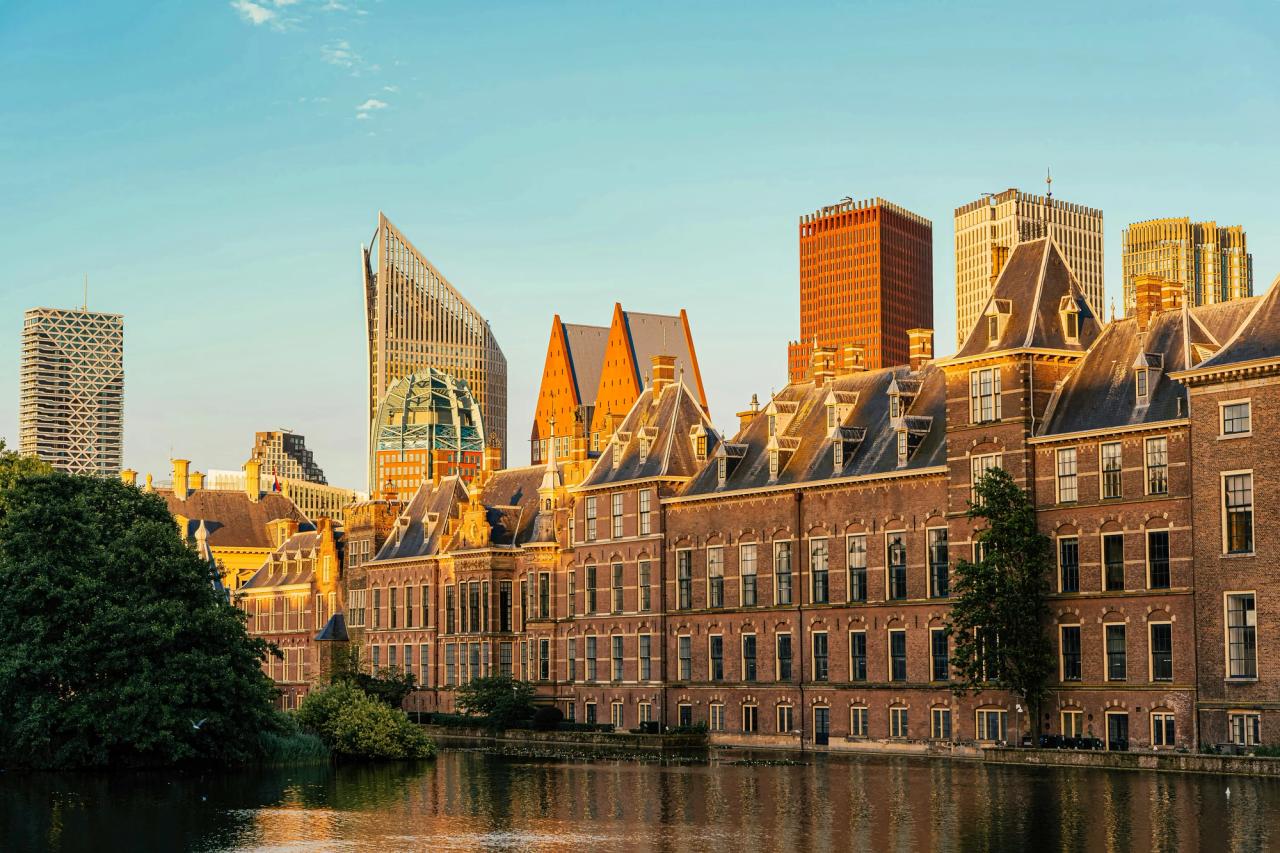
The Hague (Den Haag) is the seat of the Dutch government, the International Court of Justice, and more than 200 international organisations — yet it feels nothing like a stuffy capital. Sprawling between elegant parks and the sandy sweep of Scheveningen beach, The Hague offers a sophisticated, laid-back lifestyle that attracts diplomats, legal professionals, NGO workers, and families alike. The city blends royal heritage, seaside living, and a genuinely cosmopolitan atmosphere shaped by embassies from over 150 countries. If you value quality of life, international career opportunities, and the option to walk to the ocean after work, The Hague may be your perfect Dutch home.
The Hague at a Glance
- Population
- 560,000 (municipality), 1.1 million metro area
- Region
- South Holland, Western Netherlands
- Known For
- Government, international courts, Peace Palace, Scheveningen beach
- Average Rent (1BR)
- €1,200–€1,900 (city centre), €900–€1,350 (outer areas)
- Average Salary
- €2,900 net/month
- Expat Community
- Large diplomatic community, international organisations, EU and NATO staff
Why Move to The Hague
- International Organisations: No other European city offers this concentration of global institutions. The International Court of Justice (ICJ), International Criminal Court (ICC), International Tribunal for the Law of the Sea, Europol, and over 200 NGOs all maintain headquarters here, creating unparalleled career paths in law, diplomacy, and policy.
- Beach Lifestyle: Scheveningen beach is a 15-minute tram ride from the government quarter. Surfing, kiteboarding, beach volleyball, and seaside terraces become part of your daily routine — an amenity no other major Dutch city provides at this scale.
- Diplomatic Community: Embassies from more than 150 countries create a cosmopolitan social ecosystem. Embassy events, cultural programmes, and international networking opportunities are woven into city life throughout the year.
- Quality of Life: The Hague consistently tops Dutch quality-of-life surveys. Tree-lined avenues, lower tourist density than Amsterdam, excellent parks, and a relaxed pace make it genuinely family-friendly with spacious living compared to other Randstad cities.
- Strategic Location: Schiphol Airport is 30 minutes by direct Intercity, Amsterdam 40 minutes, and Rotterdam 25 minutes. Brussels and Paris are accessible via Eurostar (formerly Thalys) high-speed services, and Rotterdam The Hague Airport handles budget European flights.
- Royal Atmosphere: The Hague is the working residence of the Dutch royal family. The Noordeinde Palace and Huis ten Bosch are active royal residences, and the annual Prinsjesdag (Budget Day) procession brings national attention to the city.
Finding Housing in The Hague
Average Rents
| Neighborhood | 1-Bedroom | 3-Bedroom | Character |
|---|---|---|---|
| Centrum | €1,400–€2,100 | €2,200–€3,200 | Government quarter, Binnenhof, Noordeinde Palace |
| Statenkwartier | €1,100–€1,600 | €1,700–€2,400 | Museum quarter, international atmosphere, embassies |
| Scheveningen | €1,200–€1,700 | €1,800–€2,600 | Beach lifestyle, surf culture, seafood restaurants |
| Benoordenhout | €1,100–€1,600 | €1,700–€2,400 | Leafy, quiet, favoured by embassy staff |
| Segbroek | €900–€1,300 | €1,400–€1,900 | Family-friendly, near beach, green suburbs |
| Loosduinen | €800–€1,200 | €1,200–€1,700 | Traditional Dutch village atmosphere, most affordable |
How to Find Housing
- Pararius and Funda: Comprehensive rental listings across all Hague neighborhoods with English-language interfaces and daily updates.
- WoningNet Haagse Woningcorporaties: Social housing registry — register early as waiting lists are lengthy in popular areas.
- Facebook groups: "The Hague Housing" and expat groups frequently post listings before major platforms. Monitor daily for best results.
- Rental agencies: FVO Makelaars and locally-focused agents handle expat-friendly listings with English-language service and knowledge of diplomatic housing requirements.
- Employer programmes: Diplomatic and NGO staff often access housing through employer-arranged programmes — check with your organisation before beginning an independent search.
Tips for Expats
- The market is competitive but calmer than Amsterdam — expect days rather than hours for decision turnaround, giving you more breathing room.
- Start searching at least four weeks before your move; Statenkwartier and Benoordenhout require patience due to high demand from the international community.
- Beach districts (Scheveningen, Kijkduin) offer excellent value and unique lifestyle — the tram reaches the government centre in 15 minutes.
- The Hague municipality enforces strong tenant protections against unjustified rent increases and eviction, providing more security than some other Dutch cities.
- Diplomatic staff may have access to special housing programmes or allowances through their employer — investigate before committing to the private rental market.
Neighborhoods Guide
- Statenkwartier: The most international neighborhood, close to Parliament, the Peace Palace, and major museums. Favored by diplomats and NGO professionals. Mid-range rents, excellent restaurants, and the Frederik Hendriklaan shopping street ("De Fred") for daily needs. The most cosmopolitan area in the city.
- Scheveningen: The beach district — surfing, beach clubs, the pier, and boulevard dining. Combines summer tourist energy with year-round residential calm in side streets. Walking distance to the dunes, harbour, and fresh seafood restaurants. A unique lifestyle choice among Dutch cities.
- Benoordenhout: Quiet, green, and elegant. Beautiful early-20th-century architecture, proximity to the Haagse Bos forest park, and a village atmosphere despite central location. Popular with embassy families and senior professionals seeking tranquility.
- Centrum: The historic heart anchored by the Binnenhof (parliament complex), Noordeinde Palace, and the Grote Markt. Higher rents reflect proximity to all government institutions and vibrant nightlife around the Grote Marktstraat and surrounding streets.
- Segbroek: Northern suburban area with good schools, multiple parks, and more affordable housing than central The Hague. Ideal for families wanting green space while staying close to the beach and city centre with reliable tram connections.
- Loosduinen: A traditional Dutch village now absorbed into the city's western edge. Authentic local life, genuine affordability, and a slower pace — perfect for those who want a neighborhood feel over urban buzz and do not mind a longer commute.
Cost of Living in The Hague
Monthly Budget Breakdown
| Category | Budget Range |
|---|---|
| Rent (1BR, centre) | €1,200–€1,900 |
| Utilities | €120–€185 |
| Internet | €32–€50 |
| Groceries | €240–€390 |
| Transport (HTM pass) | €85–€115 |
| Dining out (4×/month) | €70–€110 |
| Leisure/Gym | €30–€55 |
| Total | €1,850–€2,850 |
Day-to-Day Costs
- Coffee: €2.50–€4.50 (specialty coffee shops in Statenkwartier charge more)
- Lunch (casual): €7–€12 (worker's lunch deals near government offices; beach restaurants slightly higher)
- Monthly transport pass: €85–€115 (HTM unlimited travel on trams and buses)
- Beer (bar): €4–€6.50 (brown cafés on the lower end, Scheveningen beach clubs on the higher end)
- Cinema ticket: €12–€16 (multiplex and Filmhuis arthouse cinema)
- Gym membership: €30–€55 (Basic Fit budget option, premium gyms near Centrum)
Getting Around The Hague
- Public transport: HTM operates trams and buses throughout the city and to Scheveningen. Monthly pass €85–€115. RandstadRail connects The Hague to Rotterdam and surrounding suburbs efficiently. Night buses run Friday and Saturday covering key nightlife areas.
- Cycling: Excellent bike infrastructure with dedicated lanes extending to the beach. Flat terrain makes cycling comfortable city-wide. Second-hand bikes from €100 via marktplaats.nl. Cycling to Scheveningen along the dedicated paths is a popular commute.
- Driving: Traffic flows better than Amsterdam — one of The Hague's genuine advantages. Parking permits cost €50–€100/month in central zones, with spaces generally available without the extreme waiting lists found in Amsterdam.
- Airport: Rotterdam The Hague Airport (25 min by bus) handles European flights. Schiphol is 30 minutes by direct Intercity — convenient enough for international travel without needing a local airport.
- Intercity: Den Haag Centraal — Amsterdam 40 min, Schiphol 30 min, Rotterdam 25 min, Brussels 2h45 (Eurostar), Paris 3h30 (Eurostar). Excellent European connectivity for a city of this size.
Healthcare in The Hague
- Hospitals/Clinics: HagaZiekenhuis provides comprehensive care including 24/7 emergency services. MC Haaglanden offers general medicine across multiple locations. The International Health Centre (IHC) specialises in expat healthcare with English-speaking staff and international insurance billing — a unique resource for the diplomatic community.
- English-speaking doctors: Very easy to find given the international population. IHC maintains English-speaking GPs familiar with diplomatic protocols and international insurance claims. Search zorgkaartnederland.nl with English filter for neighborhood GPs.
- Pharmacies: Apotheken in every district, typically open Mon–Sat. After-hours duty pharmacy: call 0900-8589 for rotating locations. Most pharmacists speak English fluently.
- Emergency number: 112 (police, fire, ambulance). Non-emergency police: 0900-8844. Non-emergency medical advice line: 0800-362 23 22.
Planning your move?
Tell us about your move to compare quotes from international moving companies.
Culture & Lifestyle
- International Institutions: Tour the Peace Palace (Vredespaleis), funded by Andrew Carnegie and home to the International Court of Justice. Visitor centres explain the history of international law. The ICC, Europol, OPCW, and dozens of other organisations maintain public-facing programmes and open days.
- Beach Culture: Scheveningen offers year-round activity — summer sunbathing and beach volleyball, winter kiteboarding and storm watching, and the monthly beach festivals that draw thousands. The harbour serves fresh herring and kibbeling from fishing boats. Kijkduin on the southern end is quieter and more family-oriented.
- Museums: The Mauritshuis houses Vermeer's Girl with a Pearl Earring and masterpieces by Rembrandt and Rubens. Escher in the Palace displays the graphic artist's optical illusions in a former royal residence. The Kunstmuseum (formerly Gemeentemuseum) showcases Mondrian's Victory Boogie Woogie and an extensive fashion collection.
- Royal Events: On Prinsjesdag (Budget Day, third Tuesday in September), the Golden Coach procession from Noordeinde Palace to the Ridderzaal draws national attention. King's Day celebrations in April transform the city with orange decorations, street markets, and open-air concerts.
- Green Spaces: Haagse Bos — a centuries-old forest in the city centre — provides running paths and wildlife. Westbroekpark is famous for its rose garden. Clingendael Park features a Japanese garden open only in spring and autumn. The dunes between Scheveningen and Kijkduin form a protected nature reserve.
Banking and Taxes
- Banking: Dutch banking is straightforward. ING, ABN AMRO, and Rabobank are the three traditional banks with branches throughout The Hague. Bunq offers app-based banking popular with tech-savvy expats. iDEAL — the national online payment system — is used for virtually all e-commerce; you need a Dutch bank account to use it.
- Income Tax: The Netherlands has a progressive income tax system. In 2026, income up to approximately €38,000 is taxed at 36.97%, income above that at 49.50%. The 30% ruling reduces effective rates for qualifying expats recruited from abroad. Diplomatic staff may have special tax arrangements through their embassy — check before filing.
- VAT and Consumer Costs: VAT (BTW) is included in all displayed prices — what you see is what you pay. The standard rate is 21%; reduced rate of 9% applies to food, books, and some services.
Dutch Language Basics for Daily Life
- Hallo / Hoi — Hello / Hi
- Dank je wel — Thank you
- Alstublieft — Please / Here you are
- Spreekt u Engels? — Do you speak English?
- Ik zou graag... — I would like...
- Tot ziens — Goodbye
- Mag ik de rekening? — Can I have the bill?
- Pinnen? — Can I pay by card?
The Hague's international population means you can function entirely in English, but learning Dutch shows respect for the host country and opens doors in government and local institutions.
Internet and Mobile
- Home internet: Major providers are Ziggo (cable), KPN (fibre/DSL), and T-Mobile (fibre). Expect €32–€50/month for 100–500 Mbps. Fibre coverage is extensive in central neighborhoods. Contracts typically run 12 months.
- Mobile: KPN, Vodafone, and T-Mobile are the main carriers. Prepaid SIM cards available at supermarkets from €10. Monthly plans with data start at €15–€25. EU roaming is included.
- Public Wi-Fi: Widely available in cafés, restaurants, and public buildings. The International Health Centre and embassy-adjacent areas offer reliable connections for working remotely.
Childcare and Parenting
- Daycare (kinderdagverblijf): Subsidised through the Dutch government (kinderopvangtoeslag). Monthly costs run €1,700–€2,300 for full-time care before subsidy. Apply through the Belastingdienst after registering at Gemeente Den Haag.
- After-school care (BSO): Available for children aged 4–12, typically €500–€850/month before subsidy. International schools often have partnered BSO providers.
- Family life: The Hague is exceptionally family-friendly. Scheveningen beach, Madurodam miniature park, the Omniversum dome cinema, and numerous parks make it a playground city. The dunes and beach provide year-round outdoor activities for families.
Waste and Recycling
- Household waste: The Hague uses an underground container system. You open containers with your municipality pass (milieupas). Restafval (general waste), GFT (organic), and PMD (plastic/metal/drinks cartons) are separated. Paper and glass go to dedicated street containers.
- Bulky waste: Schedule free pickup through the municipality website for large items.
- Second-hand: Marktplaats.nl is the Dutch equivalent of Craigslist — buy and sell used goods locally. The Hague has excellent kringloopwinkels (thrift shops) for furniture and household items.
Coworking Spaces
- The Hague Tech: Innovation hub and coworking space near the station, popular with tech startups and international professionals.
- Spaces Den Haag: Flexible offices and hot desks in the city centre with a strong international community.
- Impact Hub The Hague: Focused on social enterprises and NGOs, connecting the international organisation community with local entrepreneurs.
Food & Dining
- Local specialties: Fresh herring and seafood at Scheveningen harbour, bitterballen in traditional brown cafés, Dutch pannenkoeken (pancakes) at dedicated pancake houses in the dunes, and Indonesian rijsttafel reflecting the colonial history.
- Best areas for dining: Frederikstraat for upscale bistros and brunch spots, Scheveningen harbour for seafood with ocean views, Grote Markt for lively terrace dining with locals, and Chinatown near the city centre for authentic Asian cuisine.
- Budget options: Daily lunch specials (dagschotel) from €8 at local restaurants, weekly markets at De Helena and Herman Costerstraat for affordable produce and street food, and supermarket chains for ready meals under €6.
Expat Community
- Meetup groups: InterNations The Hague (monthly networking events for thousands), The Hague Expat Group (social gatherings, city tours), and The Hague International meetups covering everything from hiking to professional development and parenting.
- International organisations: ICJ, ICC, Europol, NATO Communications, OPCW, and 200+ NGOs create dense expat networks. Many host internal social events and integration programmes for new staff and their families, making the transition smoother.
- Language exchanges: Weekly Dutch conversation groups at community centres and cafés. ROC offers affordable evening courses. Embassies frequently run cultural programmes including language classes for diplomatic staff families. Tandem apps connect internationals with Dutch speakers.
Job Market in The Hague
- Main industries: International law and diplomacy, Dutch government and policy-making, NGOs and humanitarian organisations, defence and security (NATO, Europol, OPCW), IT consulting, and renewable energy policy.
- Major employers: International Court of Justice, International Criminal Court, Dutch government ministries, Europol, TNO (applied research organisation), Shell (policy division), and a growing tech cluster around the Bezuidenhout area.
| Sector | Monthly Net (estimated) | Annual Gross Reference |
|---|---|---|
| Law/International Law | €3,500–€6,000 | €55,000–€90,000 |
| Government/Policy | €3,000–€4,500 | €45,000–€70,000 |
| NGOs/Humanitarian | €2,500–€4,000 | €38,000–€62,000 |
| IT/Consulting | €3,200–€5,000 | €48,000–€78,000 |
| Education | €2,400–€3,500 | €36,000–€52,000 |
- Job search resources: LinkedIn, Indeed.nl, The Hague International Platform (local job board), UN Careers portal (careers.un.org), ReliefWeb for humanitarian roles, and specialised recruitment agencies including Michael Page and the Clingendael Institute network.
Education in The Hague
- International schools: International School of The Hague (ISH, IB programme), American School of The Hague (ASH, American curriculum and SAT/AP), British School in The Hague (British curriculum and IGCSE/A-Levels). Fees: €5,000–€22,000/year. Waiting lists are common — apply as early as possible.
- Universities: Leiden University Campus The Hague (international law, public administration, governance), The Hague University of Applied Sciences (business, engineering, IT, hospitality), and Campus Den Haag of TU Delft for technical programmes.
- Language schools: ROC for affordable Dutch courses across levels, private schools like Taalhuis and Loqman for intensive programmes, embassy-organised language exchanges, and university language centres for academic Dutch.
Moving Checklist for The Hague
- Secure position with an international organisation, embassy, or Dutch employer
- Check visa/permit requirements — diplomatic staff have different procedures than standard highly skilled migrants
- Arrange temporary accommodation for the first 4–6 weeks (Airbnb, HousingAnywhere, or employer-arranged housing)
- Research health insurance options; diplomatic staff may have separate coverage requirements through their embassy
- If bringing children, apply to international schools immediately — ISH and ASH both have waiting lists
- Register at Gemeente Den Haag for your BSN (required within 5 days of arrival for stays over 4 months)
- Open a Dutch bank account (ING, ABN AMRO, or Bunq)
- Activate health insurance (basisverzekering, €135–€155/month) or confirm diplomatic coverage
- Purchase an HTM OV chipkaart for trams and buses
- Secure permanent housing — Statenkwartier and Benoordenhout are most popular with the expat community
- Register with a huisarts (GP) near your home; the IHC is an excellent expat-friendly option
- Apply for residence permit if non-EU and not on diplomatic status
- Explore Dutch language classes through ROC or community centres — even basics transform daily life
Moderately. Housing runs €900–€1,900/month depending on neighborhood, and a comfortable lifestyle costs €1,850–€2,850/month — less than Amsterdam but more than Rotterdam or Utrecht. Diplomatic salaries often include housing allowances, and the 30% tax ruling benefits qualifying professionals. Overall, The Hague offers strong value given the quality of life.
Positions come through formal UN or tribunal recruitment processes. Jobs are posted on careers.un.org and individual organisation websites. Competition is intense — advanced degrees, legal expertise, and years of professional experience are typically required. Fluency in English and French is a major advantage. Networking through The Hague's diplomatic community also opens doors.
Scheveningen combines beach lifestyle with urban convenience. Trams reach the government centre in 15 minutes. The area is less expensive than central The Hague. Families enjoy the beach, dunes, and harbour; surfers thrive year-round. Summer brings tourist energy to the boulevard — choose side streets for residential calm. Winter brings dramatic North Sea storms and a tight-knit local community.
Absolutely. The HTM tram network is excellent, cycling infrastructure is top-notch, and Scheveningen beach is reachable by bike in 15 minutes. Trains connect to Amsterdam, Schiphol, and Rotterdam easily. Most expats manage entirely without car ownership, saving significantly on transport costs.
Bring a valid passport, proof of Dutch address (rental agreement), and if applicable, residence permit or entry visa. EU citizens need only a passport or EU ID card. Registration provides your BSN (Burgerservicenummer), which is required for banking, employment, insurance, and virtually all interactions with Dutch institutions.
Apply to the International School of The Hague (ISH) or American School of The Hague (ASH) as early as possible — ideally before arrival. Waiting lists are common, especially for popular year groups and mid-year entry. Fees range €5,000–€22,000/year. Many employers offer school fee assistance as part of relocation packages. The British School in The Hague is another option with shorter waiting lists for some year groups.
Diplomatic housing in The Hague operates through a mix of private rental and employer-arranged programmes. Many embassies and international organisations maintain lists of approved landlords and properties. The Statenkwartier and Benoordenhout neighborhoods have the highest concentration of diplomatic housing, with landlords experienced in lease structures that accommodate diplomatic immunity and international insurance. Expect higher standards and slightly higher rents in these areas.
Yes, the Netherlands is pet-friendly. Cats and dogs from EU countries need a microchip, rabies vaccination, and EU pet passport. Non-EU pets require a rabies antibody test. Dogs must be registered and insured. The Hague has numerous parks, the Scheveningen beach (dogs allowed off-season), and veterinary clinics with English-speaking staff. Dog tax (hondenbelasting) applies — approximately €120/year.
Related Guides
- [Moving to the Netherlands] — comprehensive country guide covering visas, taxation, and national culture
- [Moving to Amsterdam] — the Dutch capital's vibrant cultural scene and international business hub
- [Moving to Rotterdam] — Netherlands' port city with modern architecture and lower living costs
- [Moving to Utrecht] — centrally located student city with medieval charm