Rotterdam is the Netherlands' second-largest city and Europe's busiest port, a dynamic metropolis defined by bold modern architecture, a multicultural population, and a gritty creative energy that sets it apart from every other Dutch city. Destroyed in World War II and rebuilt with visionary ambition, Rotterdam attracts expats who value innovation, affordability, and a genuine urban edge. From the glass towers of Kop van Zuid to the terrace-lined Witte de Withstraat, the city offers career opportunities in logistics, energy, engineering, and tech at significantly lower living costs than Amsterdam. If you want a forward-looking city with real character, Rotterdam belongs on your shortlist.
Rotterdam at a Glance
- Population
- 673,000 (municipality), ~2.6 million (Rotterdam–The Hague metro)
- Region
- South Holland, Western Netherlands
- Known For
- Modern architecture, Europe's largest port, arts scene, diverse communities
- Average Rent (1BR)
- €1,100–€1,800 (city centre), €850–€1,250 (outer areas)
- Average Salary
- €2,800 net/month
- Expat Community
- Large and international — port professionals, university students, creatives
Why Move to Rotterdam
- Career Powerhouse: The Port of Rotterdam handles over 450 million tonnes of cargo annually and anchors Europe's logistics and energy sectors. Major employers include Shell, Unilever, Maersk, and the Port of Rotterdam Authority, while Erasmus University fuels a thriving research and healthcare economy that creates job opportunities across disciplines.
- Affordability: Housing costs run 20–35% below Amsterdam, dining and entertainment are 15–25% cheaper, and salaries remain competitive — especially in engineering, finance, and tech. Your money goes measurably further here, creating genuine work-life balance improvements.
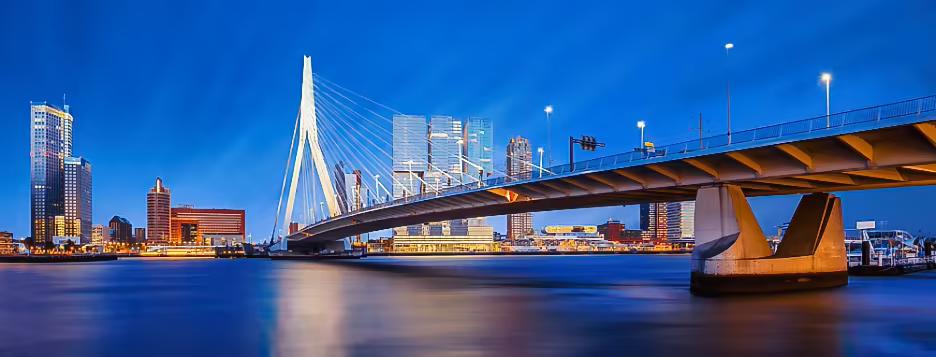
- Architectural Capital: Landmark buildings by Rem Koolhaas (OMA), MVRDV (Markthal), and Piet Blom (Kubuswoningen) make Rotterdam an open-air architecture museum. The Erasmus Bridge, nicknamed "The Swan," is an icon of post-war Dutch design ambition and one of Europe's most photographed bridges.
- Truly Multicultural: Over 180 nationalities call Rotterdam home, creating one of Europe's most diverse food scenes and cultural calendars. Witte de Withstraat alone offers cuisine spanning Surinamese to Japanese to Ethiopian, and international festivals celebrate traditions from around the globe.
- Connectivity: Amsterdam is 40 minutes by Intercity, Schiphol 30 minutes by direct train, Brussels 2h30, and Paris 2h45 via Eurostar (formerly Thalys). Rotterdam The Hague Airport adds budget European flights without the Schiphol queues, making it practical for weekend travel.
- Transportation: Excellent train connections position Rotterdam as a gateway to Europe. The efficient RandstadRail tram system connects seamlessly with The Hague and surrounding suburbs, extending the city's reach well beyond its municipal borders.
Finding Housing in Rotterdam
Average Rents
| Neighborhood | 1-Bedroom | 3-Bedroom | Character |
|---|---|---|---|
| Centrum | €1,300–€2,000 | €2,000–€3,000 | Business district, modern towers, Markthal nearby |
| Kop van Zuid | €1,200–€1,700 | €1,800–€2,600 | Regenerated docklands, Hotel New York, cultural venues |
| Kralingen | €1,000–€1,500 | €1,600–€2,200 | Student-friendly, leafy, near Erasmus University |
| Oude Noorden | €950–€1,400 | €1,400–€2,000 | Creative, vintage shops, multicultural dining |
| Blijdorp | €900–€1,300 | €1,300–€1,900 | Quiet, family-friendly, near zoo and hospitals |
| Delfshaven | €850–€1,200 | €1,200–€1,700 | Historic 17th-century quarter, affordable, diverse |
How to Find Housing
- Pararius and Funda: The two primary rental platforms with English-language interfaces and comprehensive Rotterdam coverage across all neighborhoods.
- Room Rotterdam: Specialises in rooms and shared apartments — useful for newcomers and students seeking budget options.
- WoningNet: Social housing registry with 12–24 month waiting lists in popular areas; register early if eligible.
- Facebook groups: "Expats in Rotterdam" and "Rotterdam Housing" list available units before mainstream platforms. Check multiple times daily for new posts.
- Direct from landlords: Check jaap.nl and local Facebook groups where landlords post directly without agency fees.
Tips for Expats
- Start searching 4–6 weeks before your move — the market moves fast but apartments remain available longer than in Amsterdam.
- Income requirement is typically 3× monthly rent; some landlords accept housing allowance documentation as income proof.
- Rental agents charge one month's rent plus 21% VAT but can significantly speed up the process for newcomers unfamiliar with Dutch rental customs.
- Districts outside the centre (Delfshaven, Blijdorp, Oude Noorden) save 20–35% with excellent metro and tram links that offset the distance.
- Temporary housing via HousingAnywhere or a short Airbnb stay gives you time to search without pressure or desperation.
Neighborhoods Guide
- Kop van Zuid: The showpiece of Rotterdam's regeneration — converted dockland warehouses now house modern apartments, the iconic Hotel New York, and the Fenix Food Hall. Popular with young professionals attracted to waterfront living. Mid-range rents with harbour views and cultural venues.
- Kralingen: Home to Erasmus University and its international student body. Leafy streets, affordable student housing, and the Kralingse Bos forest park make it the most academically oriented district. Great cafés, informal dining, and a youthful atmosphere.
- Oude Noorden: Rotterdam's creative frontier — vintage stores, microbreweries, international restaurants, and a strong community atmosphere. Often compared to Brooklyn for its edgy, up-and-coming vibe. Rents are rising but still below Centrum pricing.
- Delfshaven: A 17th-century historic quarter with multicultural character, traditional brown cafés, and some of the city's most affordable rents. Direct tram access to the centre makes it ideal for budget-conscious newcomers and families seeking authenticity.
- Blijdorp: Quiet and green, anchored by the famous Diergaarde Blijdorp zoo and close to Dijkzigt Hospital and University Medical Center. Families appreciate the schools, parks, and 15-minute tram commute to the centre.
- Feijenoord: Industrial heritage turned residential frontier. The most affordable entry point to Rotterdam living, with new apartment complexes and improving RandstadRail tram links driving rapid development and gentrification.
Cost of Living in Rotterdam
Monthly Budget Breakdown
| Category | Budget Range |
|---|---|
| Rent (1BR, centre) | €1,100–€1,800 |
| Utilities | €115–€180 |
| Internet | €30–€48 |
| Groceries | €230–€380 |
| Transport (RET pass) | €85–€110 |
| Dining out (4×/month) | €60–€100 |
| Leisure/Gym | €25–€50 |
| Total | €1,700–€2,700 |
Day-to-Day Costs
- Coffee: €2.50–€4 (specialty coffee culture in Oude Noorden matches Amsterdam pricing)
- Lunch (casual): €7–€10 (worker's lunch at Markt restaurants and lunchrooms)
- Monthly transport pass: €85–€110 (RET unlimited travel on trams, metros, buses)
- Beer (bar): €4–€6 (traditional brown cafés in Oude Noorden and Delfshaven are most affordable)
- Cinema ticket: €12–€15 (multiplex cinemas offer standard pricing; arthouse Cinerama slightly pricier)
- Gym membership: €25–€50 (Basic Fit at the low end, boutique studios at the premium end)
Getting Around Rotterdam
- Public transport: RET operates trams, metros, and buses throughout the city and surrounding suburbs. An OV chipkaart is essential — purchase a monthly pass for €85–€110. The RandstadRail tram extends to The Hague and connects suburbs efficiently. Night buses operate Friday and Saturday with routes covering key areas after midnight.
- Cycling: Rotterdam is bike-friendly with dedicated lanes, though the city is flatter and notably windier than Amsterdam's protected canal routes. Second-hand bikes start from €100–€150 via marktplaats.nl or local bike shops. University staff often provide pool bikes for campus commuting.
- Driving: Traffic is significantly less congested than Amsterdam, but parking permits are required and can be expensive in central areas. Monthly parking in central garage runs €150–€250; permit zones cost €50–€100/month in most areas. Many residents successfully manage without car ownership.
- Airport: Rotterdam The Hague Airport offers European budget flights on select routes. Schiphol is only 30 minutes by train via direct Intercity, providing ultimate flexibility for international travel.
- Intercity: Rotterdam Centraal is a major European terminus — Amsterdam 40 min, Brussels 2h30, Paris 2h45 (Eurostar, formerly Thalys). The station itself, designed by Benthem Crouwel Architects, is worth seeing as an architectural landmark.
Healthcare in Rotterdam
- Hospitals/Clinics: Erasmus MC is one of Europe's leading teaching hospitals with cutting-edge research and specialised departments. Maasstad Ziekenhuis and Franciscus Gasthuis provide excellent general care with 24/7 emergency departments. Erasmus MC includes the Sophia Children's Hospital — one of the best paediatric facilities in Europe.
- English-speaking doctors: Easily found through zorgkaartnederland.nl filtering for English. The Expat Medical Centre in the city centre specialises in expat healthcare with English-speaking GPs familiar with the international community and international insurance billing.
- Pharmacies: Apotheek services throughout every neighborhood, typically open Monday through Saturday. Emergency pharmacy service rotates daily coverage — dial 010-466 9378 for evening and weekend pharmacy locations.
- Emergency number: 112 for emergencies. Non-emergency medical advice: 010-444 1888 operated by regional health services.
Planning your move?
Tell us about your move to compare quotes from international moving companies.
Culture & Lifestyle
- Architecture: Iconic landmarks include the Markthal (stunning food hall with massive interior mural by Arno Coenen), De Rotterdam towers by Rem Koolhaas (massive multi-building complex), Kubuswoningen (postmodern cubical houses), and the railway station by Benthem Crouwel. Architecture walking tours explain the city's post-war reconstruction story.
- Festivals: Rotterdam hosts major events including North Sea Jazz Festival in July (one of Europe's largest), Rotterdam Unlimited summer carnival, the International Film Festival, and the Marathon. The city's creative class organises countless smaller events throughout the year.
- Nightlife: Witte de Withstraat is the city's social artery — cocktail bars, galleries, and late-night cafés line the street. Oude Haven offers waterfront terraces with harbour views, while Oude Noorden delivers hipster bars, microbreweries, and live music in converted industrial spaces.
- Waterfront: The Erasmus Bridge promenade and Maasoever development provide running paths, scenic promenades, and recreational spaces along the Nieuwe Maas waterway. Summer ferry services connect waterfront neighborhoods for leisure rides. The Rijnhaven and Maashaven areas are undergoing rapid transformation with new residential and cultural developments.
Banking and Taxes
- Banking: Dutch banking is straightforward. ING, ABN AMRO, and Rabobank are the three traditional banks with extensive branch and ATM networks across Rotterdam. Bunq offers app-based banking popular with tech-savvy expats. iDEAL — the national online payment system — is used for virtually all e-commerce; you need a Dutch bank account to use it.
- Income Tax: The Netherlands has a progressive income tax system. In 2026, income up to approximately €38,000 is taxed at 36.97%, income above that at 49.50%. The 30% ruling reduces effective rates for qualifying expats recruited from abroad. File your annual tax return via the Belastingdienst (Dutch tax authority) website.
- VAT and Consumer Costs: VAT (BTW) is included in all displayed prices — what you see is what you pay. The standard rate is 21%; reduced rate of 9% applies to food, books, and some services.
Dutch Language Basics for Daily Life
- Hallo / Hoi — Hello / Hi
- Dank je wel — Thank you
- Alstublieft — Please / Here you are
- Spreekt u Engels? — Do you speak English?
- Ik zou graag... — I would like...
- Tot ziens — Goodbye
- Pinnen? — Can I pay by card?
Rotterdam's directness is legendary even by Dutch standards — people say what they mean without sugarcoating. This is practical efficiency, not rudeness. Embrace it and you will find communication refreshingly honest.
Internet and Mobile
- Home internet: Major providers are Ziggo (cable), KPN (fibre/DSL), and T-Mobile (fibre). Expect €30–€48/month for 100–500 Mbps. Fibre coverage is growing rapidly in central Rotterdam. Contracts typically run 12 months.
- Mobile: KPN, Vodafone, and T-Mobile are the main carriers. Prepaid SIM cards available at supermarkets from €10. Monthly plans with data start at €15–€25. EU roaming is included in all plans.
- Public Wi-Fi: Widely available in cafés, restaurants, libraries, and public buildings. Rotterdam also provides free Wi-Fi in some public spaces and on RET trams.
Childcare and Parenting
- Daycare (kinderdagverblijf): Childcare is subsidised through the Dutch government (kinderopvangtoeslag). Monthly costs run €1,600–€2,200 for full-time care before subsidy — slightly lower than Amsterdam. Apply for subsidy through the Belastingdienst after registering at Gemeente Rotterdam.
- After-school care (BSO): Available for children aged 4–12, typically €500–€800/month before subsidy. Schools often partner with BSO providers.
- Playgrounds and family life: Blijdorp Zoo, the Kralingse Bos lake park, and Vroesenpark offer excellent family recreation. Rotterdam's cycling culture means children bike to school from age 4–5. The city has invested heavily in modern playgrounds and family facilities.
Waste and Recycling
- Household waste: Rotterdam uses an underground container system. You open containers with your municipality pass (milieupas). Restafval (general waste), GFT (organic), and PMD (plastic/metal/drinks cartons) are separated. Paper and glass go to dedicated containers on the street.
- Bulky waste: Schedule free pickup through the municipality website for large items like furniture and appliances.
- Second-hand: Marktplaats.nl is the Dutch equivalent of Craigslist — buy and sell used goods locally. Kringloopwinkels (thrift shops) are popular for furniture and household items.
Coworking Spaces
- 42workspace: Popular coworking space in the city centre with flexible desks, meeting rooms, and community events.
- Spaces: Multiple locations including Kop van Zuid, offering hot desks and private offices with international networking.
- Cambridge Innovation Centre (CIC): Located in the Groothandelsgebouw near the station, focused on startups and scale-ups.
Food & Dining
- Local specialties: Kibbeling (battered fish chunks from harbour stalls), bitterballen in traditional brown cafés, herring at street stands, and Surinamese roti in Delfshaven and Rotterdam-Zuid. The maritime heritage strongly influences the local food scene.
- Best areas for dining: Witte de Withstraat for trendy bistros and early evening drinks, Kop van Zuid for upscale restaurants in converted warehouses, Markthal for one-stop international variety under one stunning roof, and Oude Haven for waterfront terrace dining.
- Budget options: Weekly markets at Binnenrotte and Afrikaanderwijk offer fresh produce and international ingredients under supermarket prices. Lunch specials start at €8; supermarkets like Albert Heijn and Dirk van den Broek sell ready meals under €6.
Expat Community
- Meetup groups: InterNations Rotterdam (monthly networking events for thousands of members), Rotterdam Expat Meetup (social events and city exploration), and the large Facebook group "Expats in Rotterdam" for housing advice and social connections.
- International employers: Shell, Unilever, Heineken, Maersk, and Erasmus University maintain active expat networks with integration programmes, buddy systems, and regular social events that help newcomers settle quickly.
- Language exchanges: Weekly Dutch conversation groups via Meetup.com and Facebook. Evening courses at ROC and private schools like Koentact. Tandem language partner apps connect internationals with native Dutch speakers wanting English practice.
Job Market in Rotterdam
- Main industries: Logistics and shipping (Port of Rotterdam Authority, Maersk), petrochemicals (Shell, refineries in Botlek area), finance (ING, ABN AMRO), healthcare (Erasmus MC), and creative sectors spanning design to fashion.
- Major employers: Port of Rotterdam Authority, Shell, Unilever, Heineken, Maersk, Erasmus MC, DAF Trucks, Zalando (major fulfilment centre nearby), and a growing tech startup scene in the city centre.
| Sector | Monthly Net (estimated) | Annual Gross Reference |
|---|---|---|
| Port/Logistics | €2,800–€4,200 | €42,000–€65,000 |
| Finance/Banking | €3,000–€4,500 | €45,000–€70,000 |
| Healthcare | €2,600–€3,800 | €38,000–€58,000 |
| Tech/Engineering | €3,200–€5,000 | €48,000–€78,000 |
| Hospitality | €1,900–€2,600 | €28,000–€40,000 |
- Job search resources: LinkedIn effectively covers Dutch positions with English-language filters. Indeed.nl aggregates broad listings. Undutchables.nl specifically serves English-speaking job seekers. Specialised recruitment agencies like Michael Page and Robert Walters place international candidates across sectors.
Education in Rotterdam
- International schools: Rotterdam International Secondary School (RISS) offers IB programmes. European School Rotterdam provides multilingual EU education. The British School in Rotterdam serves primary and secondary. Fees range €3,000–€15,000/year depending on level.
- Universities: Erasmus University Rotterdam (economics, law, medicine, business — consistently ranked among Europe's top 50), Rotterdam University of Applied Sciences, and Willem de Kooning Academy for creative arts. Many programmes are English-taught at undergraduate and postgraduate levels.
- Language schools: Dutch language courses through ROC (regional training centre) with daytime and evening options. Private schools like Koentact and Loqman specialise in intensive Dutch instruction for professionals.
Moving Checklist for Rotterdam
- Secure employment or university admission (Rotterdam's job market centres on port operations, engineering, and the university)
- Arrange temporary accommodation (Airbnb, HousingAnywhere, or Booking.com) for the first 4–6 weeks
- Prepare rental dossier: income proof (3× rent), employment contract, passport, bank statements
- Compare health insurance providers on Independer.nl or Zorgwijzer.nl
- Research neighborhoods to determine best fit given budget, commute, and lifestyle preferences
- Register at Gemeente Rotterdam for your BSN (required within 5 days of arrival for stays over 4 months)
- Open a Dutch bank account (ING, ABN AMRO, Rabobank, or Bunq)
- Activate health insurance (basisverzekering, €133–€153/month average)
- Purchase an OV chipkaart and familiarise yourself with the RET network for daily commuting
- Secure permanent housing — Kralingen near university, Oude Noorden for creative vibes, Blijdorp for family friendliness
- Register with a huisarts (GP) near your home via zorgkaartnederland.nl or expat groups
- Apply for residence permit if non-EU (employer usually sponsors the MVV/visa process)
- Enroll in Dutch language classes through ROC or a private school — evening courses suit working professionals
Rotterdam is 20–35% cheaper for housing and noticeably less touristy, giving it a more residential, lived-in feel. Career opportunities are strong in logistics, energy, and engineering. The international community is equally diverse with over 180 nationalities. Amsterdam edges ahead for tech startups and tourism-oriented culture; Rotterdam wins on affordability, space, modern architecture, and a grittier creative energy.
Rotterdam is generally safe for a major European city. Centrum, Kop van Zuid, Kralingen, and Blijdorp are considered very family-friendly. As in any large city, exercise normal awareness around Central Station late at night and lock your bicycle securely. Violent crime against expats is rare, and the city legitimately ranks among Europe's safest metropolitan areas.
Salaries run 10–20% below Amsterdam for equivalent roles, but lower living costs more than compensate. Average net salary is around €2,800/month. Tech and finance positions command €3,200–€5,000 net. The 30% tax ruling can boost effective take-home pay substantially for qualifying expats with in-demand skills.
Use Pararius.nl and Funda.nl for private rentals. Apply to WoningNet for social housing if you qualify and can wait. Start 4–6 weeks before your move-in date, prepare all documentation, and consider a rental agent if unfamiliar with Dutch rental customs. Oude Noorden, Kralingen, and Kop van Zuid are the most expat-popular districts with the best transport links.
Yes. Rotterdam is highly international thanks to the port, Erasmus University, and multinational employers. English is standard in business, healthcare, and daily commerce. However, learning Dutch accelerates social integration, helps navigate local government processes, and is increasingly valued even in international firms interacting with domestic clients.
The 30% ruling allows qualifying expats to receive 30% of their gross salary tax-free for up to five years (reduced from eight in recent reforms). You must have been recruited from outside the Netherlands specifically for Dutch employment, possess in-demand skills, earn above the income threshold (approximately €45,637/year in 2026), and have lacked Dutch residency in the preceding 24 months. Your employer must apply on your behalf through the Dutch tax authorities.
Dutch landlords typically require a deposit of one to two months' rent, paid before the lease starts. The deposit must be returned within 14 days of the lease ending, minus documented damages. Always photograph the property during move-in and request a written inspection report. If a landlord asks for an unusually high deposit or cash-only payment, treat it as a red flag.
Yes. Blijdorp, Kralingen, and Hillegersberg (north of the centre) are particularly popular with families thanks to good schools, green spaces, and safe streets. International schools (RISS, British School) provide quality education. Healthcare is excellent at Erasmus MC and Sophia Children's Hospital. The city is compact enough for cycling with children and has numerous parks and playgrounds.
Related Guides
- [Moving to the Netherlands] — comprehensive country guide covering visas, taxation, and national culture
- [Moving to Amsterdam] — the Dutch capital's vibrant cultural scene and international business hub
- [Moving to The Hague] — political capital with international organisations and Scheveningen beach
- [Moving to Utrecht] — centrally located city with excellent transport links and student culture
- [Moving to Eindhoven] — Brainport tech hub with high-tech manufacturing careers