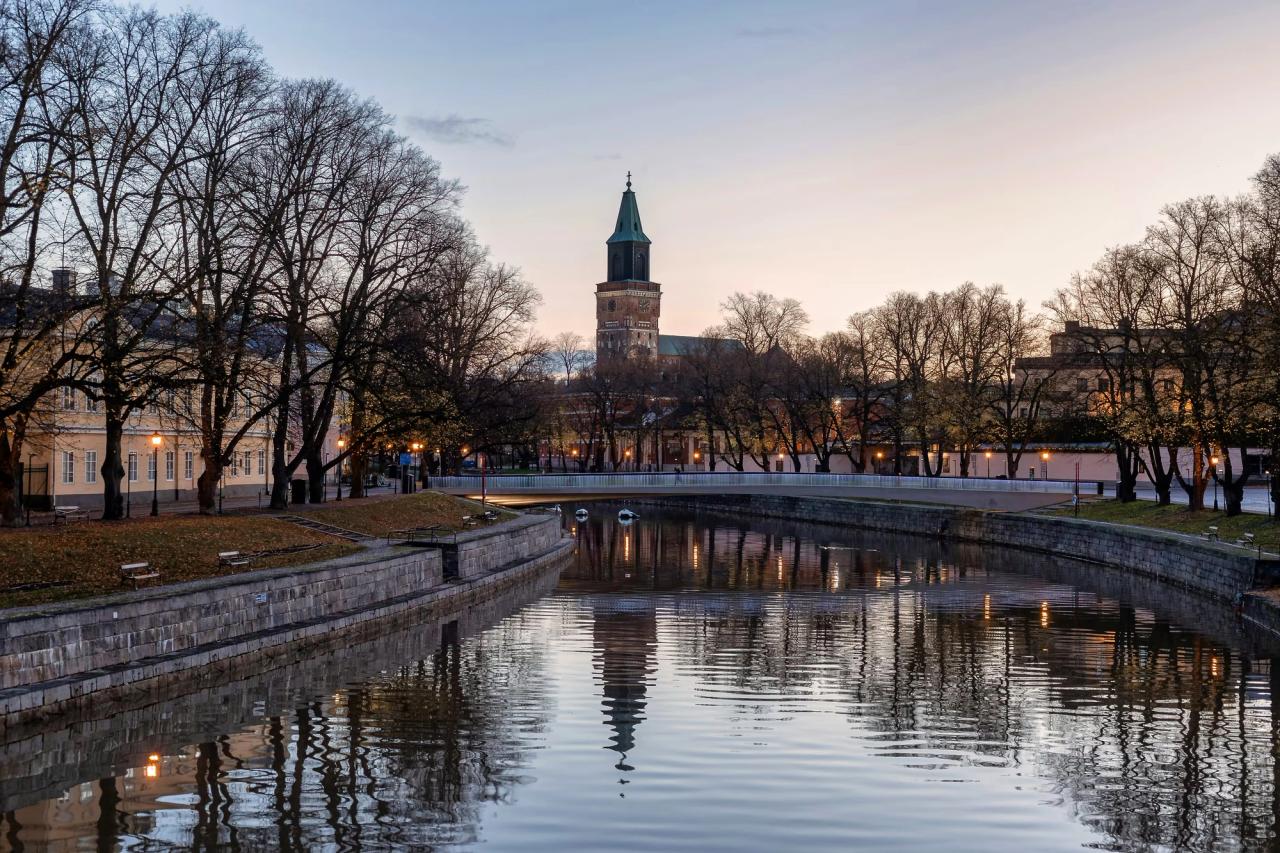
Turku, fundada por volta de 1229, é a cidade mais antiga da Finlândia e a sua antiga capital até 1812. Situada na costa sudoeste, na foz do Rio Aura, mistura história medieval com uma energia juvenil impulsionada por cerca de 40 000 estudantes universitários. A cidade fica à porta do Mar do Arquipélago — uma constelação de mais de 20 000 ilhas — e oferece ligações diretas de ferry para Estocolmo. Turku adapta-se a expatriados que procuram uma cidade finlandesa pedestrianizável e culturalmente rica, mais acessível e descontraída do que Helsíquia, mas ainda assim internacionalmente ligada através dos seus setores de biotecnologia, marítimo e universitário.
Turku em Resumo

- População
- ~210 000 (cidade); ~320 000 (região metropolitana incluindo Kaarina, Raisio, Naantali, Lieto)
- Região
- Finlândia Sudoeste (Varsinais-Suomi)
- Conhecida Por
- A cidade mais antiga da Finlândia, margem do Rio Aura, porta de entrada do Mar do Arquipélago, Capital Gastronómica da Finlândia
- Renda Média (1 Quarto)
- €650–€900
- Salário Médio
- ~€2 800–€3 200 líquidos mensais
- Comunidade de Expatriados
- Em crescimento, ancorada por investigadores universitários, engenheiros do estaleiro naval Meyer Turku e profissionais de biotecnologia; cena ativa de Erasmus e estudantes internacionais
Porque Mudar-se para Turku
- Cidade histórica acessível: As rendas são 15–25% mais baixas do que em Helsíquia, oferecendo um centro citadino denso e pedestrianizável ao longo do Rio Aura, com séculos de património construído.
- Arquipélago à sua porta: O Percurso do Arquipélago de Turku começa no limite da cidade, dando aos residentes fácil acesso a saltos entre ilhas, rotas de ciclismo e casas de veraneio por mais de 20 000 ilhas.
- Importante polo estudantil e de investigação: A Universidade de Turku (Turun yliopisto), a Universidade Åbo Akademi (a única universidade inteiramente em sueco da Finlândia) e a Universidade de Ciências Aplicadas de Turku (TUAS) trazem investigadores internacionais, mestrados em inglês e uma vida de campus vibrante.
- Indústrias marítima e de biotecnologia: O estaleiro naval Meyer Turku constrói alguns dos maiores navios de cruzeiro do mundo, e o Turku Science Park alberga dezenas de empresas de biotecnologia e diagnósticos, criando procura constante por trabalhadores internacionais qualificados.
- Ambiente bilingue: Turku tem uma das maiores comunidades falantes de sueco da Finlândia, e o nome sueco Åbo ainda é usado de forma intercambiável. Este carácter bilingue confere à cidade uma identidade distinta dentro da Finlândia e torna-a acessível também para expatriados falantes de sueco.
- Ferrys para Estocolmo e acesso ao arquipélago: Os ferrys da Tallink Silja e da Viking Line partem diariamente do Porto de Turku para Estocolmo, tornando as escapadelas de fim de semana à Suécia extremamente fáceis. O Mar do Arquipélago circundante oferece uma das paisagens costeiras mais espetaculares da Europa mesmo fora dos limites da cidade.
Clima e Tempo
Turku tem um clima continental húmido, atenuado pela sua posição costeira. Os invernos são frios e escuros — as temperaturas médias em janeiro variam entre -4 °C e -7 °C, com apenas 6 horas de luz solar por volta do solstício de inverno. A cobertura de neve dura tipicamente de dezembro a março, embora os invernos recentes tenham sido mais imprevisíveis. O Rio Aura congela frequentemente o suficiente para patinagem no gelo. Os verões são amenos e luminosos, com máximas em julho por volta de 20–23 °C e até 19 horas de luz solar no solstício de verão. A costa sudoeste tem mais horas de sol do que a Finlândia interior. Um bom guarda-roupa de inverno (camadas térmicas, botas de inverno adequadas e uma jaqueta corta-vento) é essencial — os finlandeses vestem-se em camadas e passam tempo ao ar livre independentemente da estação.
Encontrar Habitação em Turku
Rendas Médias
| Bairro | 1 Quarto | 3 Quartos | Carácter |
|---|---|---|---|
| Keskusta (Centro da Cidade) | €700–€950 | €1 100–€1 600 | Edifícios históricos em pedra ao longo do Rio Aura, a curta distância a pé de tudo |
| Portsa | €600–€800 | €1 000–€1 400 | Encantador bairro de casas de madeira a sudoeste do centro, tranquilo e muito procurado |
| Nummi | €550–€750 | €900–€1.300 | Zona residencial com parques para famílias, popular entre o pessoal universitário |
| Varissuo | €450–€600 | €750–€1.050 | Subúrbio diversificado e acessível a leste, com forte comunidade de imigrantes |
| Kupittaa | €550–€750 | €900–€1.300 | Zona com grande presença de estudantes perto do campus da TUAS e do Parque de Kupittaa, boas ligações de transporte |
| Runosmäki | €500–€700 | €850–€1.200 | Zona residencial tranquila na colina a norte do centro, popular entre famílias |
Como Encontrar Habitação
- Vuokraovi.com: o maior site de anúncios de arrendamento da Finlândia; filtre por Turku e bairro para a maior seleção de apartamentos no mercado privado.
- Oikotie.fi: importante portal imobiliário finlandês com anúncios de arrendamento e venda; forte na região de Turku.
- Habitação para estudantes (TYS — Turun Ylioppilaskyläsäätiö): Se estiver inscrito numa universidade de Turku, candidate-se através do TYS a apartamentos para estudantes subsidiados em áreas como a Student Village (Yo-kylä) perto do campus da Universidade de Turku; as rendas começam cerca de €250–€400 para quartos partilhados ou estúdios.
- Cooperativas de habitação (asunto-osuuskunta): Muitos apartamentos em Turku pertencem a cooperativas de habitação. Ao arrendar, o senhorio normalmente trata das quotas da cooperativa. Se comprar, espere uma taxa de manutenção mensal (rahoitusvastike + hoitovastike) de €200–€500 além do empréstimo bancário.
- Grupos do Facebook: "Asunnot Turku" e "Vuokra-asunnot Turku" movimentam-se depressa — publique um pedido em finlandês ou inglês e os senhorios costumam responder em poucas horas.
Dicas para Expatriados
- Registe a sua morada no Serviço de Registo Local (Maistraatti, formalmente DVV — Digi- ja väestötietovirasto) dentro de uma semana após a mudança; isto é necessário para o seu município de residência (kotikunta), que desbloqueia benefícios da Kela e acesso aos cuidados de saúde.
- Os contratos de arrendamento finlandeses são tipicamente sem prazo (toistaiseksi voimassa) com um período de pré-aviso de um mês, embora os contratos a prazo fixo (määräaikainen) sejam cada vez mais comuns em zonas estudantis.
- Os senhorios podem pedir uma verificação de crédito ou comprovativo de rendimentos; ter um código de identificação pessoal finlandês (henkilötunnus) torna o processo simples.
- O aquecimento está quase sempre incluído na renda ou na taxa de manutenção do edifício, graças ao sistema de aquecimento urbano (kaukolämpö) da Finlândia.
Guia dos Bairros
- Keskusta (Centro da Cidade): O coração de Turku que se estende ao longo de ambas as margens do rio Aura. A pé da Kauppatori (Praça do Mercado), da Catedral de Turku e de dezenas de restaurantes ribeirinhos. Ideal para profissionais que querem viver sem carro. As rendas são as mais altas da cidade, mas ainda moderadas pelos padrões nórdicos.
- Portsa: Um dos bairros de casas de madeira melhor preservados da Finlândia, situado logo a sudoeste do centro, do outro lado da ponte Auransilta. Ruas calcetadas, pequenos jardins e atmosfera de aldeia. Atrai arquitetos, académicos e famílias que valorizam o carácter em detrimento dos metros quadrados.
- Kupittaa: A leste do centro, em redor do Parque de Kupittaa e do campus da TUAS. Densa em habitação estudantil, campos desportivos e a piscina exterior de Kupittaa. Acessível e bem servida por rotas de autocarro Föli. Ideal para estudantes e profissionais em início de carreira com orçamento limitado.
- Varissuo: Um subúrbio multicultural no leste de Turku, construído nas décadas de 1970–80, com uma mistura de torres de apartamentos e espaços verdes. As rendas mais baixas da cidade e excelentes ligações de autocarro pelo corredor da Varissuontie até ao centro. Tem uma cena gastronómica vibrante que reflete a sua população diversificada.
- Vartiovuori: Um bairro arborizado numa colina a leste do rio Aura, conhecido pelo Parque de Vartiovuori e pelas suas vistas panorâmicas sobre a catedral. Uma mistura de casas de madeira antigas e apartamentos modernos. Popular entre académicos e famílias que procuram uma localização tranquila e central.
- Nummi: Uma zona residencial espaçosa a norte de Kupittaa, com moradias, moradias geminadas e blocos de apartamentos de média altura. Boas escolas e parques infantis tornam-na um íman para famílias. Deslocação um pouco mais longa até ao centro (15–20 minutos de autocarro), mas mais espaço de vida por euro.
- Halinen: Um pequeno bairro no limite norte da cidade ao longo do rio Aura, com os rápidos de Halinen e uma mistura de habitação mais antiga e construções mais recentes. Pacífico e verde, com fácil acesso de bicicleta tanto à universidade como ao centro.
- Runosmäki: Uma zona residencial tranquila e arborizada a norte do centro, em terreno elevado. Sobretudo edifícios de apartamentos dos anos 1960–80 com árvores adultas. Rendas acessíveis e ambiente familiar, embora as opções de vida noturna e restauração se limitem a pizzarias locais e supermercados.
Custo de Vida em Turku
Repartição do Orçamento Mensal
| Categoria | Gama de Orçamento |
|---|---|
| Renda (1BR, centro) | €700–€950 |
| Serviços públicos (eletricidade, água, resíduos) | €80–€150 |
| Internet (100 Mbps) | €20–€30 |
| Produtos alimentares | €250–€400 |
| Transportes (passe mensal Föli) | €46 |
| Refeições fora (4x/mês) | €80–€160 |
| Lazer / Ginásio | €30–€70 |
| Total | €1,206–€1,806 |
Custos do dia a dia
- Café (filtrado/kahvi num café): €2.50–€4.00
- Almoço (informal, incluindo refeição subsidiada na cantina universitária): €2.95–€13
- Passe mensal de transportes Föli (todas as zonas): €46
- Cerveja (0.5L num bar): €6–€9
- Bilhete de cinema (Finnkino): €12–€16
- Almoço no mercado de Kauppatori (Kauppahalli): €10–€15
- Pão de centeio (ruisleipä) numa padaria: €3–€5
- Inscrição no ginásio (básico, p.ex. Elixia Turku): €25–€50/mês
- Consulta de clínico geral (copagamento em centro de saúde público): ~€20–€25
- Ferry Tallink Silja para Estocolmo (só ida, lugar em convés): €30–€50
Deslocar-se por Turku
- Transportes públicos: A rede de autocarros Föli cobre toda a cidade de Turku e os municípios vizinhos (Kaarina, Raisio, Naantali, Lieto, Rusko). Um bilhete simples custa €3 e é válido durante duas horas em todas as zonas. O passe mensal de €46 oferece viagens ilimitadas. Os autocarros circulam aproximadamente das 5h30 à meia-noite nas rotas principais, com autocarros noturnos ao fim de semana.
- Bicicleta: Turku é excepcionalmente amiga da bicicleta, com ciclovias dedicadas ao longo do rio Aura e por toda a cidade. O sistema de partilha de bicicletas urbanas (bicicletas municipais de Turku, Föli-fillarit) funciona de maio a outubro, com estações espalhadas pela cidade. Um passe de época custa aproximadamente €35.
- Condução: O estacionamento no centro é gerido por zonas — a zona A perto de Kauppatori custa €2.50/hora, enquanto as zonas periféricas são mais baratas. As proibições de estacionamento no inverno aplicam-se nas ruas assinaladas com placas de limpeza de neve (lumiaurapäivystys). Um carro não é necessário no centro de Turku, mas é útil para chegar ao arquipélago.
- Aeroporto: O Aeroporto de Turku (TKU) é um pequeno aeroporto regional a 8 km a norte do centro. Os voos são limitados — principalmente rotas domésticas via Finnair para Helsínquia (embora o comboio seja geralmente mais rápido) e algumas ligações sazonais ou charter. Para voos internacionais, Helsínquia-Vantaa (HEL) fica a 2 horas de comboio.
- Comboios intercity: A Estação Central de Turku liga a Helsínquia em aproximadamente 2 horas nos comboios regulares da VR, ou 1 hora e 45 minutos no Pendolino expresso. Os comboios para Tampere demoram cerca de 1 hora e 40 minutos com uma ligação em Toijala. Reserve em VR.fi para obter os melhores preços.
- Ferrys: A Tallink Silja e a Viking Line operam ferrys noturnos para automóveis a partir do porto de Turku (via Ilhas Åland) para Estocolmo, na Suécia. A travessia demora aproximadamente 10–11 horas. Esta é uma das maiores vantagens logísticas de Turku — pode acordar em Estocolmo.
- Táxis: Os táxis de Turku são caros — uma viagem de 5 km do centro para o aeroporto custa aproximadamente €20–€30. A aplicação Taksi Turku ou a Valopilkku permite reservar e pagar pelo telemóvel. Muitos expatriados optam antes por autocarros e bicicleta.
- Partilha de automóveis: A 24Rent e a Hertz DriveNow operam na área de Turku, oferecendo aluguer de carros por hora que podem ser levantados e devolvidos em vários pontos da cidade — prático para passeios de fim de semana ao arquipélago sem possuir um veículo.
Saúde em Turku
- Hospitais e clínicas: O Hospital Universitário de Turku (Tyks — Turun yliopistollinen keskussairaala) é o maior hospital do VSSHP (Distrito Hospitalar do Sudoeste da Finlândia) e funciona como centro de referência para toda a região. Fica situado em Kupittaa (Hämeentie 11), acessível por várias rotas de autocarro Föli. O serviço de urgência principal do Tyks funciona 24/7.
- Centros de saúde públicos (terveysasema): Turku está dividida em distritos de centros de saúde. Deve registar-se no que abrange a sua morada. As consultas têm um copagamento fixo de aproximadamente €20–€25 por visita, com um limite anual para os custos suportados pelo doente.
- Médicos de língua inglesa: Amplamente disponíveis no Tyks e em clínicas privadas. Os médicos finlandeses geralmente falam excelente inglês. As cadeias privadas Mehiläinen e Terveystalo têm ambas clínicas em Turku com pessoal de língua inglesa.
- Kela (Kansaneläkelaitos — Instituto de Seguros Sociais da Finlândia): Assim que tiver o município de residência registado na Maistraatti/DVV, solicite o cartão Kela. Este dá-lhe direito a consultas médicas reembolsadas, medicamentos subsidiados e ao sistema nacional de seguro de saúde finlandês.
- Farmácias (apteekki): A farmácia central de Turku (Turun pääapteekki) na Kauppiaskatu está aberta até tarde e aos fins de semana. Farmácias de bairro mais pequenas encontram-se espalhadas por todos os bairros.
- Cuidados dentários: Os serviços dentários públicos estão disponíveis através do município de Turku para todos os residentes registados, embora os tempos de espera possam ser longos. Clínicas dentárias privadas (Hammas Mehiläinen, etc.) oferecem acesso mais rápido a um custo mais elevado.
- Número de emergência: 112 (número único de emergência em toda a Finlândia e na EU).
Receba um plano de mudanca personalizado
Deixe o seu e-mail e enviaremos uma checklist personalizada e tres orcamentos de empresas verificadas.
Cultura e Estilo de Vida
- Margens do rio Aura: O rio é a espinha dorsal social de Turku. Ambas as margens estão repletas de restaurantes, bares e esplanadas de verão que se estendem desde o porto até à catedral. Nas noites quentes, os residentes reúnem-se junto ao rio (rannalla) para beber, fazer piqueniques e ver os barcos passar.
- Monumentos históricos: O Castelo de Turku (Turun linna), uma fortaleza medieval que remonta à década de 1280, situa-se na extremidade do porto do rio. A Catedral de Turku (Turun tuomiokirkko), consagrada em 1300, marca a outra extremidade perto do centro da cidade. Ambos albergam museus e acolhem eventos ao longo de todo o ano.
- Instituições culturais: O Logomo é uma antiga oficina ferroviária convertida num centro cultural e criativo, que acolhe exposições, concertos e eventos de design. A Orquestra Filarmónica de Turku (Turun filharmoninen orkesteri) é a orquestra mais antiga da Finlândia, actuando na Sala de Concertos de Turku (Turun konserttitalo).
- Festivais e eventos: O Festival de Música de Turku (Turun musiikkijuhlat) é um importante evento anual de música clássica em agosto. Outros eventos de destaque incluem o Mercado Medieval (Keskiaikaiset markkinat) em junho, o festival de rock Ruisrock na ilha de Ruissalo em julho, e o Mercado de Natal de Turku ao longo do rio em dezembro.
- Ilha de Ruissalo: A uma curta viagem de autocarro ou de bicicleta do centro, Ruissalo oferece carvalhais antigos, o Jardim Botânico da Universidade de Turku, uma praia pública e o hotel-spa (Ruissalon kylpylä). É o refúgio natural de Turku e o local do festival Ruisrock.
- Cena restaurativa: A oferta gastronómica de Turku está acima do que seria de esperar para uma cidade do seu tamanho — desde refeições requintadas à beira-rio em restaurantes como o Kaskis e o Smör, até almoços informais de arenque no Kauppahalli (Mercado Coberto). A cidade promove-se como a Capital Gastronómica da Finlândia.
Comida e Restaurantes
- Kauppahalli (Mercado Coberto): Localizado perto do Kauppatori na margem leste do Aura, este mercado coberto de tijolo com 120 anos é o local ideal para queijos locais, peixe fresco, pão de centeio e almoços económicos em bancas como a Herkku e a MARI.
- Corredor restaurativo ribeirinho: O troço entre Puutorinranta e Aurakatu, entre a ponte e a catedral, é denso em restaurantes, bares e cafés. No verão, esplanadas forram ambas as margens. Locais de destaque incluem o Smör (menus de degustação de nova cozinha nórdica), o Kaskis (favorito local com menus sazonais) e a padaria-café Kisälli.
- Opções económicas: As cantinas universitárias (restaurantes Unica) servem refeições subsidiadas a qualquer pessoa — não só a estudantes — por cerca de €2,95 com cartão de estudante ou €8–€10 sem. O Flavour Centre (Unica) no campus da Universidade de Turku é particularmente recomendado.
- Especialidades locais: Procure arenque do Báltico (silakka) servido frito com puré de batata nas bancas do Kauppahalli, karjalanpiirakka (empadas da Carélia com manteiga de ovo) em qualquer padaria, e lohikeitto (sopa de salmão) em quase todos os menus de restaurantes na época. O Dia do Restaurante de Turku (Ravintolapäivä), um evento de restauração pop-up, realiza-se várias vezes por ano.
- Cervejeiras: Turku tem uma crescente cena de cerveja artesanal com cervejeiras locais como a Besserwisser e a Koulu, e vários pubs ao longo do rio servem cervejas artesanais finlandesas.
Comunidade Expatriada
- Turku International Friends: Um grupo ativo no Facebook que organiza encontros, intercâmbios de idiomas e eventos sociais para internacionais que vivem na região de Turku.
- Expat Finland Turku: Uma rede comunitária que partilha informações sobre habitação, empregos e burocracia finlandesa específicas da região do Sudoeste da Finlândia.
- Cafés de idiomas (kielikahvila): A Biblioteca Municipal de Turku e vários cafés acolhem sessões informais de intercâmbio de idiomas onde pode praticar finlandês ou sueco com locais. Os centros de línguas das universidades também promovem programas de aprendizagem em tandem que juntam falantes de finlandês com internacionais.
- International Turku: O serviço municipal de integração e apoio a expatriados da cidade de Turku, que oferece orientação sobre vistos, cursos de idiomas e integração social. O seu website (turku.fi/international-turku) é um recurso essencial para recém-chegados.
- ESN Turku e AIESEC: Organizações estudantis da Universidade de Turku e da Åbo Akademi que organizam eventos regulares, viagens e noites sociais abertas a todos os internacionais — não apenas a estudantes de licenciatura.
- Câmaras de Comércio: A Câmara de Comércio de Turku (Turun kauppakamari) organiza eventos de networking em inglês para profissionais e empresários da região.
Mercado de Trabalho em Turku
- Principais indústrias: Biotecnologia e ciências da vida (Turku Science Park / Turun tiedepuisto), engenharia marítima e construção naval (estaleiro Meyer Turku em Perno), TIC, tecnologia alimentar, logística, e saúde pública e educação.
- Principais empregadores: Meyer Turku (estaleiro), Universidade de Turku e Universidade Åbo Akademi, Hospital Universitário de Turku (Tyks), Bayer (fabrico de diagnósticos), Valio (lacticínios, unidade de produção em Turku), HKScan, Wartsila, e o município de Turku.
- Salários médios por setor:
| Setor | Bruto Mensal | Líquido Mensal (aprox.) |
|---|---|---|
| Biotecnologia / Farmacêutica | €3.800–€5.500 | €2.700–€3.700 |
| Engenharia Marítima | €4.000–€5.800 | €2.800–€3.800 |
| TIC / Software | €3.500–€5.200 | €2.500–€3.500 |
| Investigador Universitário | €2.800–€4.200 | €2.100–€3.000 |
| Saúde (enfermeiro) | €2.600–€3.400 | €1.900–€2.500 |
| Educação (professor) | €2.800–€3.800 | €2.100–€2.800 |
- Recursos de procura de emprego: portal de emprego do Turku Science Park, TE-palvelut (o serviço nacional de emprego, em transição para o novo modelo Ohjaamo), LinkedIn (muitas vagas em biotecnologia e engenharia são publicadas apenas em inglês), páginas de carreiras da Åbo Akademi e da Universidade de Turku para posições académicas, e o gabinete de emprego da região de Turku (Turun seudun työllisyyspalvelut).
- Trabalho por conta própria e startups: Turku tem um ecossistema de startups em crescimento centrado no Turku Science Park e no espaço de coworking SparkUp. A Business Turku (Turun Seudun Kehittämiskeskus) oferece serviços de consultoria gratuitos para a constituição de empresas, e a cidade recruta ativamente empresários internacionais através do seu programa Talent Turku.
Educação em Turku
Escolas Internacionais
- Turku International School (TIS): Localizada em Varissuo, oferece ensino em inglês do 1.º ao 9.º ano. Gerida pela Cidade de Turku em cooperação com a Universidade de Turku. Os prazos de candidatura são normalmente em março para o semestre de outono seguinte.
- International School of Turku / Turun normaalikoulu: O Programa do Diploma IB é oferecido na Turun normaalikoulu com turmas em inglês disponíveis. Localizada perto do campus universitário no centro.
Universidades
- Universidade de Turku (Turun yliopisto): Uma importante universidade de investigação com faculdades de humanidades, medicina, ciências, ciências sociais e tecnologia. Oferece diversos mestrados lecionados em inglês e emprega um grande número de investigadores internacionais.
- Åbo Akademi University: A única universidade de língua sueca da Finlândia, localizada no centro de Turku. Oferece alguns programas em inglês, particularmente em engenharia química, ciências biomédicas e TI. Tem um forte perfil de investigação internacional.
- Turku University of Applied Sciences (TUAS): Focada em ciências aplicadas, engenharia, negócios e saúde. Localizada no campus de Kupittaa. Oferece vários programas de licenciatura e mestrado em inglês.
Escolas de Línguas
- Centro de Educação para Adultos de Turku (Turun työväenopisto): Oferece cursos de finlandês e sueco a preços acessíveis em todos os níveis, desde iniciante (A1) a avançado (C1). Os cursos custam aproximadamente 30–80 € por semestre.
- Axxell: Um fornecedor de educação para adultos em língua sueca com campus em Turku, oferecendo cursos de sueco para imigrantes.
- Universidade de Verão de Turku (Turun kesäyliopisto): Realiza cursos intensivos de verão de finlandês populares entre expatriados e estudantes que chegam.
- Creche (päiväkoti) e pré-escola: A Cidade de Turku fornece creche subsidiada para todas as crianças a partir de um ano de idade. As mensalidades são baseadas no rendimento, com um limite máximo de aproximadamente 300 €/mês. Existem creches internacionais com ensino em inglês, mas os lugares são limitados — candidate-se com antecedência através do sistema eletrónico de candidatura a creches da cidade (eVaka).
Lista de Verificação para Mudança para Turku
- Confirme a sua autorização de residência ou registo na EU através da Migri (Maahanmuuttovirasto — Serviço Finlandês de Imigração) se for cidadão de fora da EU; os cidadãos da EU registam-se na esquadra local ou no gabinete da Migri após a chegada.
- Obtenha o seu código de identificação pessoal finlandês (henkilötunnus) — pode candidatar-se numa embaixada finlandesa antes de se mudar ou na DVV/Maistraatti após a chegada.
- Reserve alojamento temporário para as suas primeiras semanas (hotel, hostel ou aluguer de curta duração) para ter uma morada registada na DVV.
- Abra uma conta bancária finlandesa online ou prepare-se para visitar uma agência (OP Turku, Nordea Turku, Danske Bank ou S-Pankki) — necessitará do seu henkilötunnus e passaporte.
- Contrate um seguro de saúde abrangente para os seus primeiros meses antes de a cobertura da Kela entrar em vigor.
- Se trouxer um carro, verifique os requisitos da Traficom para importar um veículo para a Finlândia e agende uma inspeção (katsastus) com antecedência.
- Descarregue a aplicação Föli (para o transporte local de Turku) para poder pagar as passagens de autocarro diretamente do seu telemóvel.
- Registe a sua morada e município de residência na DVV (Digi- ja väestötietovirasto, antiga Maistraatti) no centro de Turku — isto é essencial para a Kela, saúde e registo fiscal.
- Candidatar-se a um cartão Kela no gabinete da Kela em Turku (Kela, Aurakatu 22) — traga o seu registo DVV e a autorização de residência.
- Compre um cartão SIM pré-pago da DNA, Elisa ou Telia num R-Kioski ou numa loja de operadores — os planos começam em 20–30 €/mês com dados.
- Registe-se no gabinete de impostos de Turku (Vero, Varvinkatu 2) se estiver empregado na Finlândia; o seu empregador normalmente retém os impostos, mas necessita de um cartão de imposto (verokortti).
- Configure as credenciais de banca online (pankkikirjautuminen) — os bancos finlandeses emitem-nas após verificação de identidade; necessita delas para quase tudo, desde os serviços online da Kela até ao arrendamento de um apartamento.
- Visite o International Turku em turku.fi para uma sessão de acolhimento e para recolher guias impressos sobre serviços locais, eventos e apoio à integração.
- Inscreva-se no seu centro de saúde local (terveysasema) através do site da Cidade de Turku ou por telefone, com base no seu distrito de residência registado.
- Registe o seu veículo em Ajoneuvohallintakeskus (Traficom) se trouxe um carro do estrangeiro; os veículos registados na Finlândia exigem pneus de inverno (talvirenkaat) de dezembro a fevereiro por lei.
- Peça o cartão municipal de desportos e biblioteca em qualquer delegação da Biblioteca Municipal de Turku ou através do site da cidade — acesso gratuito a bibliotecas, piscinas e ginásios.
- Inscreva-se num curso de finlandês ou sueco através do Centro de Educação de Adultos de Turku ou do programa de integração do seu empregador.
- Se tem filhos, inscreva-os na escola ou infantário (päiväkoti) mais próximo através do departamento de educação da Cidade de Turku (Turun kasvatus- ja opetusvirasto); as famílias internacionais devem contactar a Turku International School cedo, pois os lugares são limitados.
- Peça o cartão de estacionamento residencial (pysäköintilupa) no site da Cidade de Turku se vive numa zona de estacionamento central — isto reduz significativamente os seus custos de estacionamento em comparação com as tarifas horárias.
- Celebrar contratos de serviços públicos se não estiverem incluídos no seu aluguel: eletricidade (Turku Energia é o fornecedor local) e seguro de habitação (kotivakuutus da OP, If ou Lähitapiola).
- Compre ou alugue equipamento de inverno localmente — a Stockmann e outras lojas do centro da cidade têm roupa de inverno adequada, e lojas de segunda mão como a UFF e a Fida oferecem opções acessíveis.
- Explore o arquipélago: apanhe um autocarro ou conduza até à primeira ligação de ferry em Kaatingantie e viva a Saariston rengastie (Estrada Circular do Arquipélago) mesmo sendo recém-chegado — é a melhor forma de compreender por que a localização costeira de Turku é importante.
Guias Relacionados
- Mudar-se para a Finlândia — guia completo do país sobre vistos, impostos e cultura finlandesa
- Mudar-se para Helsínquia — capital e maior cidade da Finlândia, a 2 horas de comboio para leste
- Mudar-se para Tampere — terceira maior região urbana da Finlândia, conhecida pelo seu património industrial e cena tecnológica