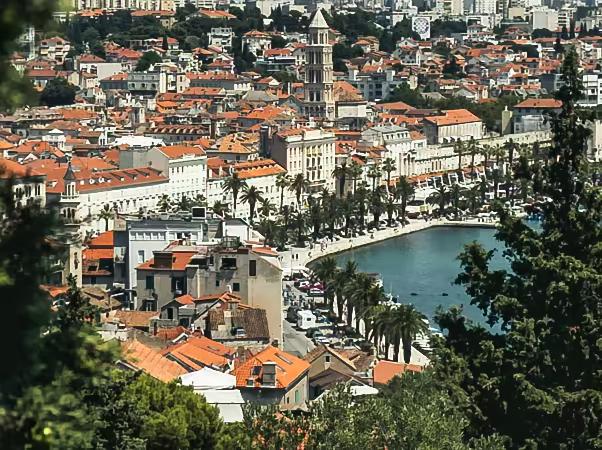
Split is de op een na grootste stad van Kroatië en de hoofdstad van de Dalmatische kust. Gebouwd rond de ruïnes van het Paleis van Diocletianus — een UNESCO-werelderfgoedsite die al meer dan 1.700 jaar onafgebroken bewoond is — is Split een zeldzame plek waar de Romeinse geschiedenis en het mediterrane strandleven samenkomen in het dagelijks leven. De stad trekt werknemers op afstand, gepensioneerden en ondernemers aan, gelokt door uitzicht op de Adriatische Zee, loopbare straten en levenskosten die lager zijn dan die van de meeste West-Europese kuststeden. Toerisme is de economische motor, maar Split is veel meer dan een zomerbestemming — het hele jaar door genieten bewoners van betaalbaar leven buiten het seizoen, een groeiende techscene en een ontspannen tempo dat elders in de EU moeilijk te vinden is.
Levende UNESCO-geschiedenis: het Paleis van Diocletianus is geen museumstuk — het is het stadscentrum, vol met winkels, restaurants, appartementen en nachtleven binnen 4e-eeuwse Romeinse muren. Bewoners lopen op hun ochtendlijke woon-werkverkeer langs zuilen van 1.700 jaar oud.
Leven aan de Adriatische kust: meer dan 2.600 zonuren per jaar, kiezelsstranden op loopafstand van het centrum en snelle veerverbindingen naar Brač, Hvar en Vis. Het zwemseizoen loopt van mei tot en met oktober.
Betaalbare kosten buiten het seizoen: van oktober tot en met mei dalen de huren met 30–40% ten opzichte van de hoogzomer, en de stad houdt haar restaurants, markten en diensten draaiende voor de lokale bevolking in plaats van voor toeristen.
EU-lidmaatschap en euro als munteenheid: Kroatië sloot zich in 2023 aan bij de eurozone, wat wisselkoersproblemen voor de meeste Europese verhuizers wegneemt en bankieren, salarissen en belastingverplichtingen vereenvoudigt.
Compact en loopbaar: de meeste dagelijkse boodschappen, stranduitjes en sociale activiteiten vereisen geen auto. Het hele historische centrum is autovrij, en het bussysteem dekt de buitenwijken efficiënt.
Eilandbereikbaarheid: de haven van Split is de belangrijkste toegangspoort tot de centrale Dalmatische eilanden. Weekendtripjes naar Brač, Hvar en Vis zijn hier een normaal onderdeel van het leven — geen vakantieluxe.
Aan het strand; sport, gezinnen, jonge professionals
Meje
€650–€850
€1.300–€2.000
Chique; uitzicht op zee, villa's, rustige woonwijk
Firule
€500–€750
€1.000–€1.500
Woonwijk; ziekenhuizen, scholen, rustige straten
Spinut
€450–€650
€800–€1.200
Modern; winkelcentra, openbaar vervoer, gezinnen
Varoš
€500–€700
€900–€1.400
Traditionele stenen huizen; konoba's, kunstenaars, karakter
Huisvesting vinden
Njuškalo.hr: De grootste advertentiesite van Kroatië; de meeste verhuurders plaatsen hier als eerste een advertentie. Filter op wijk, prijs en gemeubileerd/ongemeubileerd.
Index oglasi: Een populair alternatief met een aparte vastgoedrubriek en iets minder concurrentie in het toeristenseizoen.
Facebook-groepen: Zoek naar "Split apartments for rent" of "Expats in Split" voor rechtstreekse verhuuraanbiedingen en onderverhuur. Veel expats vinden via deze groepen hun eerste appartement.
Lokale makelaars: Makelaars als Split Stan en andere lokale bedrijven zijn gespecialiseerd in gemeubileerde appartementen en langere huurcontracten. Reken op een courtage van één maand, te betalen door de huurder.
Spotahoe: Een nieuwer huurplatform dat aan populariteit wint, vooral voor gemeubileerde appartementen gericht op expats en digital nomads.
Tips voor expats
Onderhandel over huurcontracten buiten het seizoen, vanaf oktober — verhuurders geven de voorkeur aan stabiele, langdurige huurders boven alleen zomerse verhuur. Als je in de herfst tekent, kun je 30–40% besparen ten opzichte van de piekprijzen in de zomer.
Vraag altijd om een schriftelijk huurcontract ("Ugovor o najmu"), ook als de verhuurder dit niet aanbiedt. Dit beschermt beide partijen en is nodig voor inschrijving in het bevolkingsregister.
Budgetteer apart voor nutsvoorzieningen: elektriciteit, water en internet zijn zelden inbegrepen bij de geadverteerde huur. De maandelijkse lasten voor een appartement van 85 m² liggen gemiddeld tussen de €130 en €180.
Sta erop het energielabel (energetski certifikat) te zien; oudere stenen gebouwen in de binnenstad kunnen 's winters koud zijn en duur om te verwarmen.
Bekijk het appartement op verschillende momenten van de dag. Appartementen in de binnenstad in de buurt van bars en clubs kunnen 's zomers na middernacht erg lawaaiig zijn.
Betaal nooit meer dan één maand huur als borg. De vraag is hoog, maar meer dan één maand is ongebruikelijk op de Kroatische markt en kan wijzen op oplichting.
Wijkgids
Binnenstad (Paleis van Diocletianus): Ideaal voor singles en stelletjes die in een Romeins paleis willen wonen. Op loopafstand van alles — markten, restaurants, de Riva, veerboten. 's Zomers is er veel geluidsoverlast van het nachtleven. De hoogste huren van de stad, en de meeste appartementen zijn klein en omgebouwd uit historische ruimtes. Beperkt daglicht in sommige woningen door de smalle middeleeuwse straatjes.
Bačvice: Ideaal voor strandliefhebbers en jonge professionals. Bekend zandstrand (zeldzaam in Split), volleybalvelden en een levendige barscene. Gemiddelde huren met goede busverbindingen naar het centrum (10 minuten). Gezinsvriendelijk overdag. 's Zomers druk, maar rustiger buiten het seizoen.
Meje: Ideaal voor gezinnen en gepensioneerden die op zoek zijn naar rust. Chique woonstraten met zeezicht, met bomen omzoomde paden langs de kust en de nabijheid van het bospark Marjan Hill. Rustiger dan het centrum, met een mix van oudere villa's en nieuwere appartementsgebouwen. Beperkt nachtleven, wat voor de meeste bewoners hier een pluspunt is.
Firule: Ideaal voor professionals die in het ziekenhuis of het universiteitsdistrict werken. Rustig, praktisch en goed bereikbaar per bus naar zowel de binnenstad als de zuidelijke buitenwijken. Thuisbasis van een bekend strand en het belangrijkste ziekenhuiscomplex van de stad. Goede prijs-kwaliteitverhouding voor deze locatie.
Spinut: Ideaal voor gezinnen met een beperkt budget. Moderne appartementencomplexen, nabijgelegen supermarkten, scholen en gemakkelijke toegang tot Marjan Hill voor wandelen en joggen. De huren behoren tot de laagste in centraal Split, en de buurt heeft een lokale, niet-toeristische sfeer. Iets verder van de binnenstad (15–20 min lopen).
Varoš: Ideaal voor wie karakter zoekt dicht bij het centrum. Smalle straatjes, traditionele stenen huizen en enkele van de beste konoba-restaurants van de stad. Populair bij kunstenaars en langdurige bewoners. De huren zijn gematigd, maar parkeren is bijna onmogelijk en veel straatjes zijn te smal voor auto's.
Levenskosten in Split
Maandelijks budgetoverzicht
Categorie
Budgetbereik
Huur (1-slaapkamer, centrum)
€500–€750
Nutsvoorzieningen (elektriciteit, water, gas)
€130–€180
Internet (100+ Mbps)
€25–€35
Boodschappen
€200–€300
Openbaar vervoer (buskaart)
€35–€45
Uit eten (4x/maand)
€80–€150
Vrije tijd/Sportschool
€30–€50
Totaal
€1.000–€1.510
Dagelijkse kosten
Koffie (espresso): €1,50–€2,50
Lunch (gemiddeld restaurant): €8–€12
Maandelijkse buskaart: ~€40
Bier (lokaal, café): €2,50–€4
Bioscoopkaartje: €5–€7
Brood (heel): €1–€1,50
1 liter melk: €1–€1,30
Sportschoolabonnement: €30–€50/maand
Doosje eieren: €2,50–€3,50
Maaltijd in een middenklasse restaurant: €15–€25
Voordeel buiten het seizoen
De levenskosten in Split veranderen aanzienlijk per seizoen. In de zomer (juni–september) drijft de toeristische vraag huren en restaurantprijzen op, vooral in de oude stad en bij de Riva-promenade. Vanaf oktober verlagen verhuurders die jaarrond contracten aanbieden hun vraagprijzen met 30–40%, en lokale restaurants gaan weer over op gablec (dagelijkse lunchspecials) voor €6–€9. Veel expats die er langdurig wonen, plannen hun woningzoek rond september of oktober om de beste deals te vinden. Supermarktprijzen en nutsvoorzieningen blijven het hele jaar stabiel. De energierekening daalt in de winter zelfs ten opzichte van de zomer, omdat airconditioning de elektriciteitskosten in de zomer meer opdrijft dan de verwarming in de milde wintermaanden doet.
Seizoensgebonden prijsvergelijking
Item
Zomer (jun–sep)
Buiten seizoen (okt–mei)
Huur 1-slaapkamer (Oude Stad)
€700–€900
€450–€650
Restaurantmaaltijd (toeristisch gebied)
€15–€25
€10–€18
Koffie op de Riva
€2,50–€4
€1,50–€2,50
Korte-termijn Airbnb (per nacht)
€80–€150
€30–€60
Boodschappen
Stabiel
Stabiel
Nutsvoorzieningen
Hoger (airco)
Lager
Geld besparen
Doe je boodschappen op de Pazar (groentemarkt) en Peskarija (vismarkt) voor de helft van de supermarktprijs. Kom vroeg voor de beste keuze.
Koop een maandabonnement voor de bus in plaats van losse kaartjes — dat bespaart ongeveer 30% als je dagelijks reist.
Kook thuis met ingrediënten van de markt; een stel kan goed eten voor €150–€200 per maand aan boodschappen.
Profiteer van restaurantdeals buiten het seizoen. Veel konoba's in Varoš en langs de haven bieden lunchmenu's aan tegen lokale prijzen van oktober tot mei.
Overweeg een tweedehands fiets te kopen — de vlakke boulevard en het compacte centrum van Split maken het praktisch voor dagelijkse boodschappen, en tweedehands fietsen zijn te vinden voor €50–€100 op Njuškalo.
Je verplaatsen in Split
Openbaar vervoer: Stadsbusnetwerk van Promet Split. Losse kaartjes kosten ongeveer €1,50; maandabonnement ~€40. Het netwerk dekt alle belangrijke wijken en voorsteden. Bussen rijden van ongeveer 5:00 tot 23:00 uur, met een beperkte dienstregeling in het weekend en op feestdagen.
Fietsen: De vlakke paden langs het water en het Marjan Hill-pad zijn populair, hoewel er in het centrum weinig fietsstroken zijn. E-scooters kun je in de warmere maanden huren via lokale apps.
Auto: De smalle straatjes in de oude stad zijn grotendeels autovrij. Parkeren is mogelijk in parkeergarages (Green Garage, Joker Center) voor €1–€2 per uur. Een auto is handig om de kust en het binnenland te verkennen, maar niet nodig voor het dagelijks leven in het centrum.
Luchthaven: Luchthaven Split (SPU), 25 km ten westen van het centrum in Kaštela. Seizoensgebonden en jaarlijkse vluchten naar Londen, Frankfurt, Amsterdam, Rome en andere Europese hubs. De shuttlebus (€5) en taxi (€30–€40) naar het centrum doen er 30–40 minuten over.
Intercity: Het busstation aan de haven verbindt met Zagreb (5 uur, €20–€30), Dubrovnik (4,5 uur, €15–€25) en Zadar (3 uur). Veerboten vanuit de haven van Split bedienen de eilanden (Brač, Hvar, Vis) en hebben nachtroutes naar Ancona, Italië.
Ride-hailing: Bolt en Uber zijn actief in Split en zijn betrouwbare alternatieven voor taxi's, meestal €3–€8 voor ritjes binnen het centrum.
Gezondheidszorg in Split
Ziekenhuizen/Klinieken: KBC Split (Universitair Ziekenhuiscentrum) is het grootste openbare ziekenhuis van Dalmatië. Diverse particuliere polyklinieken (bijv. Poliklinika Split, Poliklinika Sunce) bieden snellere afspraken, Engelstalig personeel en moderne voorzieningen.
Engelstalige artsen: Beschikbaar bij particuliere klinieken en sommige afdelingen van het openbare ziekenhuis, met name in de radiologie, cardiologie, tandheelkunde en huisartsgeneeskunde. Particuliere consulten kosten doorgaans €30–€60.
Apotheken: Ruim voorhanden ("ljekarna") met een groen kruis als herkenningsteken. Velen volgen een rouleerschema voor late diensten en weekendopenstelling — kijk op de deur voor het huidige rooster. Vrij verkrijgbare medicijnen zijn betaalbaar.
Tandheelkunde: Particuliere tandartspraktijken zijn populair bij expats, zowel wat betreft kwaliteit als prijs. Een standaard reiniging kost €30–€50; complexere behandelingen zijn aanzienlijk goedkoper dan in West-Europa. Veel expats en medische toeristen combineren tandheelkundige behandelingen met een verblijf in Split.
Zorgverzekering: EU-burgers kunnen hun EHIC gebruiken voor spoedeisende hulp. Bij langer verblijf biedt inschrijving bij HZZO (Kroatisch Zorgverzekeringsfonds) toegang tot het publieke systeem. Particuliere zorgverzekeringen bij aanbieders zoals Allianz of Croatia Osiguranje zijn ook gebruikelijk onder expats die sneller toegang willen tot specialisten.
Alarmnummer: 112 (algemeen alarmnummer) of 194 (ambulance).
Krijg een persoonlijk verhuisplan
Laat je e-mailadres achter en we sturen een checklist op maat plus drie offertes van gecontroleerde verhuizers.
Cultuur & Lifestyle
Paleis van Diocletianus: Het 4e-eeuwse rustpaleis van de Romeinse keizer is nu een levende wijk vol cafés, galerieën en appartementen. Het Peristil (centrale plein) organiseert het hele jaar door concerten, opera en culturele evenementen. De paleiskelders — opmerkelijk goed bewaard gebleven — zijn toegankelijk voor bezoekers en worden vaak gebruikt voor tentoonstellingen en kleine markten. Naast het paleis wonen betekent je wijk delen met toeristen, maar ook met eeuwen zichtbare geschiedenis.
Riva-promenade: De iconische boulevard van Split, met palmbomen, koffiebars en uitzicht op zee. Locals gebruiken de Riva voor hun avondkorzo (promenade) — een sociaal ritueel waarbij de stad tot leven komt tussen 18:00 en 22:00 uur. De Riva is ook de locatie voor seizoensmarkten, festivalopeningen en oudejaarsvieringen. Buiten het seizoen is de Riva het sociale hart voor koffie en gesprekken.
Toerisme en seizoenen: Toerisme is een belangrijke motor van de economie van Split, en de bevolking neemt aanzienlijk toe tussen juni en september. Het voordeel voor expats is dat het laagseizoen (oktober–mei) een rustigere, betaalbaardere stad onthult met een sterk lokaal karakter dat hoogseizoengangers zelden te zien krijgen.
Festivals en nachtleven: Ultra Europe-muziekfestival (juli, in het Poljud-stadion), Split Summer Festival (toneel- en operavoorstellingen op openluchtlocaties) en tientallen kleine bars in de paleiskelders en langs de haven. Het clubseizoen piekt van juni–september. In de winter verplaatst het nachtleven zich naar de wijken Varoš en Radunica.
Buitenleven: Het bospark Marjan Hill — de "groene long" van Split — biedt hardlopen, wandelen en klimmen met panoramisch uitzicht op zee. De stranden variëren van het zandige Bačvice tot verborgen baaitjes die per kajak of met een korte boottocht bereikbaar zijn. Winterse wandelingen op de Mosor-berg (30 min. rijden) zijn populair bij actieve expats.
Koffiecultuur: In Split wordt koffie serieus genomen. Lange, sociale koffiemomenten zijn een dagelijks ritueel — geen snelle koffie meenemen. Verbaas je niet als een "koffie" twee uur duurt. Zo socialiseren, zaken doen en ontspannen Kroaten.
Eten & Uitgaan
Lokale specialiteiten: Pašticada (langzaam gegaard Dalmatisch rundvlees in wijnsaus), zwarte risotto (crni rižot, gemaakt met inkt van zeekatten), gegrilde verse vis, peka (vlees of schaaldieren langzaam gegaard onder een klokvormige deksel) en soparnik (snijbietentaart, een beschermde Kroatische lekkernij uit het Dalmatische achterland).
Beste plekken om uit te eten: De Riva-boulevard voor vis en schaaldieren met uitzicht op zee, de wijk Varoš voor traditionele konoba (herberg) restaurants en de Pazar-groentemarkt voor verse producten en betaalbare maaltijden. Het gebied rond de haven Matejuška vlak bij de Riva heeft informele visrestaurants die populair zijn bij de locals.
Budgetopties: Burek-gebak van de markt (€1–€2), pizzapunten (€2–€3) en dagelijkse lunchmenu's (gablec) bij lokale restaurants voor €6–€9. Op de Pazar-markt verkopen ze seizoensfruit en -groenten voor een fractie van de supermarktprijzen. Zelf koken met ingrediënten van de markt is de voordeligste optie.
Expatgemeenschap
Meetup-groepen: Actieve Facebookgemeenschappen zoals "Expats in Split" en "Digital Nomads Split" organiseren regelmatig sociale evenementen, taaluitwisselingen en dagtripjes. Deze groepen zijn de snelste manier om een sociaal netwerk op te bouwen als nieuwkomer.
Coworkingruimtes: Split heeft een groeiende coworkingscene — ruimtes zoals ScaleUp en Locals'n'Nomads bieden vaste werkplekken, vergaderruimtes, snell internet en community-evenementen voor remote werkers. Maandelijkse lidmaatschappen variëren van €100–€200.
Taaluitwisseling: Wekelijkse taaluitwisselingsavonden in bars en cafés in de oude binnenstad. Kroatische lessen zijn beschikbaar via de Universiteit van Split en privétaalscholen. Veel expats geven aan dat je met regelmatige oefening binnen 6–12 maanden basis-Kroatisch kunt leren spreken.
Sport en recreatie: Hardloopclubs, zeilgroepen, beachvolleybalcompetities en wandel-meetups zijn het hele jaar door actief. De klimcommunity rond Marjan Hill en Mosor verwelkomt nieuwkomers. Kayak- en paddleboardverhuur is goedkoop buiten het seizoen.
Vrijwilligerswerk: Dierenopvangcentra, strandopruimgroepen en buurttuinen verwelkomen expat-vrijwilligers. Het is een praktische manier om Kroatisch te oefenen en locals te ontmoeten buiten de expat-bubbel.
Belastingen en Bankieren
Fiscale inwoner: Kroatië belast het wereldwijde inkomen van inwoners (183+ dagen per jaar). De inkomstenbelastingtarieven zijn progressief: 20% over een jaarinkomen tot €60.000 en 30% daarboven (standaard nationale tarieven; de stad Split kan binnen wettelijke marges aanpassen). Lokale toeslagen variëren per gemeente.
Bankieren: Een bankrekening openen gaat eenvoudig met een paspoort en OIB. Belangrijkste banken zijn Zagrebačka Banka, Erste, PBZ en OTP. Online bankieren is standaard; mobiele apps werken goed maar zijn soms beperkt in het Engels. Euro-overboekingen binnen SEPA zijn gratis en snel.
Freelancer-opzet: De paušalni obrt (eenmanszaak met vast tarief) is de populairste optie voor freelancers. Het plafonneert de jaarlijkse belasting op een vast bedrag (€150–€500) en vereenvoudigt de boekhouding. Registratie duurt 1–2 weken via het handelsregister.
Arbeidsmarkt in Split
Belangrijkste sectoren: Toerisme en horeca, scheepsbouw (Brodosplit), IT en softwareontwikkeling, maritieme diensten en onderwijs.
Belangrijkste werkgevers: Brodosplit (scheepswerf), Universiteit van Split, Jadrolinija (veerbootmaatschappij), lokale overheid en een groeiende cluster van tech-startups en outsourcingbedrijven.
Gemiddelde salarissen per sector:
Sector
Gemiddeld netto per maand
IT / Software
€1.200–€2.000
Toerisme / Horeca
€800–€1.100
Onderwijs
€900–€1.200
Gezondheidszorg
€1.000–€1.400
Bouw / Ambachten
€900–€1.300
Vacaturebanken: MojPosao.net, Posao.hr, LinkedIn en lokale Facebook-vacaturegroepen. Remote werkers in dienst van niet-Kroatische bedrijven registreren zich vaak als eenmanszaak (obrt) of gebruiken een employer-of-record-dienst voor fiscale naleving.
Freelancertip: De Kroatische paušalni obrt (eenmanszaak met vast tarief) is populair bij freelancers en digitale nomaden. Het biedt vereenvoudigde boekhouding en een vaste jaarlijkse belasting van ongeveer €150–€500, afhankelijk van de omzet. Daarmee is het een van de meest freelancer-vriendelijke structuren in de EU.
Realiteit van de toerismesector: Veel banen in het toerisme zijn seizoensgebonden (mei–oktober) en betalen bescheiden salarissen. Het hele jaar door zijn er vacatures in management, marketing en technische functies bij toerismebedrijven, maar de concurrentie is groot. Als je inkomen afkomstig is van remote werk voor een buitenlandse werkgever, wordt Split aanzienlijk aantrekkelijker.
Onderwijs in Split
Internationale scholen: Split heeft nog geen volledige internationale school met IB- of Brits curriculum, maar er zijn wel diverse privébilinguale programma's in de bredere regio Dalmatië. De dichtstbijzijnde volledige internationale scholen vind je in Zagreb, op ongeveer 5 uur rijden of met de bus.
Universiteiten: De Universiteit van Split biedt opleidingen in techniek, geesteswetenschappen, rechten, geneeskunde, maritieme studies en economie. Het collegegeld voor EU-burgers is laag of gratis voor Kroatisch-talige programma's. Sommige Engelstalige programma's zijn beschikbaar op masterniveau, met name in informatica en bedrijfskunde.
Taalscholen: Diverse privéscholen bieden Kroatisch voor anderstaligen, evenals cursussen Engels, Duits en Italiaans. De Croatian Language School van de Universiteit van Split is populair bij expats die langdurig verblijven en organiseert intensieve zomerprogramma's.
Openbare scholen: Kroatische openbare scholen zijn gratis voor inwoners. Het onderwijs is in het Kroatisch, dus kinderen hebben in het eerste jaar meestal taalondersteuning nodig. Scholen in het centrum en de wijk Bačvice hebben ervaring met het integreren van buitenlandse leerlingen.
Verhuislijst voor Split
Voor aankomst
Controleer de visum- of verblijfsvergunningvereisten voor jouw nationaliteit
Zorg voor tijdelijke huisvesting (Airbnb of een serviced apartment) voor de eerste 2–4 weken
Verzamel geapostilleerde documenten: geboorteakte, diploma en evt. huwelijksakte
Informeer je bank over de verhuizing naar het buitenland en controleer de mogelijkheden voor eurozone-overboekingen
Onderzoek ziektekostenverzekeringen — EU-burgers moeten voor vertrek een EHIC-kaart aanvragen
Eerste week
Registreer je adres bij het lokale politiebureau (MUP) — verplicht bij een verblijf langer dan 90 dagen
Vraag een OIB (persoonlijk identificatienummer) aan bij de Belastingdienst
Open een Kroatische bankrekening (Zagrebaška Banka, Erste of PBZ)
Koop een lokale simkaart (T-Mobile, A1 of Tele2) — verkrijgbaar bij kiosken en supermarkten
Download de Bolt- of Uber-app voor voordelig vervoer door de stad
Eerste maand
Schrijf je in bij HZZO (Kroatisch Zorgverzekeringsfonds) als je in aanmerking komt voor publieke gezondheidszorg
Teken een langetermijnhuurcontract
Regel nutsvoorzieningen: elektriciteit (HEP), water (Vodovod), internet (A1 of T-Com)
Verken de buurten voordat je je definitief op een wijk vastlegt
Schrijf je in voor een Kroatische taalcursus als je langere tijd blijft
Sluit je aan bij minstens één expat-Facebookgroep of een coworkingruimte om een sociaal netwerk op te bouwen
Veelgestelde vragen
Gerelateerde gidsen
[Verhuizen naar Kroatië] — uitgebreide landgids over visa, belastingen en verblijfsvergunningen
[Verhuizen naar Dubrovnik] — gids voor de nabijgelegen kuststad
[Verhuizen naar Zagreb] — stadsgids voor de hoofdstad van Kroatië
R
ReloAdvisor Team
ReloAdvisor heeft duizenden expats geholpen met verhuizen in Europa. Onze gidsen zijn gebaseerd op actuele regelgeving, geverifieerde expat-ervaring en nauwe samenwerking met erkende verhuizers, relocatie-advocaten en visumspecialisten.