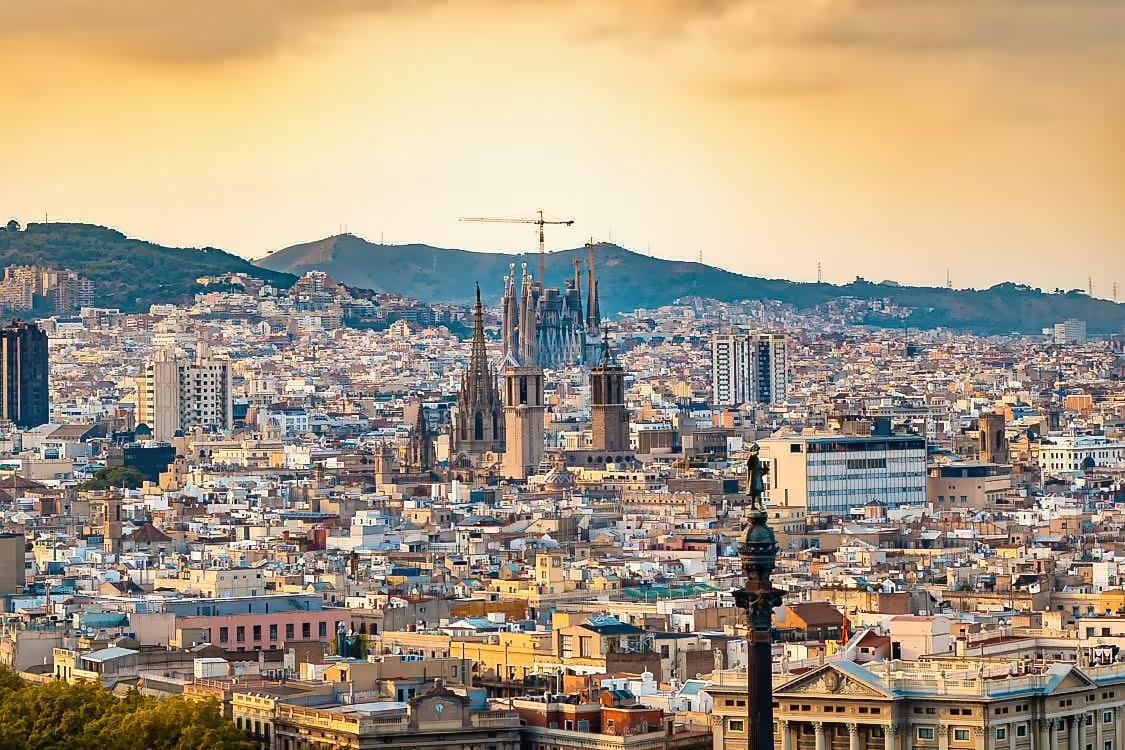

Barcelone est la deuxième ville d'Espagne et la capitale de la Catalogne, connue dans le monde entier pour son mélange unique de vie de plage méditerranéenne, d'architecture avant-gardiste et d'une économie créative bouillonnante. Que vous soyez nomade numérique, jeune professionnel ou famille en quête de soleil et de culture, Barcelone offre une qualité de vie incomparable sur la côte nord-est de l'Espagne.
Barcelone en bref

- Population
- 1,69 million (ville) / 5,5 millions (aire métropolitaine)
- Région
- Catalogne, nord-est de l'Espagne
- Connu pour
- Architecture de Gaudí, plages méditerranéennes, FC Barcelona
- Loyer moyen (1 chambre)
- 1 100 €–1 500 € par mois
- Salaire moyen
- 1 800 €–2 200 € net par mois
- Communauté d'expatriés
- Grande et diverse — plus de 300 000 résidents étrangers
- Langue
- Espagnol et catalan (tous deux co-officiels)
- Climat
- Méditerranéen — hivers doux, étés chauds, plus de 2 500 heures d'ensoleillement
Pourquoi s'installer à Barcelone
- Art de vivre méditerranéen : plus de 2 500 heures d'ensoleillement par an, des hivers doux et un accès direct à la plage font de la vie en plein air une réalité tout au long de l'année.
- Richesse culturelle : de la Sagrada Família au quartier gothique, la ville est un musée à ciel ouvert qui s'étend des vestiges romains à l'art contemporain.
- Opportunités professionnelles : une scène technologique, design et startup florissante, ancrée dans le quartier 22@, attire des talents internationaux de toute l'Europe et au-delà.
- Connectivité : l'aéroport de Barcelone-El Prat propose des vols directs vers la plupart des capitales européennes et des hubs intercontinentaux, notamment New York, Dubaï et São Paulo.
- Gastronomie et vie sociale : une restauration d'excellence, des bars à tapas animés et un calendrier chargé de festivals créent une vie sociale vibrante tout au long de l'année.
- Praticabilité à pied : la ville est suffisamment compacte pour être parcourue à pied, avec un excellent réseau de métro couvrant chaque recoin.
Trouver un logement à Barcelone
Loyers moyens
| Quartier | 1 chambre | 3 chambres | Caractère |
|---|---|---|---|
| Eixample | 1 100 €–1 500 € | 1 800 €–2 500 € | Plan en grille emblématique, immeubles modernistes, central |
| Gràcia | 1 000 €–1 250 € | 1 600 €–2 300 € | Ambiance de village bohème, cafés locaux, jeune clientèle |
| Barceloneta | 1 050 €–1 300 € | 1 700 €–2 400 € | En bord de mer, restaurants de fruits de mer, très touristique |
| Poblenou | 1 000 €–1 300 € | 1 600 €–2 200 € | Pôle technologique, lofts modernes, proche de la plage |
| El Born | 1 000 €–1 400 € | 1 600 €–2 300 € | Historique, artistique, bars à tapas, ruelles étroites |
| Sarrià-Sant Gervasi | 1 100 €–1 500 € | 2 000 €–3 000 € | Haut de gamme, calme, adapté aux familles, espaces verts |
Comment trouver un logement
- Idealista : le plus grand portail de location d'Espagne — filtrez par quartier, prix et surface. La plupart des annonces sont mises à jour quotidiennement.
- Fotocasa : une autre grande plateforme avec des annonces vérifiées et des visites virtuelles.
- Spotahome : visites en ligne pour appartements meublés — pratique si vous cherchez depuis l'étranger avant votre arrivée.
- Agences locales : de nombreux propriétaires préfèrent encore passer par des agences ; prévoyez des honoraires d'un mois de loyer plus TVA.
- Groupes Facebook : « Pisos y habitaciones en Barcelona » et des groupes similaires proposent des annonces directes de propriétaires, mais méfiez-vous des arnaques.
Conseils pour les expatriés
- Prévoyez une caution de 1 à 2 mois de loyer plus le premier mois d'avance.
- Les charges ne sont presque jamais incluses dans le loyer affiché — comptez un supplément de 100 € à 140 € par mois.
- La concurrence est rude en septembre et octobre, à la rentrée des universités — commencez à chercher au moins quatre semaines à l'avance.
- De nombreux immeubles anciens sont dépourvus d'ascenseur et de climatisation — vérifiez avant de signer un contrat.
- Les contrats de location sont généralement d'un an, le locataire ayant le droit de proroger jusqu'à cinq ans en vertu du droit espagnol.
Guide des quartiers
- Eixample : le cœur du Barcelone moderniste. Grands boulevards, excellentes liaisons de métro et un mélange de restaurants haut de gamme et de commerces locaux le long du Passeig de Gràcia. Idéal pour les professionnels et les couples qui souhaitent être au centre.
- Gràcia : un ancien village absorbé par la ville, qui a conservé son identité bohème. La Plaça del Sol en est le cœur social. Les loyers sont modérés, l'ambiance est créative et détendue, et la Festa Major annuelle transforme les rues chaque mois d'août.
- Barceloneta : en bord de Méditerranée. Idéal pour les amateurs de plage, bien que les étés soient marqués par un fort afflux touristique et du bruit. Les loyers sont supérieurs à la moyenne par rapport à la superficie des appartements.
- Poblenou : la réponse de Barcelone à la Silicon Valley. Autrefois industriel, le quartier est aujourd'hui peuplé d'espaces de coworking, de micro-brasseries et d'appartements neufs. Bon rapport qualité-prix comparé aux quartiers centraux.
- El Born : ruelles médiévales étroites animées de boutiques, galeries d'art et bars à tapas. À quelques pas de la plage et du Parc de la Ciutadella. Très prisé des jeunes créatifs et des professionnels du design.
- Sarrià-Sant Gervasi : un quartier plus calme et verdoyant dans les collines au-dessus de la ville. Écoles internationales, appartements plus spacieux et ambiance de village — idéal pour les familles en quête d'espace et de tranquillité.
Coût de la vie à Barcelone
Répartition du budget mensuel
| Catégorie | Fourchette budgétaire |
|---|---|
| Loyer (1 chambre, centre) | €1 000–€1 300 |
| Charges (électricité, eau, gaz) | €120–€170 |
| Internet (fibre 300 Mbps+) | €30–€45 |
| Courses alimentaires | €250–€350 |
| Transport (T-Casual / mensuel) | €40–€55 |
| Repas au restaurant (4x/mois) | €80–€120 |
| Loisirs/Salle de sport | €30–€50 |
| Forfait téléphonique | €10–€20 |
| Total | €1 560–€2 110 |
Coûts du quotidien
- Café (espresso) : €1,50
- Déjeuner (menú del día) : €10–€14
- Carnet de trajets (T-Casual, 10 trajets) : €11,35
- Bière (bar, caña) : €3,00–€4,50
- Billet de cinéma : €8–€10
- Abonnement mensuel salle de sport : €30–€50
- Miche de pain : €1,20–€1,80
Visa et résidence à Barcelone
L'Espagne propose plusieurs voies de visa pour les citoyens non-EU/EEE :
- Visa de travail : Nécessite une offre d'emploi d'un employeur espagnol. L'employeur initie la procédure à l'Oficina de Extranjería. Le traitement prend 1 à 3 mois.
- Visa étudiant : Pour les étudiants inscrits dans des établissements reconnus. Autorise un travail à temps partiel (jusqu'à 20 heures/semaine).
- Visa sans activité lucrative : Pour les retraités ou les personnes disposant d'une épargne suffisante. Travail non autorisé. Nécessite un justificatif de revenus ou d'épargne de €2 400+/mois.
- Visa nomade numérique (Ley de Startups) : Pour les travailleurs à distance employés par des entreprises non espagnoles. Offre un régime fiscal spécial (taux fixe de 24 % sur les revenus jusqu'à €600 000) pendant cinq ans au maximum.
- Carte bleue EU : Pour les professionnels hautement qualifiés. Nécessite un diplôme et un salaire supérieur à 1,5 fois la moyenne nationale.
- Visa doré : Pour les investissements immobiliers supérieurs à €500 000. Aucune exigence de séjour minimum. En cours de suppression – vérifiez le statut actuel.
Une fois en Espagne, vous aurez besoin d'un NIE (Número de Identificación de Extranjero) pour pratiquement toutes les démarches officielles. Faites la demande au commissariat local avec votre passeport et le motif de votre demande.
Obligations fiscales
Si vous passez plus de 183 jours par an en Espagne, vous devenez résident fiscal et êtes imposé sur vos revenus mondiaux. L'impôt sur le revenu espagnol (IRPF) varie de 19 % à 47 % selon le niveau de revenu. Les cotisations sociales couvrent les soins de santé, les retraites et les allocations chômage. L'Espagne a conclu des conventions de double imposition avec plus de 90 pays.
| Composante fiscale | Description | Taux |
|---|---|---|
| Impôt sur le revenu (IRPF) | Sur les revenus mondiaux | 19 %–47 % progressif |
| Sécurité sociale | Cotisations obligatoires | ~6,35 % salarié / ~30 % employeur |
| TVA (IVA) | Sur les biens et services | 21 % standard |
| Taxe de solidarité | Remplace l'impôt sur la fortune en Catalogne pour les particuliers à patrimoine élevé | 0,21 %–3,5 % sur l'actif net au-delà de €3 M (seuil de €700 000 toujours applicable pour le calcul) |
Se déplacer à Barcelone
- Transports en commun : Vaste réseau de métro (12 lignes), de bus et de tramway couvrant l'ensemble de l'aire métropolitaine. La carte T-Casual (€11,35 pour 10 trajets en Zone 1) est l'option la plus économique pour les usagers occasionnels. Un abonnement mensuel coûte environ €40.
- Vélo : Plus de 200 km de pistes cyclables ; Bicing est le système de vélo en libre-service de la ville (abonnement annuel ~€50). Les vélos électriques sont de plus en plus disponibles.
- En voiture : Déconseillé dans le centre – rues étroites, stationnement limité et zones à faibles émissions (ZBE) restreignant les véhicules plus anciens. Un permis de stationnement résident (Zona Verda) aide, mais les places sont rares.
- Aéroport : Barcelone-El Prat (BCN), à 15 km du centre. Liaisons directes en métro (L9 Sud) et en Aerobus (€7,75 l'aller simple, 35 minutes jusqu'à la Plaça Catalunya).
- Intercités : Trains à grande vitesse AVE vers Madrid (2 h 30), lignes de banlieue régionales Rodalies, et autocars longue distance depuis l'Estació del Nord et l'Estació de Sants.
Santé à Barcelone
- Hôpitaux/Cliniques : Hospital Clínic, Hospital de la Santa Creu i Sant Pau, Hospital del Mar – tous financés par l'État. Les options privées comprennent le Centro Médico Teknon et l'Hospital Quirónsalud Barcelona.
- Médecins anglophones : Largement disponibles dans les cliniques privées ; le système public compte moins de locuteurs anglophones, mais des interprètes peuvent être sollicités dans les grands hôpitaux.
- Pharmacies : Croix vertes visibles partout. La plupart des pharmaciens parlent un peu anglais. Les médicaments sur ordonnance sont fortement subventionnés pour les résidents.
- Numéro d'urgence : 112 (paneuropéen), 061 pour les urgences médicales.
- Assurance maladie : L'assurance privée (Adeslas, Sanitas, MAPFRE) coûte €50–€150/mois selon l'âge et la couverture. De nombreux expatriés recourent à une assurance privée en attendant leur affiliation à l'assurance maladie publique.
Recevez un plan de demenagement personnalise
Laissez votre e-mail et nous vous enverrons une checklist adaptee ainsi que trois devis de demenageurs verifies.
Culture et mode de vie
- Architecture : La Sagrada Família de Gaudí, le Park Güell et la Casa Batlló définissent le paysage urbain. L'ensemble du quartier de l'Eixample est une vitrine du modernisme avec des œuvres de Domènech i Montaner et Puig i Cadafalch.
- Plages : Barceloneta, Bogatell et Nova Icària offrent des étendues de sable intra-muros – idéales de mai à octobre. Les bars de plage (chiringuitos) ouvrent en été.
- Vie nocturne : Razzmatazz, Apolo et d'innombrables bars en rooftop maintiennent la ville en éveil jusqu'à l'aube. La scène nocturne couvre la musique électronique, le jazz et l'indie.
- Festivals : La Mercè (septembre), Sant Joan (juin – feux de joie sur les plages) et la fête de rue de Gràcia (août – les rues décorées s'affrontent pour remporter des prix) sont incontournables.
Gastronomie et restaurants
- Goûtez aux plats locaux : pa amb tomàquet (pain à la tomate), fideuà (paella de nouilles aux fruits de mer), crema catalana et bombas (croquettes de pommes de terre à la sauce épicée).
- Meilleurs quartiers pour se restaurer : El Born pour les tapas haut de gamme, Gràcia pour les bistrots de quartier, Poble-sec (Carrer de Blai pour des pintxos à volonté).
- Options économiques : Le menú del día au déjeuner propose un repas complet de trois plats avec une boisson pour €10–€14 dans de nombreux restaurants de quartier.
Communauté d'expatriés
- Groupes de rencontre : Barcelona Expat Meetup (plus de 10 000 membres), InterNations Barcelona, et des événements d'échanges linguistiques ont lieu chaque semaine dans toute la ville.
- Organisations internationales : Catalan International Viewpoints, American Society of Barcelona, British Chamber of Commerce in Spain.
- Échanges linguistiques : Tandem Barcelona et Mundo Lingo organisent des soirées d'échange linguistique gratuites ou à faible coût dans des bars de toute la ville – une excellente façon de pratiquer l'espagnol et le catalan.
Excursions à la journée et destinations proches
La situation de Barcelone sur la côte méditerranéenne offre d'excellentes options pour le week-end :
- Montserrat : un superbe monastère de montagne (à 60 km au nord-ouest). Prenez le train à crémaillère pour profiter de vues spectaculaires. Concerts gratuits de chœur de garçons la plupart des après-midis.
- Sitges : une charmante ville balnéaire à 35 km au sud, avec une scène artistique animée et une ambiance accueillante pour les personnes LGBTQ+. 30 minutes en train.
- Girona : ville médiévale avec un quartier juif, des remparts et l'une des meilleures scènes gastronomiques d'Espagne. 40 minutes en train AVE.
- Costa Brava : Tossa de Lloret, Calella de Palafrugell et d'autres plages en crique se trouvent à 1 à 2 heures au nord en voiture ou en bus.
- Ski dans les Pyrénées : les stations de La Molina et Masella se trouvent à 2 heures au nord en voiture. Les week-ends au ski sont populaires de décembre à mars.
- Régions viticoles : le Penedès (production de cava) et le Priorat (rouges haut de gamme) sont à 1 à 2 heures. De nombreuses bodegas proposent des visites et dégustations.
Marché de l'emploi à Barcelone
- Principaux secteurs : technologie, tourisme, logistique, design, finance, sciences de la vie et jeux vidéo.
- Grands employeurs : SEAT/CUPRA, HP Inc., CaixaBank, Glovo, King (Activision Blizzard), Amazon (hub logistique), Adevinta.
- Salaires moyens par secteur :
| Secteur | Fourchette de salaire annuel |
|---|---|
| Informatique / Développement logiciel | 30 000 €–45 000 € |
| Marketing / Communication | 24 000 €–35 000 € |
| Hôtellerie / Tourisme | 18 000 €–24 000 € |
| Finance / Comptabilité | 28 000 €–50 000 € |
| Ingénierie | 30 000 €–50 000 € |
| Éducation (enseignement des langues) | 18 000 €–25 000 € |
- Ressources pour chercher un emploi : InfoJobs.net, LinkedIn, Barcelona Activa (portail emploi de la ville), Welcome Talent (pour les internationaux), Glassdoor.
Éducation à Barcelone
- Écoles internationales : Benjamin Franklin International School, American School of Barcelona, British School of Barcelona, Kensington School.
- Universités : Universitat de Barcelona (UB), Universitat Politècnica de Catalunya (UPC), Universitat Pompeu Fabra (UPF), ESADE Business School, IESE.
- Écoles de langues : International House, Speakeasy BCN, Linguaschools — proposent des cours d'espagnol et de catalan pour tous les niveaux, y compris la préparation à l'examen DELE.
Checklist de déménagement pour Barcelone
- Sécuriser un logement, ou au moins une location courte durée pour le premier mois
- Demander le bon visa (si vous êtes non-EU) — prévoyez 2 à 3 mois de traitement
- Rassembler les documents apostillés (acte de naissance, diplôme, extrait de casier judiciaire)
- Souscrire une assurance santé internationale pour les premiers mois
- Commencer à apprendre les bases de l'espagnol avec des applications comme Duolingo ou Babbel
- Vous inscrire à la mairie locale (empadronamiento) — obligatoire pour presque toutes les démarches administratives
- Demander votre NIE (numéro d'identification d'étranger) au commissariat le plus proche
- Ouvrir un compte bancaire espagnol (CaixaBank, Sabadell ou des banques numériques comme N26)
- Obtenir une carte SIM espagnole (Movistar, Vodafone, Orange ou des options économiques comme Digi)
- Vous inscrire au système de santé public (CatSalut) si vous y êtes éligible
- Mettre les contrats d'énergie et de services à votre nom (électricité via Endesa ou Iberdrola, eau via Aigües de Barcelona, gaz et internet)
- Explorer votre quartier et repérer la station de métro, la pharmacie et le supermarché les plus proches
- Rejoindre des groupes locaux d'expatriés ou des échanges linguistiques pour commencer à créer votre réseau social
- Enregistrer votre contrat de location auprès du fisc si nécessaire
- Obtenir une carte TIE (carte d'identité d'étranger) si la durée de votre visa dépasse 6 mois
- Vous inscrire au système de vélos en libre-service de la ville (Bicing) si vous prévoyez de vous déplacer à vélo
Guides associés
- [S'installer en Espagne] — guide complet du pays
- [S'installer à Madrid] — guide de la capitale espagnole
- [S'installer à Valence] — alternative méditerranéenne abordable
- [S'installer à Séville] — culture andalouse et flamenco