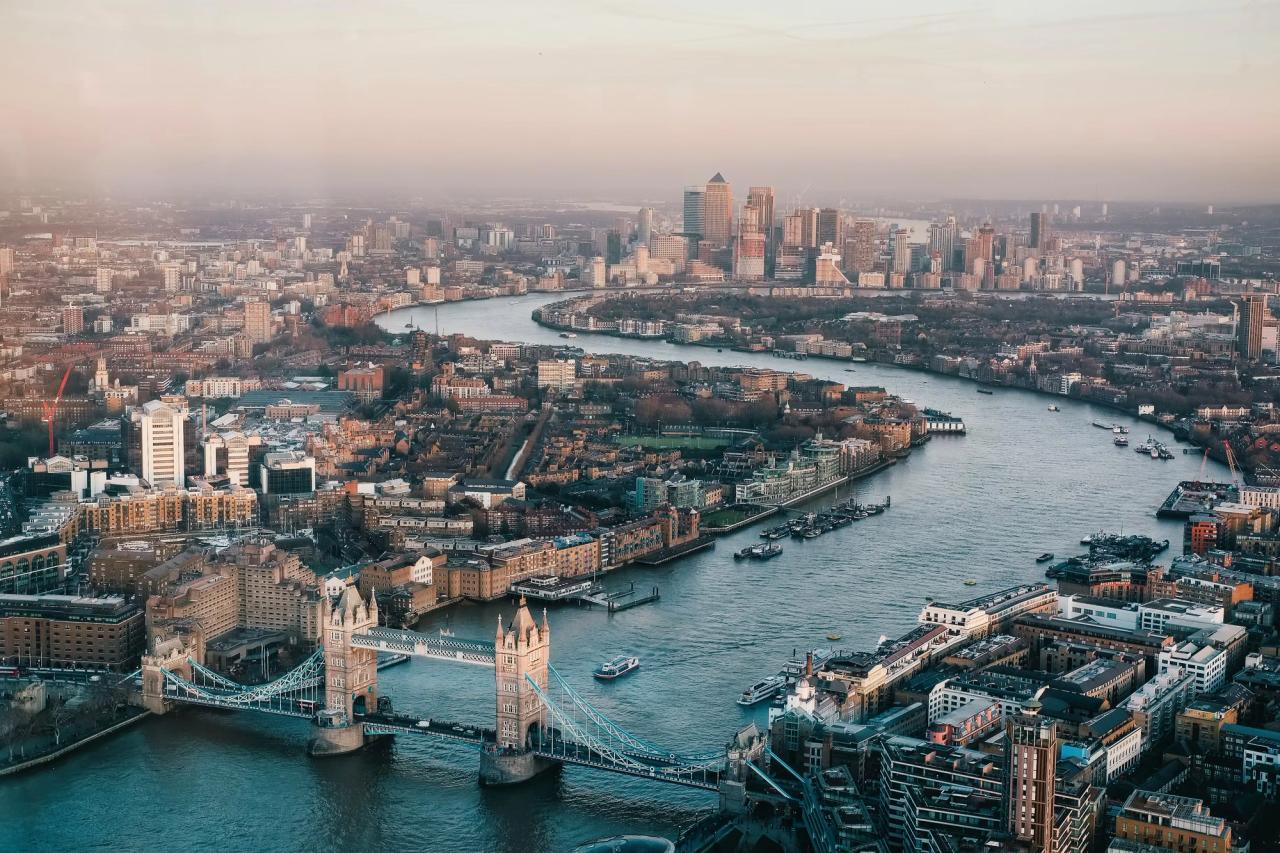

London is the United Kingdom's capital and one of the world's most influential cities — a global centre for finance, culture, and politics. With nearly 9 million residents in Greater London, the city attracts professionals, students, and families from every continent. If you value career opportunity, world-class dining and arts, and a truly international community, London delivers — at a premium price. This guide covers everything you need to know about relocating to London as an expat.
London at a Glance
- Population
- ~9 million (Greater London)
- Region
- Greater London, England
- Known For
- Finance, history, world-class arts & theatre
- Average Rent (1BR)
- £1,500–£2,200/month
- Average Salary
- ~£2,900/month net (~£44,000/year gross)
- Expat Community
- One of the largest and most diverse in the world
- Currency
- British Pound Sterling (GBP)
Why Move to London
- Career opportunities: London is Europe's leading financial centre and a global hub for tech, law, creative industries, and healthcare. Major employers include HSBC, Google, the BBC, and the NHS.
- Cultural richness: Over 170 museums, the West End theatre district, and year-round festivals from Notting Hill Carnival to the Thames Festival. Most national museums are free to enter.
- International connectivity: Six airports and direct rail links to Paris, Brussels, and Amsterdam via Eurostar. Heathrow alone serves over 200 destinations.
- Education: Home to Imperial College, UCL, LSE, and dozens of top-ranked international schools offering IB, French, German, and American curricula.
- Diversity: Over 300 languages are spoken in London. No matter where you are from, you will find a community that shares your background.
Finding Housing in London
Average Rents
| Neighborhood | 1-Bedroom | 3-Bedroom | Character |
|---|---|---|---|
| Zone 1 — Westminster / Kensington | £1,800–£2,500 | £3,500–£6,000 | Prestigious, central, leafy squares |
| Zone 2 — Clapham / Brixton | £1,300–£1,800 | £2,400–£3,500 | Young professionals, lively nightlife |
| Zone 2–3 — Islington / Hackney | £1,200–£1,700 | £2,200–£3,200 | Trendy, creative, independent shops |
| Zone 3–4 — Greenwich / Lewisham | £1,000–£1,400 | £1,800–£2,600 | Family-friendly, parks, riverside |
| Zone 4+ — Croydon / Ealing | £900–£1,200 | £1,500–£2,200 | Affordable, suburban feel, good transport |
| Zone 2 — Canary Wharf | £1,400–£1,900 | £2,500–£3,500 | Modern towers, finance hub, waterfront |
How to Find Housing
- Rightmove and Zoopla: The two dominant UK property portals — search by postcode, price, and property type. Most listings appear on both.
- SpareRoom: Flatshare specialist, popular for finding shared accommodation and housemates. Essential if you are looking to share.
- OpenRent: Direct landlord listings, no agency fees. Growing rapidly in London.
- Gumtree: Still widely used in London for direct-to-landlord lets, though beware of scams.
- Register with local estate agents early; demand outstrips supply in most zones. Be ready to commit within 24–48 hours of viewing.
Tips for Expats
- Budget for a deposit of up to five weeks' rent plus the first month in advance. Letting agent admin fees have been fully banned in England since June 2019 for all new tenancies (Tenant Fees Act 2019). The only permitted charges are: rent, deposit (capped at 5 weeks), holding deposit (capped at 1 week), utilities, Council Tax, and replacement key/contract change fees (capped at £50).
- References from a UK employer or previous landlord speed up approval significantly.
- Consider zones 3–4 for significantly lower rents with still-excellent Tube connections — areas like Greenwich, Tooting, and Walthamstow offer great value.
- Use the TfL journey planner to check commute times before committing to a location.
- Short-term lets (Airbnb, serviced apartments) for the first 2–4 weeks give you time to explore neighborhoods before signing a lease.
Neighborhoods Guide
- Clapham: Popular with young professionals from Australia, South Africa, and Europe. Vibrant Clapham Common, bustling High Street with bars and restaurants. Mid-to-high rents.
- Islington: Upper Street's restaurants and theatres attract creative professionals and media workers. Georgian townhouses and modern flats. High rents.
- Greenwich: Maritime history, the Royal Observatory, and Greenwich Park. Family-oriented with a village feel and riverside walks. Moderate rents.
- Hackney (Dalston / Stoke Newington): Independent cafés, street art, and Victoria Park. Appeals to creatives and young families. Mid-range rents.
- Canary Wharf: Modern towers and corporate offices — popular with finance professionals. High rents, excellent DLR and Jubilee line links.
- Richmond: Thames-side parks, deer in Richmond Park, and outstanding state and independent schools. Quiet, affluent, family-focused. Premium rents.
- Brixton: Caribbean culture, Brixton Market, and a thriving live music scene. Diverse, energetic, and more affordable than neighboring Clapham. Mid-range rents.
- Walthamstow: East London's rising star — the Village, Walthamstow Wetlands, and improving transport links. Young families and creatives. Lower rents.
Cost of Living in London
Monthly Budget Breakdown
| Category | Budget Range |
|---|---|
| Rent (1BR, center) | £1,200–£2,000 |
| Utilities (gas, electric, water) | £140–£200 |
| Internet | £25–£35 |
| Groceries | £250–£350 |
| Transport (Oyster/contactless) | £150–£180 |
| Dining out (4x/month) | £120–£200 |
| Leisure/Gym | £30–£60 |
| Mobile phone | £15–£30 |
| Total | £1,930–£3,055 |
Day-to-Day Costs
- Coffee (flat white): £3.50–£4.50
- Lunch (casual restaurant): £10–£15
- Monthly travelcard (Zones 1–3): ~£176
- Beer (pint, central pub): £6–£7.50
- Cinema ticket: £13–£18
- Pint of milk: £1.00–£1.40
- Loaf of bread: £1.10–£1.60
Getting Around London
- Public transport: The Underground (Tube), buses, Overground, DLR, Elizabeth Line, and Thames Clippers form one of the most extensive networks in the world. A monthly Zones 1–3 travelcard costs around ~£176 (subject to annual TfL fare adjustments). Contactless Oyster cards or bank cards are essential — cash is not accepted on buses.
- Cycling: Santander Cycles (Boris Bikes) available across central London. Cycle lanes expanding but traffic remains heavy. E-scooters are available via rental trials in some boroughs.
- Driving: Congestion charge (~£15/day) and Ultra Low Emission Zone (ULEZ, ~£12.50/day for non-compliant vehicles) apply across Greater London. Most residents rely on public transport — owning a car in zones 1–3 is rare and expensive.
- Airports: Heathrow (LHR), Gatwick (LGW), Stansted (STN), Luton (LTN), London City (LCY), and Southend (SEN) — connecting to virtually every major global destination.
- Intercity: Eurostar from St Pancras to Paris (2h15m), Brussels, and Amsterdam. Domestic high-speed services: King's Cross/London Euston to Edinburgh (4h20m), Euston to Manchester (2h07m), Paddington to Bristol (1h40m) and Cardiff (2h).
Healthcare in London
- Hospitals/Clinics: Major NHS trusts include Guy's and St Thomas', University College Hospital (UCLH), the Royal Free, St Mary's, and King's College Hospital. Numerous private clinics in Harley Street and across the city.
- English-speaking doctors: English is the primary language; NHS GPs are widely available in every borough. Register with a GP near your home address as soon as you move in.
- Pharmacies: Boots, Superdrug, and independent chemists on nearly every high street. Emergency contraception is available over the counter.
- Emergency number: 999 (also 112). NHS 111 for non-emergency medical advice.
- Health surcharge: Visa holders pay the Immigration Health Surcharge (£1,035/year as of 2025) which grants full NHS access.
Get a personalised relocation plan
Drop your email and we'll send a tailored checklist plus three quotes from vetted movers.
Culture & Lifestyle
- Theatre & arts: The West End, Tate Modern, the National Gallery, the British Museum, the V&A, and the Natural History Museum are world-class institutions. Most are free.
- Parks & green space: Hyde Park, Regent's Park, Hampstead Heath, Richmond Park, and over 3,000 parks and green spaces — London is one of the greenest cities of its size.
- Sport: Premier League football (Arsenal, Chelsea, Tottenham, West Ham, Fulham, Crystal Palace, Brentford), Wimbledon, Twickenham rugby, and the 2012 Olympic legacy venues in Stratford.
- Nightlife: Soho, Shoreditch, Camden, Brixton, and Peckham offer everything from cocktail bars to live music venues and late-night clubs.
Food & Dining
- London's restaurant scene spans every cuisine on earth — Brick Lane for curry, Chinatown for East Asian, Borough Market for artisan food, and Michelin-starred dining across the city.
- Best areas for dining: Soho, Bermondsey, Marylebone, Dalston, and Peckham.
- Budget options: Street markets (Borough, Maltby Street, Broadway Market, Boxpark) and supermarket meal deals from £3.50.
Expat Community
- Massive communities of Americans, Australians, French, Spanish, Indians, Nigerians, Poles, and many others — over 35% of London's population was born outside the UK.
- Meetup groups, InterNations, and Citysocializer offer regular social events.
- Language exchanges are common through apps like Tandem and at pub-based conversation clubs.
Job Market in London
- Main industries: Financial services (the City and Canary Wharf), technology (Silicon Roundabout / Old Street), creative/media, healthcare, legal, hospitality.
- Major employers: HSBC, Barclays, Unilever, NHS Trusts, Google, Amazon, Meta, BBC, Deloitte, PwC, McKinsey.
- Average salaries by sector:
| Sector | Average Annual Salary |
|---|---|
| Finance & Banking | £50,000–£80,000 |
| Technology | £45,000–£75,000 |
| Healthcare (NHS) | £30,000–£55,000 |
| Creative & Media | £30,000–£50,000 |
| Legal | £45,000–£90,000 |
| Hospitality | £22,000–£30,000 |
- Job search resources: LinkedIn, Indeed UK, Reed.co.uk, CityJobs, and specialist recruiters like Robert Half, Hays, and Michael Page.
Education in London
- International schools: American School in London (ASL), Lycée Français Charles de Gaulle, International School of London, Southbank International School, Deutsche Schule London.
- Universities: Imperial College London, UCL, King's College London, LSE, University of the Arts London, Royal College of Art.
- Language schools: British Council, International House, Kaplan International, and OISE.
Moving Checklist for London
- Secure your visa and ensure passport validity (apply at least 8–12 weeks ahead)
- Obtain quotes from at least three moving companies
- Apply for Transfer of Residence (ToR) relief for customs duty exemption
- Arrange temporary accommodation for the first 2–4 weeks
- Research neighborhoods and commute times using the TfL journey planner
- Open a UK bank account (Monzo, Starling, or a high-street bank like Barclays or HSBC)
- Register with a local NHS GP near your home address
- Apply for a National Insurance Number (NIN) via the gov.uk website
- Get an Oyster card or set up contactless payment on your bank card
- Register with a local council for council tax purposes
- Secure long-term housing and sign a tenancy agreement
- Set up utilities (British Gas, Octopus Energy, EDF) and internet (BT, Virgin, Hyperoptic)
- Explore your neighborhood, local parks, and key transport routes
- Join local expat or community groups on Meetup or InterNations
- Register for the electoral roll (if eligible) — it helps build your credit history
- Set up a UK mobile phone contract (EE, Three, Vodafone, O2, or budget providers like GiffGaff)
- Apply for a provisional UK driving licence if you plan to drive (available via DVLA)
Opening a Bank Account and Getting a National Insurance Number
Opening a bank account in London requires valid photographic ID (passport or UK driver's licence) and proof of address such as a tenancy agreement or utility bill. Digital banks like Monzo and Starling allow you to open an account from your phone with just a passport — useful for the first weeks before you have proof of address. Traditional banks like Barclays, HSBC, and Lloyds may require an in-branch appointment.
You should apply for a National Insurance Number (NIN) soon after arriving. It is mandatory for employment and accessing benefits. Apply online via gov.uk — processing takes 2–4 weeks. You can start working while your application is being processed.
Tax Obligations
UK residents pay income tax on worldwide earnings. The UK uses a progressive tax system — the personal allowance is £12,570 (tax-free), with rates of 20% (basic), 40% (higher), and 45% (additional). National Insurance contributions are also deducted from your salary.
Double taxation agreements with many countries help prevent paying tax twice on the same income. If you are self-employed, have foreign income, or own property abroad, consult a qualified tax adviser. Self-assessment tax returns are due by 31 January each year for the previous tax year (6 April – 5 April).
Car Import and Driver's Licence
Bringing a vehicle into the UK requires customs declarations and payment of VAT and customs duty unless exemptions apply. The vehicle must meet UK safety and emissions standards (MOT test). Cars driven in London may be subject to the Congestion Charge (£15/day) and ULEZ (£12.50/day for non-compliant vehicles).
Drivers with EU or EEA licences can use them for 12 months after becoming a UK resident. After that, you must exchange your licence for a UK one via the DVLA. Drivers from other countries may need to take a UK driving test after 12 months.
Moving Belongings to London
Moving costs depend on shipment size and transport method. Using mid-2025 market data, standard costs are:
| Move Type | Delivery Time | Estimated Cost (GBP) |
|---|---|---|
| 20ft container (origin-dependent) | 2–4 weeks | £1,800–£3,100 |
| 40ft container (origin-dependent) | 2–4 weeks | £3,300–£5,000 |
| Air freight (1m³, origin-dependent) | 4–7 days | £800–£1,400 |
| Customs clearance fees | — | £130–£360 |
Apply for Transfer of Residence (ToR) relief before shipping to avoid customs duty on used household goods owned for at least 6 months. Use ReloAdvisor's volume calculator for a tailored quote.
Customs and Duty Rules
All personal belongings brought into the UK must be declared on Form C3. Transfer of Residence (ToR) relief allows duty-free import of used household goods if the UK is your primary residence and you have owned the items for at least six months. New, commercial, or restricted goods may attract VAT and customs duties. Accurate and timely declarations reduce clearance delays and unexpected costs.
Pet Relocation
Pets entering the UK must be microchipped, vaccinated against rabies, and accompanied by a valid pet passport or Animal Health Certificate (AHC). Depending on the country of origin, tapeworm treatment and quarantine rules may apply. Use authorised pet transport agents and prepare documentation well in advance.
Useful Tips for London Expats
- Get a 16–25 Railcard or 26–30 Railcard for 1/3 off off-peak rail fares across the UK.
- The Citymapper app is essential for navigating London's transport network in real time.
- Register to vote (if eligible) — it improves your credit score and helps with financial applications.
- London's tap water is safe to drink — it comes from the Thames and local reservoirs.
- Tipping is customary (10–12.5%) in restaurants but not expected in pubs or for counter service.
- Sunday trading laws mean large shops can only open for 6 hours on Sundays (typically 11am–5pm).
Related Guides
- [Moving to the UK] — comprehensive country guide
- [Moving to Manchester] — northern England's dynamic city
- [Moving to Birmingham] — the UK's second city