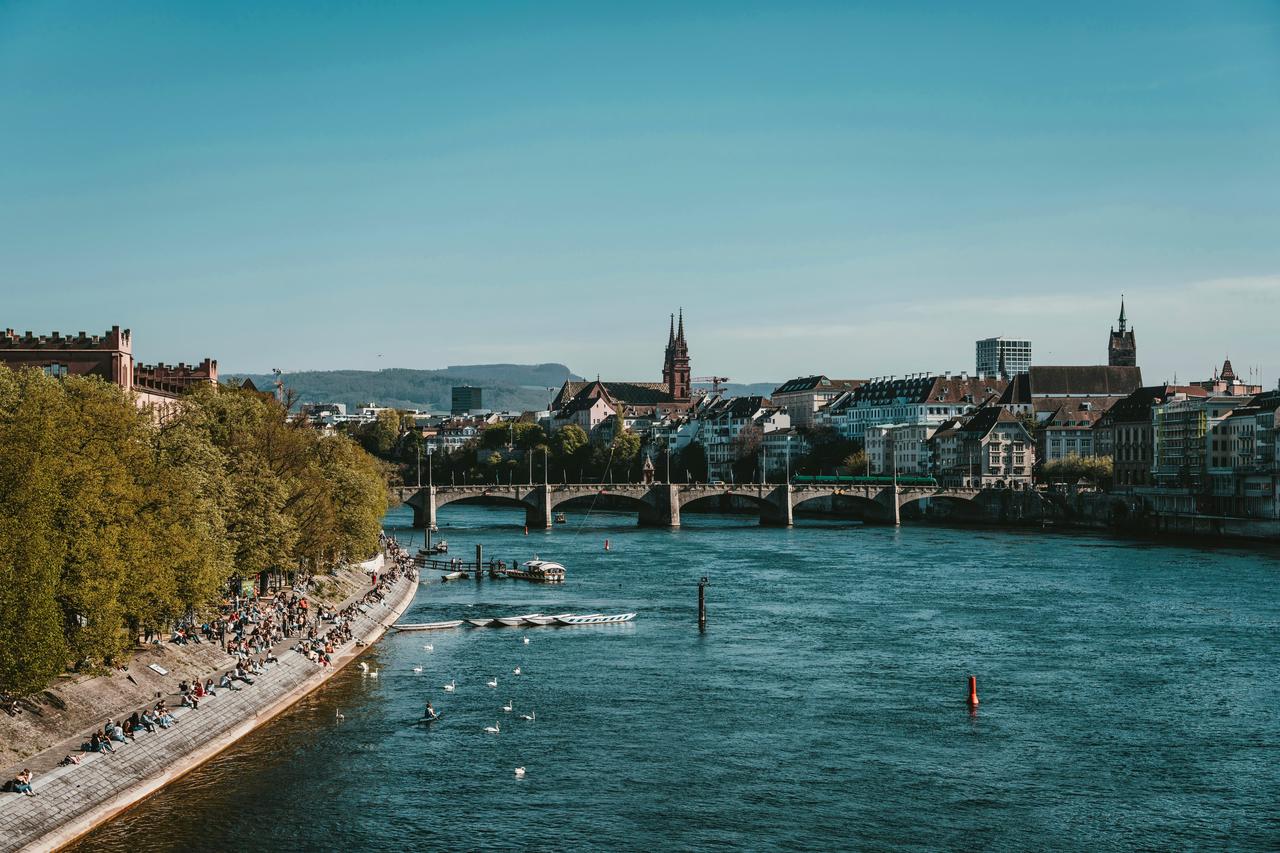
Basel sits where Switzerland meets Germany and France, a tri-border city that punches well above its weight in culture, science, and quality of life. Home to global pharmaceutical giants Novartis and Roche, a world-renowned art fair, and the Rhine River cutting through its heart, Basel draws researchers, creatives, and professionals who want a smaller city with outsized international character.
The city has a distinctly different feel from Zurich or Geneva — more relaxed, more compact, and deeply proud of its local identity. Swiss German (specifically Baseldytsch) is the everyday language, though English is common in pharma and research circles. Basel rewards those who engage with the local culture rather than staying in an expat bubble.
Basel at a Glance

- Population
- 175,000 (metro area ~540,000)
- Region
- Canton of Basel-Stadt, northwestern Switzerland
- Known For
- Pharmaceuticals (Novartis, Roche), Art Basel, Rhine River
- Average Rent (1BR)
- CHF 1,400–2,000/month
- Average Salary
- CHF 5,800–7,500/month net
- Expat Community
- Large — strong international pharma and research presence
Why Move to Basel
- Pharmaceutical capital: Novartis and Roche are headquartered here, along with hundreds of biotech and life-science spinoffs, creating a deep job market for researchers, engineers, project managers, and healthcare professionals.
- Cultural wealth: Art Basel (the world's premier art fair), the Fondation Beyeler, and over 40 museums make it Switzerland's most museum-dense city relative to its size. Basel punches far above its weight culturally.
- Tri-border convenience: Living in Basel means easy access to Germany (Weil am Rhein, Lörrach) and France (Huningue, Saint-Louis), expanding housing options, shopping opportunities, and weekend destinations.
- Rhine lifestyle: Swimming in the Rhine during summer — drifting downstream with the current in a Wickelfisch waterproof bag — is a uniquely Basel tradition that defines the city's quality of life.
- Compact and walkable: The city center is manageable on foot. Most neighborhoods are within 20 minutes of each other by tram.
Finding Housing in Basel
Average Rents
| Neighborhood | 1-Bedroom | 3-Bedroom | Character |
|---|---|---|---|
| Gundeldingen | CHF 1,400–1,800 | CHF 2,400–3,200 | Up-and-coming, diverse, good tram links to campuses |
| St. Alban | CHF 1,700–2,200 | CHF 2,800–3,800 | Leafy, near the Rhine, family-friendly |
| Matthäus | CHF 1,300–1,700 | CHF 2,200–3,000 | Central, multicultural, younger crowd |
| Clara | CHF 1,400–1,900 | CHF 2,400–3,300 | Near SBB station, lively nightlife and restaurants |
| Bruderholz | CHF 1,500–2,000 | CHF 2,600–3,500 | Elevated residential area, quieter, greener |
| Kleinbasel (Kleinriehen) | CHF 1,200–1,600 | CHF 2,000–2,800 | Affordable, across the Rhine, authentic local feel |
How to Find Housing
- Homegate.ch: Switzerland's largest portal with extensive Basel listings.
- ImmoScout24.ch: Good coverage of rental and purchase options across the city.
- Local agencies: Wincasa, Livit, and real estate offices along Greifengasse and Aeschenvorstadt offer curated listings.
- Marktplattform / Ron Orp Basel: Community boards with shared housing, sublets, and furnished rentals.
- FlatFox: Growing platform popular for direct landlord listings without agency fees.
Tips for Expats
- Prepare a complete Mieterdossier (renter's dossier) before you start applying: ID, work contract, salary proof, debt extract (Betreibungsauszug), and references from previous landlords.
- Competition is fierce near the Novartis and Roche campuses — start your search early and be ready to view and sign within days.
- Living across the border in Germany (Lörrach, Weil am Rhein) can cut rent by 30–50%, but commuting rules, health insurance requirements, and tax implications differ. Research carefully before committing.
- Basel has a strong housing cooperative scene (Genossenschaften). They offer below-market rents with long-term security, though waitlists can be long.
Neighborhoods Guide
- Gundeldingen: A favorite among young professionals and expats working in pharma. Converted industrial buildings, good restaurants along Dornacherstrasse, and quick tram access to the Novartis campus and Roche towers.
- St. Alban: One of Basel's most desirable residential areas. Quiet leafy streets, riverside walks, proximity to the Old Town, and close to the Fondation Beyeler in nearby Riehen. Family-friendly with high rent.
- Matthäus: Central and multicultural with a village-like feel despite its location near the SBB train station. Affordable dining, small independent shops, and a strong sense of community.
- Clara: The nightlife hub around Barfüsserplatz and Kaserne cultural center. Ideal for singles and couples who want to be in the middle of things. Diverse food scene.
- Bruderholz: A hilltop residential area popular with families. Calm, green streets, slightly cooler air in summer, and views over the city. Well-connected by bus but feels removed from the urban core.
- Kleinbasel (north bank of the Rhine): More affordable, edgier, and authentically Basel. The Claraplatz area has some of the city's best restaurants and bars. Klybeckquai is developing quickly with new waterfront projects.
Cost of Living in Basel
Monthly Budget Breakdown
| Category | Budget Range (CHF) |
|---|---|
| Rent (1BR, center) | 1,400–2,000 |
| Utilities | 130–180 |
| Internet | 50–65 |
| Groceries | 400–550 |
| Transport | 75–85 |
| Dining out (4x/month) | 180–300 |
| Leisure/Gym | 50–100 |
| Health insurance | 300–450 |
| Total | 2,585–3,730 |
Day-to-Day Costs
- Coffee: CHF 4.50–5.50
- Lunch (casual restaurant): CHF 18–25
- Monthly transport pass: CHF 80 (BVB)
- Beer (bar): CHF 6.50–8.00
- Cinema ticket: CHF 17–19
- Loaf of bread: CHF 2.80–4.00
- 12 eggs: CHF 6.00–7.50
- Monthly gym membership: CHF 50–100
Grocery Shopping Tips
Shop at Migros and Coop for everyday needs. Budget alternatives include Aldi and Lidl, which have multiple locations in Basel and are significantly cheaper. Cross-border shopping in Weil am Rhein (Germany) at Rewe or Kaufland can save 30–40% on many items. The Markthalle near SBB is great for fresh produce, international ingredients, and ready-to-eat meals.
Tips for Reducing Costs
- Choose a higher insurance deductible (franchise) of CHF 2,500 to lower monthly premiums significantly.
- Live in Kleinbasel or Matthäus for lower rents without sacrificing convenience.
- Cross-border grocery shopping in Germany is a major money-saver — many Basel residents make it a weekly routine.
- Use Migros and Coop loyalty cards for regular discounts and cashback on groceries.
- Consider a shared apartment (WG/Wohngemeinschaft) if you are single — it is common and affordable.
- Use free activities: swimming in the Rhine, cycling along the river paths, and visiting museums on free admission days.
- Monthly mobile plans from Salt or Sunrise start at CHF 20–30 for basic data — Swisscom is pricier but has the best coverage.
Getting Around Basel
- Public transport: BVB (Basler Verkehrs-Betriebe) operates an efficient network of trams and buses throughout the city. A monthly pass costs around CHF 80. The Basel Tarifverbund (BVT) zone system integrates trams, buses, trains, and cross-border routes into Germany and France.
- Cycling: Flat terrain along the Rhine and growing dedicated bike lanes make cycling practical. Rent a bike at Basel SBB station or use the PubliBike system at stations across the city.
- Driving: The city is compact and parking is limited and expensive. Many residents rely on public transport. Car-sharing services like Mobility are popular for occasional trips.
- Airport: EuroAirport Basel-Mulhouse-Freiburg (BSL/MLH) is 6 km northwest of the city. Budget airlines like EasyJet offer extensive European routes. Tram 2 connects directly to the terminal in about 20 minutes.
- Intercity: Basel SBB is a major Swiss rail hub. Zurich in 53 minutes, Bern in 56 minutes, Lucerne in 1 hour, Frankfurt in 2h 45min, and Paris in 3h by TGV Lyria.
Healthcare in Basel
- Hospitals/Clinics: University Hospital Basel (Universitätsspital Basel) is the leading public hospital and a major research center. Claraspital is a well-regarded private option. Felix Platter Spital specializes in geriatric care.
- English-speaking doctors: Widely available, especially near the Novartis and Roche campuses where international staff is common. Many GPs in St. Alban and Gundeldingen specifically list English as a service language. The University Hospital's international desk can help with referrals.
- Pharmacies: Apotheke (pharmacies) are found on nearly every major street. Many offer extended hours. The main station pharmacy at Basel SBB operates until late evening and on weekends.
- Emergency number: 144 (ambulance), 112 (European emergency), 117 (police), 145 (poison center).
- Health insurance: Basic health insurance (LaMal/KVG) is mandatory and must be arranged within three months of arrival. Monthly premiums in Basel range from CHF 300–450 depending on insurer and deductible.
Planning your move?
Tell us about your move to compare quotes from international moving companies.
Culture & Lifestyle
- Rhine swimming: In summer, locals swim with the current from Schaffhauserrheinweg down to the Tinguely Museum area. The Wickelfisch — a fish-shaped waterproof bag — keeps your belongings dry while you float. This is free, communal, and an essential Basel experience.
- Museums: Over 40 museums including Kunstmuseum (the world's oldest public art collection, established 1661), Fondation Beyeler in Riehen, Museum Tinguely (kinetic art), Historisches Museum Basel, and the Jean Tinguely–designed Carnival Fountain.
- Art Basel: The world's premier international art fair takes place every June at Messe Basel, drawing over 250 galleries and collectors from around the globe. The city transforms during fair week.
- Fasnacht: Switzerland's largest carnival erupts at 4 AM on the Monday after Ash Wednesday — three days of parades, lanterns, masks, and Guggenmusik (discordant brass bands). Basel's Fasnacht is Protestant (unlike Catholic carnivals elsewhere in Switzerland) and takes itself very seriously.
Food & Dining
- Basler Läckerli: Traditional spiced honey biscuit, a must-try local specialty. Buy them from Läckerli Huus.
- Mehlsuppe: A rich flour soup traditionally eaten during Fasnacht. Simple, warming, and deeply Basel.
- Best dining areas: Claraplatz (Kleinbasel) for international and modern Swiss cuisine, St. Johanns-Vorstadt for Michelin-starred restaurants (Chez Donati, Stucki), and the Markthalle near SBB for casual international food stalls.
- Budget options: Migros and Coop self-service restaurants, university Mensa canteens (open to public for a small surcharge), and Markthalle stalls with meals from CHF 12–18.
Expat Community
- InterNations Basel: Regular networking events, social groups, and activity clubs (running, hiking, wine tasting).
- Basel Area Business & Innovation: Offers orientation events, welcome services, and integration support for international professionals moving to the region.
- Language exchanges: Mundo Lingo Basel organizes multilingual social evenings. The Volkshochschule (VHS) runs Sprachcafé conversation groups for German practice.
- Pharma expat networks: Novartis and Roche both maintain internal expat networks and spouse/partner support groups for international transferees.
Job Market in Basel
- Main industries: Pharmaceuticals, life sciences, biotech, chemicals, finance, logistics (Rhine port), culture and arts.
- Major employers: Novartis, Roche, Lonza, Syngenta, Clariant, UBS, Swiss Post, University of Basel, University Hospital Basel.
- Average salaries by sector:
| Sector | Monthly Net (CHF) |
|---|---|
| Pharma/Biotech | 6,500–11,000 |
| Finance | 6,000–10,000 |
| University/Research | 4,500–7,500 |
| Healthcare | 5,000–8,000 |
| Hospitality | 3,500–5,000 |
| Technology/IT | 5,500–9,000 |
- Job search resources: jobup.ch, local.ch, Novartis and Roche career portals, LinkedIn, University of Basel job board, Basel Area Business & Innovation job listings.
Education in Basel
- International schools: International School of Basel (ISB, in Münchenstein), Swiss International School (SIS) Basel, eurécole.
- Universities: University of Basel (Switzerland's oldest university, founded 1460), FHNW University of Applied Sciences Northwestern Switzerland, Basel Academy of Art and Design.
- Language schools: Migros Klubschule (offers German, French, and other languages), VHS Basel (affordable integration courses), Berlitz Basel.
Banking and Finances
- Opening a bank account: Requires a valid passport and proof of Basel residence (registration confirmation). Banks include UBS, Kantonalbank Basel, and PostFinance. Many allow remote setup before arrival.
- AHV number: The social security number (AHV/AVS) is issued automatically when you register your residence with the local Einwohneramt.
- Taxes: Basel-Stadt has competitive cantonal tax rates compared to Geneva or Zurich. Residents are taxed on worldwide income at federal, cantonal, and municipal levels. Professional tax advice is recommended for the first year, especially if you have cross-border income.
Moving Checklist for Basel
- Apply for a visa or residence permit through the Swiss embassy or consulate.
- Confirm employment contract or proof of financial means.
- Compile a renter's dossier (ID, salary proof, debt extract, references).
- Obtain apostilled or legalized copies of key documents (birth certificate, marriage certificate, diplomas).
- Research health insurance providers — mandatory within 3 months of arrival.
- If working for Novartis or Roche, contact HR about relocation packages and housing support.
- Register at the Einwohneramt (residents' office) or Migrationsamt in your district within 14 days.
- Open a Swiss bank account (UBS, Kantonalbank Basel, PostFinance).
- Sign the rental contract and deposit the guarantee (usually 1–3 months' rent in a blocked account).
- Buy a Swiss SIM card (Swisscom for best coverage, Salt or Sunrise for cheaper plans).
- Familiarize yourself with tram and bus routes to your workplace.
- Enroll children in school or kindergarten (Kita).
- Register for German language courses if needed (VHS, Migros Klubschule).
- Purchase a BVB monthly or annual transport pass.
- Register with a local GP (Hausarzt) and dentist.
- Explore Kleinbasel and the Rhine — find your favorite swimming spot for summer.
Swiss Culture and Integration Tips
Swiss culture values punctuality, precision, and respect for rules. Being on time is not optional — it is a sign of respect. Quiet hours (Ruhezeit) are strictly observed, typically from 10 PM to 7 AM and all day Sunday. Noisy activities like drilling or vacuuming on Sundays are frowned upon and may draw complaints from neighbors.
Recycling is taken seriously. Switzerland has a detailed waste separation system — check your commune's guidelines for glass, paper, cardboard, metal, and organic waste. Unauthorized disposal can result in fines. You will need to buy official garbage bags (Kehrichtsack) which include a disposal fee.
Greeting people is important. Say Grüezi (Swiss German greeting) to neighbors, shopkeepers, and people in your building. It is a small gesture that signals you are making an effort to integrate.
On Sundays, nearly all shops are closed — plan grocery shopping for Saturday. Restaurants, gas station shops, and the Basel SBB station shop are the exceptions that remain open. The Roche cafeteria is also an option for employees on weekends.
Basel is more German-oriented than Geneva. English is common in pharma companies, research institutions, and among the expat community, but Swiss German (Baseldytsch) dominates daily life. Local government offices operate in German. Learning basic German is highly recommended for integration, dealing with authorities, and navigating everyday situations like shopping and healthcare.
Yes, many people live in Lörrach, Weil am Rhein (Germany), or Huningue (France) and commute daily. German border towns offer significantly lower rents — sometimes 30–50% cheaper. You need a cross-border commuter permit (Grenzgängerbewilligung, permit G) and will need to navigate different tax rules and health insurance requirements. The tram connects directly to Weil am Rhein.
Basel is smaller, more intimate, and culturally dense — more museums per capita than any Swiss city in the world. Zurich offers a larger job market, more nightlife, and a bigger international airport. Rent is slightly lower in Basel. Pharma and life-science professionals naturally gravitate to Basel; finance professionals tend toward Zurich. Both cities are within an hour of each other by train.
The BVB tram and bus network is efficient, reliable, and covers the city well. The Basel Tarifverbund (BVT) zone system also includes regional trains and cross-border routes into Germany (Bad Säckingen) and France (Mulhouse). A monthly pass costs around CHF 80. Trams run from approximately 5 AM to midnight, with extended night bus services on weekends.
Late spring (May–June) or early fall (September–October). The weather is pleasant, rental market is active, and you settle in before winter. Avoid late February if possible — Fasnacht celebrations dominate the city for several days, and many services slow down. Winter moves are manageable but cold and dark.
No. Basel is compact, relatively flat, and well-served by trams, buses, and trains. Most expats rely on public transport, cycling, and occasional car-sharing (Mobility is well-established). Parking in the city center is expensive and limited. If you want a car for weekend trips, car-sharing or rentals are more cost-effective than ownership.
The Markthalle is a former market hall near Basel SBB station that has been transformed into a food court with international stalls — Thai, Vietnamese, Italian, Mexican, Ethiopian, and more. It is a popular lunch spot for the pharma crowd and a social hub on weekend evenings. Meals typically cost CHF 12–20.
Swiss German (Baseldytsch) is the everyday language. Standard German (Hochdeutsch) is used in writing, official documents, and schools. French is widely understood due to the tri-border location. English is common in pharma companies and among expats. You can manage in English but German opens more doors.
Customs and Importing Belongings
All personal belongings must be declared upon arrival using Swiss customs form 18.44. If you move your main residence to Basel, used household goods and personal effects are typically exempt from import duties. New or high-value items may attract VAT at 8.1% or other applicable taxes. Having complete invoices and packing lists facilitates smooth customs clearance.
If shipping a vehicle, it must be declared at customs separately. Import duties and VAT apply unless the vehicle was owned for more than six months before import with proper documentation. Most EU/EEA driving licences can be exchanged for a Swiss equivalent within 12 months without retesting.
Bringing Pets to Basel
Pets must be microchipped and vaccinated against rabies with a valid EU or Swiss pet passport. Dogs must be registered with Basel local authorities within 10 days of arrival. Additional health protocols may apply depending on the country of origin. Basel has several dog parks along the Rhine, and dogs are welcome on public transport with a reduced-fare ticket.
Safety and Emergency Information
Basel is very safe by international standards. Violent crime is rare. The most common issue is bicycle theft — invest in a good lock. In emergencies, dial 144 for ambulance, 117 for police, or 112 for the European emergency line. The fire department can be reached at 118. Basel's hospital (Universitätsspital) has a 24-hour emergency department.
Related Guides
- [Moving to Switzerland] — comprehensive country guide
- [Moving to Zurich] — finance hub and largest city
- [Moving to Geneva] — international diplomacy center on Lake Geneva
- [Moving to Bern] — the Swiss capital with medieval charm