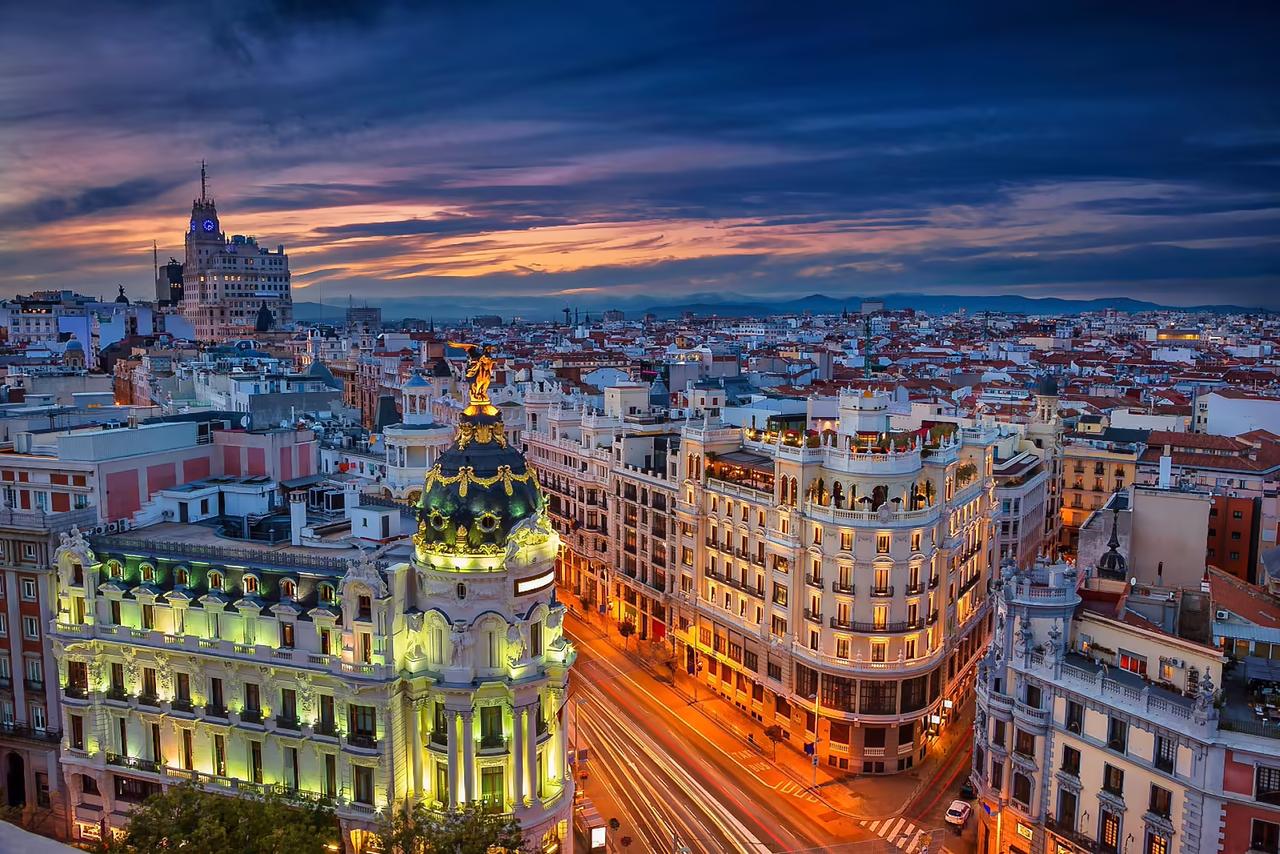
Madrid is Spain's capital and largest city — a sprawling metropolis that combines centuries of royal history with a fiercely modern creative and business scene. It sits at the geographic heart of the Iberian Peninsula, offering expats excellent transport links, world-class museums, and a cost of living lower than most Western European capitals.
Madrid at a Glance
- Population
- 3.3 million (city) / 6.8 million (metro area)
- Region
- Community of Madrid, central Spain
- Known For
- Prado Museum, Royal Palace, vibrant nightlife
- Average Rent (1BR)
- €1,100–€1,500 per month
- Average Salary
- €1,900–€2,400 net per month
- Expat Community
- Very large — over 500,000 foreign-born residents
- Language
- Spanish (Castellano)
- Climate
- Continental — hot dry summers (35°C+), cold winters (2–8°C)
Why Move to Madrid
- Career hub: Madrid is Spain's economic engine, home to the stock exchange, major banks, and the headquarters of most multinationals operating in the country.
- Cultural capital: The Prado, Reina Sofía, and Thyssen-Bornemisza form the "Golden Triangle of Art" — one of the finest museum clusters in the world.
- Central location: High-speed AVE trains reach Barcelona, Seville, and Valencia in under three hours; Madrid-Barajas Airport connects to 200+ destinations worldwide.
- Social life: From rooftop terraces in Malasaña to flamenco tablaos in Lavapiés, the city's social calendar never stops. Nightlife famously starts at midnight.
- Climate: Over 2,800 hours of sunshine per year with dry heat in summer and crisp, clear winters — snow is rare but possible in January.
- Transport excellence: One of Europe's best metro systems (13 lines) plus the comprehensive Abono monthly pass covering all zones.
Finding Housing in Madrid
Average Rents
| Neighborhood | 1-Bedroom | 3-Bedroom | Character |
|---|---|---|---|
| Salamanca | €1,400–€1,900 | €2,500–€3,500 | Upscale, luxury shopping, elegant boulevards |
| Chamberí | €1,100–€1,400 | €1,900–€2,600 | Central, family-friendly, traditional tapas bars |
| Malasaña | €1,000–€1,300 | €1,700–€2,300 | Trendy, nightlife, creative crowd |
| Retiro | €1,100–€1,500 | €1,900–€2,800 | Quiet, leafy, near the park |
| Lavapiés | €850–€1,150 | €1,450–€2,000 | Multicultural, affordable, lively street culture |
| La Latina | €950–€1,300 | €1,650–€2,400 | Historic, tapas bars, Sunday Rastro market |
How to Find Housing
- Idealista: Spain's dominant rental platform — set alerts for fast-moving listings in desirable neighborhoods.
- Fotocasa: Strong Madrid coverage with detailed filters and neighborhood heatmaps.
- Milanuncios: Classifieds site where private landlords list directly — often cheaper and avoids agency fees.
- Spotahome: Useful for furnished rentals with remote viewings before arrival.
- Agency fee: If using an agency, expect a fee of one month's rent plus 21% VAT — though a 2023 law shifts this cost to landlords in many cases.
Tips for Expats
- Expect a deposit of 1–2 months. Many landlords request proof of income equaling 2.5–3× the monthly rent.
- Competition is intense in September–October when the academic year starts. Begin searching at least four weeks before your target move date.
- Verify whether the apartment has air conditioning — Madrid summers regularly exceed 35°C.
- Check the building's age — pre-1960s apartments may lack central heating and elevators.
Neighborhoods Guide
- Salamanca: Madrid's most prestigious district. Wide, tree-lined streets, designer boutiques on Calle de Serrano, and Michelin-starred restaurants. Rents are the highest in the city but the area is clean, safe, and impeccably connected.
- Chamberí: A classic residential neighborhood popular with young professionals and families. Excellent metro coverage (four lines cross through), traditional markets like Mercado de Vallehermoso, and a strong sense of community.
- Malasaña: The creative heart of Madrid. Street art, independent boutiques, craft beer bars, and a buzzing nightlife scene make it ideal for younger expats and artists. Rents have risen but remain below Salamanca levels.
- Retiro: Built around the famous Parque del Buen Retiro, this district offers a quieter pace. Apartments tend to be older but spacious. Popular with families and professionals seeking green space within walking distance.
- Lavapiés: One of Madrid's most diverse neighborhoods. Affordable rents, international restaurants (Indian, Moroccan, Senegalese), and a grassroots cultural scene anchored by the Reina Sofía museum nearby. Some streets feel edgy but the area is transforming.
- La Latina: The oldest part of Madrid. Narrow lanes, centuries-old tapas bars, and the famous Sunday Rastro flea market. Rents are mid-range and the atmosphere is authentically Madrileño — especially on weekend afternoons.
Cost of Living in Madrid
Monthly Budget Breakdown
| Category | Budget Range |
|---|---|
| Rent (1BR, center) | €1,100–€1,500 |
| Utilities (electricity, water, gas, heating) | €120–€160 |
| Internet (fiber 300 Mbps+) | €30–€45 |
| Groceries | €250–€350 |
| Transport (Abono monthly pass) | €20–€55 (1) |
| Dining out (4x/month) | €80–€130 |
| Leisure/Gym | €30–€55 |
| Mobile phone plan | €10–€20 |
| Total | €1,720–€2,315 |
Day-to-Day Costs
- Coffee (café con leche): €1.50–€2.00
- Lunch (menú del día): €11–€15
- Monthly transport pass (Abono Zone A): €54.60 (unsubsidised; Comunidad de Madrid has offered discounted rates of ~€20–€30 recently — check current subsidies)
- Beer (bar, caña): €2.50–€3.50
- Cinema ticket: €8–€10
- Gym monthly membership: €30–€55
- Loaf of bread: €1.00–€1.50
Visa & Residency for Madrid
Spain offers several visa pathways for non-EU/EEA citizens:
- Work Visa: Requires a job offer from a Spanish employer. The employer initiates the process. Processing takes 1–3 months.
- Student Visa: For enrolled students. Allows part-time work up to 20 hours/week.
- Non-Lucrative Visa: For retirees or those with sufficient savings. No work allowed. Requires proof of income equal to 400% of IPREM (approximately €2,400+/month, indexed annually).
- Digital Nomad Visa (Ley de Startups): For remote workers employed by non-Spanish companies. Offers a special 24% flat tax rate for up to five years.
- EU Blue Card: For highly qualified professionals. Requires a degree and above-average salary.
- Entrepreneur Visa: For those launching innovative business projects in Spain.
Once in Spain, you'll need a NIE (Número de Identificación de Extranjero) for virtually all official transactions — opening bank accounts, signing leases, and registering for healthcare. Apply at the local police station or Extranjería office.
Tax Obligations
Tax residents (183+ days/year in Spain) are taxed on worldwide income. IRPF ranges from 19% to ~43.5% in Madrid (the 47% national top rate does not apply in the Community of Madrid). The Community of Madrid offers some of the lowest regional tax rates in Spain, which is a draw for high earners.
| Tax Component | Description | Rate |
|---|---|---|
| Income Tax (IRPF) | On worldwide income | 19%–43.5% progressive (Madrid) |
| Social Security | Mandatory contributions | ~6.35% employee / ~30% employer |
| VAT (IVA) | On goods and services | 21% standard |
| Wealth Tax | On net assets (Madrid: 100% bonified) | 0% effectively |
Getting Around Madrid
- Public transport: One of Europe's best metro systems (13 lines, 300+ stations), plus 200+ bus routes and light rail (Metro Ligero). The Abono monthly pass (€54.60 Zone A; subsidised rate of ~€20 for under-26s) covers unlimited travel on metro, bus, and cercanías commuter trains — exceptional value.
- Cycling: BiciMAD public bike-share covers central neighborhoods with 260+ stations and 3,000+ bikes. Cycling infrastructure is expanding but still patchy outside the center.
- Driving: Heavy congestion and expensive parking make a car impractical for daily commutes. Madrid's low-emission zone (ZBE) restricts vehicles without eco-labels from the city center.
- Airport: Madrid-Barajas Adolfo Suárez (MAD), 12 km northeast. Metro Line 8 connects directly (€4.50–€6 supplement). Express bus runs 24/7 to Cibeles.
- Intercity: AVE high-speed rail to Barcelona (2.5 hrs), Seville (2.5 hrs), Valencia (1.5 hrs), Málaga (2.5 hrs). Bus hub at Estación Sur for budget intercity travel to smaller cities.
Healthcare in Madrid
- Hospitals/Clinics: Hospital Universitario La Paz, Hospital Gregorio Marañón, Hospital 12 de Octubre — major public hospitals with full specialties. Private options include Hospital Quirónsalud Madrid and HM Hospitales.
- English-speaking doctors: Readily available in private hospitals and international clinics. Public system has fewer English speakers; bring a Spanish-speaking friend for complex appointments.
- Pharmacies: Ubiquitous — look for the green cross. Over-the-counter medicines are affordable; prescriptions are subsidized for residents. Duty pharmacies (farmacias de guardia) operate 24/7 on rotation.
- Emergency number: 112 (pan-European), 061 for medical emergencies.
- Private insurance: Popular providers are Adeslas, Sanitas, MAPFRE, and Cigna Global. Costs range from €50–€150/month depending on age and coverage level.
Get a personalised relocation plan
Drop your email and we'll send a tailored checklist plus three quotes from vetted movers.
Culture & Lifestyle
- Museums: The Prado (European masters), Reina Sofía (Picasso's Guernica), and Thyssen-Bornemisza (private collection spanning centuries) — visit free during evening hours on select days.
- Nightlife: Madrid's nightlife is legendary. Clubs open at midnight and close at dawn. Key areas: Malasaña, Chueca, La Latina, and Sol. Spaniards typically pre-party at home (el pre) before heading out at 1–2 AM.
- Sports: Santiago Bernabéu (Real Madrid, newly renovated) and Wanda Metropolitano (Atlético Madrid) are world-class venues. Running in Casa de Campo or Retiro Park is a daily ritual for thousands of residents.
- Festivals: San Isidro (May — patron saint celebration), La Paloma (August), Pride (July — one of Europe's largest), and New Year's Eve at Puerta del Sol.
Food & Dining
- Must-try: cocido madrileño (chickpea and meat stew — a winter staple), bocadillo de calamares (squid sandwich at Plaza Mayor), churros con chocolate at Chocolatería San Ginés (open since 1894).
- Best dining areas: La Latina for tapas crawls, Lavapiés for international food, Malasaña for brunch, Salamanca for fine dining.
- Budget options: Menú del día at lunchtime is a Madrid institution — a full meal with bread and a drink for €11–€15 at nearly every neighborhood restaurant.
Expat Community
- Meetup groups: InterNations Madrid (one of the largest in Spain), Madrid Expat Social, and language exchange events at bars across the city run nightly.
- International organizations: American Club of Madrid, British Chamber of Commerce in Spain, French Chamber of Commerce.
- Language exchanges: Madrid Language Exchange, Mundo Lingo, and Conversation Exchange events run multiple nights per week in Chueca, Malasaña, and Sol.
Day Trips & Nearby Destinations
Madrid's central location makes it an excellent base for exploring Spain:
- Toledo: The "City of Three Cultures" — medieval Christian, Muslim, and Jewish heritage. 30 minutes by AVE. A UNESCO World Heritage Site.
- Segovia: Roman aqueduct, fairy-tale Alcázar, and roast suckling pig. 30 minutes by AVE.
- El Escorial: The massive Renaissance palace-monastery of Philip II. 1 hour by Cercanías train.
- Sierra de Guadarrama: Mountains north of Madrid for hiking, skiing (Navacerrada, Valdesquí), and fresh air. 45 minutes by car.
- Ávila: Complete medieval city walls, 90 minutes by train. Famous for chuletón (T-bone steak).
- Chinchón: A small town south of Madrid with a circular Plaza Mayor and anise liqueur. 50 minutes by bus.
Job Market in Madrid
- Main industries: Finance, technology, tourism, consulting, media, telecommunications, and public administration.
- Major employers: Telefónica, Banco Santander, BBVA, Iberia Airlines, Accenture, Deloitte, Amadeus IT, Repsol.
- Average salaries by sector:
| Sector | Annual Salary Range |
|---|---|
| IT / Software Development | €30,000–€50,000 |
| Finance / Accounting | €28,000–€55,000 |
| Marketing / Communications | €25,000–€40,000 |
| Hospitality / Tourism | €18,000–€25,000 |
| Engineering | €30,000–€50,000 |
| Education (language teaching) | €18,000–€28,000 |
- Job search resources: InfoJobs.net (Spain's largest job portal), LinkedIn, Tecnoempleo (IT-specific), Welcome Talent Spain, Glassdoor.
Education in Madrid
- International schools: International College Spain, The British Council School, American School of Madrid, Hastings School, Lycee Francais de Madrid.
- Universities: Universidad Complutense de Madrid (UCM, one of Spain's largest), Universidad Politécnica de Madrid (UPM — engineering), IE University (business), Carlos III, Autónoma de Madrid.
- Language schools: International House Madrid, Inhispania, Don Quijote, AIL Madrid — Spanish courses from beginner to advanced with DELE exam preparation.
Moving Checklist for Madrid
- Secure short-term accommodation (Airbnb or serviced apartment) for at least the first month
- Apply for the correct visa if you are a non-EU citizen — allow 2–3 months processing
- Get documents apostilled and translated into Spanish by a sworn translator
- Arrange private health insurance (required for visa applications and recommended for the first year)
- Research neighborhoods online and join Facebook expat groups for housing tips
- Register on the municipal census (empadronamiento) at your local district office — this is required for nearly everything
- Apply for your NIE at the nearest Extranjería office (book cita previa online well in advance)
- Open a bank account (Santander, BBVA, or online options like N26 or Revolut for initial setup)
- Purchase a Spanish SIM card (Movistar, Vodafone, Orange, or budget carriers like Digi)
- Register with the public healthcare system (if eligible through employment or social security)
- Set up utilities — electricity (Iberdrola/Endesa), water (Canal de Isabel II), gas (Naturgy), and internet (Movistar, Orange, Digi)
- Buy a monthly Abono transport card at any metro station
- Explore multiple neighborhoods before committing to a long-term lease
- Register with your home country's embassy or consulate
- Get a TIE card (foreigner ID card) if your visa duration exceeds 6 months
- Sign up for BiciMAD bike-share if you plan to cycle around the center
Related Guides
- [Moving to Spain] — comprehensive country guide
- [Moving to Barcelona] — Spain's second city guide
- [Moving to Valencia] — affordable Mediterranean alternative
- [Moving to Seville] — Andalusian culture guide