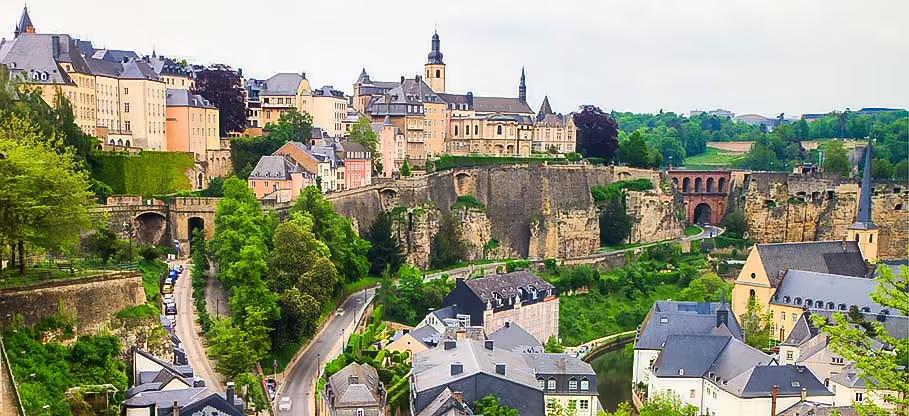

Planning your move to Luxembourg? This guide covers every practical step you need — from residency and work permits to housing, healthcare, banking, and daily life — so you can relocate with confidence to Europe's wealthiest and most international Grand Duchy.
Luxembourg is a tiny country of roughly 685,000 people that punches far above its weight. Home to major EU institutions, a world-class finance sector, and the highest average salaries in Europe, it attracts professionals from across the globe. The trade-off is steep: housing is among the most expensive on the continent, and the rental market is fiercely competitive. This guide gives you the realistic, up-to-date information you need to plan every stage of your relocation.
Luxembourg at a Glance

- Population
- ~686,000
- Capital
- Luxembourg City
- Currency
- Euro (EUR / €)
- Average Salary
- ~€70,000–€80,000/year (highest in EU)
- Language
- Luxembourgish (official), French, German; English widely spoken in business
- Climate
- Temperate maritime; mild summers (~20 °C), cold winters (~1 °C)
- Time Zone
- CET / CEST (UTC+1 / UTC+2 summer)
Why Move to Luxembourg in 2026
- Highest Salaries in Europe: Average gross salaries consistently top the EU rankings, making Luxembourg one of the most financially rewarding countries for skilled professionals.
- Strong, Diverse Job Market: Finance, EU institutions, tech, logistics, and legal services all offer plentiful opportunities for expats with the right qualifications.
- Free Public Transport: Since 2020, all public transport — buses, trams, and trains — is free for everyone, residents and visitors alike, nationwide.
- Exceptional Safety: Luxembourg has one of the lowest crime rates in Europe. Violent crime is rare, and day-to-day safety is excellent across the country.
- Trilingual, International Society: With Luxembourgish, French, and German as official languages and English widely used, you will find a remarkably multicultural environment — roughly half the population is foreign-born.
- EU & Finance Hub: Luxembourg City hosts the European Court of Justice, the European Investment Bank, and hundreds of banks and fund managers, creating a uniquely international professional environment.
Moving Costs to Luxembourg
Understanding the financial aspects of your move is crucial for proper planning. Costs depend on your origin, volume of goods, and shipping method.
| Origin | Estimated Cost Range | Container/Volume |
|---|---|---|
| UK / Western Europe | €1,500–€3,000 | 20ft container |
| Eastern Europe | €2,000–€3,500 | 20ft container |
| North America | €3,500–€5,500 | 20ft container |
| Asia / Middle East | €3,000–€5,000 | 20ft container |
| Air freight (any origin) | €1,000–€1,800 | 1–2 m³ |
Component Costs Explained
- Transportation: €800–€2,500 depending on distance, volume, and whether you use road freight (common within Europe) or sea freight.
- Insurance: €100–€300 for transit coverage. Always declare the full value of your belongings.
- Customs Clearance: €150–€350 for paperwork, inspection, and handling at the border.
- Packing Materials: €100–€250 for boxes, wrapping, and specialty containers.
- Storage (if needed): €50–€150 per month at secure facilities in Luxembourg City or near the border.
- Administrative Fees: €50–€150 for documentation, notarisation, and certificates.
Need a personalised estimate?
Get three vetted moving-company quotes in under 48 hours.
Visa & Residency Requirements
Luxembourg's immigration rules depend entirely on your nationality. EU/EEA citizens enjoy free movement, while non-EU nationals must navigate a work-permit-based system.
For EU/EEA and Swiss Citizens
EU, EEA, and Swiss nationals have the right to live and work in Luxembourg without a visa. However, you must register your arrival with the commune (Gemeng) of your new municipality within eight days. If you plan to stay longer than three months, you must then apply for a registration certificate (certificat d'enregistrement) from the Immigration Directorate of the Ministry of Foreign and European Affairs.
Key steps:
- Arrive in Luxembourg and find accommodation.
- Register at your local Gemeng (commune/municipal office) within 8 days.
- Apply for a registration certificate within 3 months if staying long-term.
- Provide proof of employment, self-employment, or sufficient financial resources.
For Non-EU Nationals: Main Work Permit Categories
Employee Work Permit (Autorisation de Travail pour Salarié)
- Requirements: A confirmed job offer from a Luxembourg employer. The employer must demonstrate that no suitable EU/EEA candidate was available for the role (labour market test), unless the occupation is on the shortage list.
- Processing time: 2–4 months.
- Duration: Typically 1–3 years, renewable.
- Key details: The employer initiates the application with the National Employment Agency (Agence pour le développement de l'emploi — ADEM). Once approved, the worker applies for a residence permit with the Immigration Directorate.
EU Blue Card (Carte Bleue Européenne)
- Requirements: A university degree or equivalent qualification, plus a job offer with a gross annual salary of at least the average gross annual salary in Luxembourg (€65,652 in 2026, per Ministerial regulation of February 2026).
- Processing time: 1–3 months.
- Duration: Up to 4 years; can lead to long-term EU resident status.
- Key details: Designed for highly skilled workers. Offers faster processing and easier mobility within the EU after 18 months.
Intra-Company Transfer (ICT) Permit
- Requirements: Employment with a multinational company transferring you to its Luxembourg office. Must hold a managerial, specialist, or trainee position.
- Processing time: 1–2 months.
- Duration: Up to 3 years for staff, 1 year for trainees.
- Key details: The transfer must be to the same company or a subsidiary. Salary and role must meet minimum thresholds.
Self-Employment Permit
- Requirements: A viable business plan, proof of investment capital, and relevant professional qualifications.
- Processing time: 3–6 months.
- Duration: 2 years initially, renewable.
- Key details: The business must demonstrably benefit the Luxembourg economy. Expect thorough scrutiny of your business plan.
Family Reunification
- Requirements: A family member already legally residing in Luxembourg can sponsor a spouse, minor children, and in some cases dependent parents. Proof of adequate housing and financial means is required.
- Processing time: 3–6 months.
- Duration: Matches the sponsor's residence permit.
Commune Registration (Gemeng)
Registering with your local commune is the single most important bureaucratic step after arriving in Luxembourg. It triggers your tax identification, social security enrolment, and establishes your legal residence.
Required Documents
- Valid passport or national ID card
- Proof of address (rental contract or property deed)
- Employment contract or proof of financial means
- Birth certificate (may need apostille and translation)
- Marriage or civil partnership certificate if applicable
- Passport-sized photographs (check commune requirements)
The Registration Process (Step-by-Step)
-
Secure accommodation
You need a signed lease or proof of ownership before you can register.
-
Visit your commune office
Go in person to the Bureau de la Population of your municipality within 8 days of moving in.
-
Submit documents
Present all required originals and copies. Staff will verify and record your details.
-
Receive a registration certificate
You will get a certificat d'inscription confirming your legal residence.
-
Apply for a social security number
Registration automatically enrols you in the social security system. Your CNS number will arrive by post within a few weeks.
Timeline: The commune registration itself is usually completed in a single visit. Your social security number (matricule) typically arrives within 2–4 weeks.
Finding Housing in Luxembourg
Luxembourg has one of the most expensive and competitive housing markets in Europe. Demand far outstrips supply, especially in and around Luxembourg City. Most expats rent, and finding a suitable apartment can take several weeks of dedicated searching.
Average Rents by Major City (2026)
| City | 1-Bedroom (Centre) | 3-Bedroom | Market Competitiveness |
|---|---|---|---|
| Luxembourg City | €1,800–€2,500 | €3,200–€4,800 | Extremely competitive |
| Esch-sur-Alzette | €1,200–€1,600 | €2,000–€2,800 | Competitive |
| Differdange | €1,100–€1,500 | €1,800–€2,500 | Moderate |
| Dudelange | €1,100–€1,500 | €1,800–€2,500 | Moderate |
| Ettelbruck | €1,000–€1,400 | €1,600–€2,200 | Less competitive |
Rent Terminology
- Loyer: The base rent before charges (equivalent to Kaltmiete or cold rent).
- Charges: Additional monthly costs for communal services — water, building maintenance, waste collection, and sometimes heating. Typically €150–€350 per month.
- Loyer charges comprises: The total rent including all charges (equivalent to Warmmiete or warm rent).
How to Find Housing
Online Platforms:
- Immotop.lu: The largest property portal in Luxembourg; most listings appear here first.
- Athome.lu: Another popular platform with a wide range of rental and purchase listings.
- Facebook Groups: Groups such as "Appartments/Rooms in Luxembourg" and "Expats in Luxembourg" regularly feature direct listings from landlords and departing tenants.
Local Resources:
- Estate agents (agents immobiliers): Useful if you want professional help, but note that agency fees typically equal one month's rent plus VAT.
- Commune notice boards: Some smaller municipalities still post available rentals locally.
Tips for Foreigners Finding Housing
- Start early: Begin your search 6–8 weeks before your planned move. Be prepared to commit quickly — good apartments are taken within days.
- Prepare a dossier: Have your employment contract, pay slips, ID, and proof of financial means ready to present at viewings.
- Budget for a deposit: Standard deposits are 2–3 months' rent, held in a blocked bank account (compte de garantie).
- Consider suburbs and neighbouring cities: Commuting from Esch-sur-Alzette, Differdange, or even across the Belgian or French border can save significantly on rent.
- Network: In Luxembourg's small market, personal referrals and expat community connections often lead to opportunities not listed publicly.
Rental Agreement & Legal Protection
Luxembourg has strong tenant protections. Lease agreements (contrat de bail) are typically for 1–3 years and automatically renew unless proper notice is given. The landlord must provide at least 6 months' notice to end a fixed-term lease. Tenants can usually terminate with 3 months' notice. Rent increases are regulated and must reflect actual changes in the cost-of-living index.
Warning: Rental Scams
Luxembourg's tight housing market has attracted scammers. Be wary of:
- Listings that seem unusually cheap compared to market rates.
- Landlords who request payment before you have seen the apartment in person.
- Requests to wire money abroad or pay via unusual methods.
- Always insist on viewing the property and signing a formal lease before transferring any funds.
Healthcare & Insurance
Luxembourg has a high-quality, mandatory health insurance system administered by the CNS (Centre Commun de la Sécurité Sociale). All residents must have health coverage, which is primarily public but supplemented by private insurance.
Public Health Insurance
CNS
- Cost: The total health contribution rate is 5.6% of gross salary, split equally between employee and employer — so your personal contribution is 2.8%. Self-employed individuals pay the full 5.6%.
- Coverage: Doctor visits, hospital stays, prescriptions, maternity care, dental (basic), rehabilitation, and medical devices.
- Eligibility: All residents employed or resident in Luxembourg are automatically enrolled through social security registration.
- Best for: The vast majority of expats. Public coverage is comprehensive and the standard route.
Private (Complementary) Health Insurance
- Cost: €50–€200 per month depending on coverage level and provider.
- Coverage: Private hospital rooms, enhanced dental and optical, alternative therapies, faster specialist access, and coverage outside Luxembourg.
- Eligibility: Available to all residents as a supplement to public insurance.
- Best for: Those wanting shorter waiting times, private rooms, or broader international coverage.
Top Insurance Providers
- LALUX: One of Luxembourg's largest insurers, offering a range of complementary health plans.
- DKV Luxembourg: Well-regarded for comprehensive supplementary health coverage.
- Foyer: A major local insurer with competitive complementary plans.
Getting Healthcare Coverage (Timeline)
-
Register with your commune and receive your social security number (matricule).
-
You are automatically enrolled with the CNS.
-
Receive your CNS card by post within 2–4 weeks.
-
Choose a GP (médecin traitant) and register with them — this is required for full reimbursement.
-
Optionally, take out complementary private insurance.
Out-of-Pocket Costs
- Doctor visits (GP): €30–€50; CNS reimburses approximately 80–88%.
- Prescriptions: Subsidised by CNS; typical co-pay is 20–40% of the medication cost.
- Dental: Basic care covered; cosmetic or advanced dental work often requires private insurance.
- Hospital stays: Covered by CNS; private room upgrades require complementary insurance.
Get a personalised relocation plan
Drop your email and we'll send a tailored checklist plus three quotes from vetted movers.
Banking & Finance
Opening a Bank Account
- When: As soon as you have proof of address. Some banks allow remote account opening with digital identity verification before you arrive.
- Required documents: Valid passport or national ID, proof of Luxembourg address (rental contract), employment contract or proof of income.
- Top banks for expats:
- BCEE (Banque et Caisse d'Épargne de l'État): State-owned savings bank with a wide branch network and competitive fees. Popular with residents for everyday banking.
- BGL BNP Paribas: One of the largest banks in Luxembourg, part of the BNP Paribas group. Full-service banking with strong digital tools and English-speaking staff.
- ING Luxembourg: Known for a streamlined app-based experience and straightforward account setup. Good for expats who prefer digital-first banking.
- Spuerkeess (BCEE): The same institution — Spuerkeess is the Luxembourgish trading name of BCEE. Reliable local institution with straightforward products and a strong reputation among long-term residents.
Credit Score System
Luxembourg does not have a formal credit scoring system like SCHUFA in Germany or FICO in the US. Banks assess creditworthiness based on income, employment stability, and existing financial commitments. There is no personal credit score to "build" — your financial reputation is based on your relationship with your bank and your income documentation.
Getting Your Social Security Number (Numéro Matricule)
- What it is: A unique 13-digit identification number used for all interactions with Luxembourg's social security, tax, and healthcare systems.
- When issued: Automatically generated after you register with your commune. Arrives by post within 2–4 weeks.
- Why you need it: Required for employment, tax filing, healthcare access, opening certain bank accounts, and nearly all administrative processes.
Bank Account Features & Costs
- Monthly fee: €0–€5 for basic accounts; premium accounts may cost €10–€15.
- Debit card: Typically included with the account at no extra charge.
- Credit card: €20–€50 per year, depending on the bank and card type.
- International transfers: Free or low-cost within SEPA. Non-SEPA transfers may cost €15–€30 per transaction.
Payment Culture
Luxembourg is largely cashless. Contactless payments (card and mobile) are the norm in shops, restaurants, and public services. Apple Pay and Google Pay are widely supported. That said, carrying some cash is sensible for smaller vendors and markets. ATMs (distributeurs automatiques) are plentiful.
Cost of Living in Luxembourg
Luxembourg is one of the most expensive countries in Europe, driven almost entirely by housing costs. Salaries, however, are the highest in the EU, which partially offsets the expense.
Monthly Budget Breakdown by City
| City | One-Person Budget | Family of 3 Budget | Cost Level |
|---|---|---|---|
| Luxembourg City | €2,200–€3,200 | €4,000–€5,500 | Very High |
| Esch-sur-Alzette | €1,600–€2,400 | €3,000–€4,200 | High |
| Differdange | €1,500–€2,200 | €2,800–€3,800 | High |
Detailed Cost Breakdown
Housing:
- 1-bedroom apartment (city centre): €1,800–€2,500
- 3-bedroom apartment: €2,800–€4,800
- Utilities (electricity, heating, water, waste): €150–€300
- Internet (broadband): €30–€50
Groceries & Food:
- Weekly groceries (1 person): €80–€120
- Restaurant meal (casual): €15–€25
- Restaurant meal (mid-range, 2 courses): €40–€70
Transportation:
- Public transport: Free (all buses, trams, trains nationwide)
- Car insurance: €600–€1,200 per year
- Fuel (per litre): €1.50–€1.80
Insurance & Healthcare:
- Complementary health insurance: €50–€200 per month
Leisure & Entertainment:
- Gym membership: €30–€60 per month
- Cinema ticket: €10–€14
- Streaming services: €10–€20 per month
Comparison with Other Countries
- vs Germany: Luxembourg is roughly 30–40% more expensive overall, mainly due to housing. Salaries are 40–60% higher.
- vs Belgium: About 25–35% more expensive; salaries are correspondingly higher.
- vs France: 20–30% more expensive, with a significant salary premium that often makes the net financial position better.
Language & Culture Tips
Do You Need to Speak Luxembourgish?
Luxembourg is a trilingual society: Luxembourgish is the national language, French is the dominant language in business, law, and daily commerce, and German is used in media and some administrative contexts. In practice, you can get by with French and English in most situations. However, learning some Luxembourgish is deeply appreciated and useful for social integration, dealing with commune offices, and understanding local culture.
Where English works: International companies, EU institutions, banking, tech, and among the expat community — English is widely spoken. Where English is less reliable: Small shops, older residents, commune offices (though most have staff who speak English), and some traditional businesses.
Luxembourgish Language Levels (CEFR)
- A1 (Beginner): Basic greetings, ordering food, simple directions. Achievable in 3–4 months of part-time study.
- A2 (Elementary): Everyday conversations, understanding commune notices, following basic instructions. 6–9 months.
- B1 (Intermediate): Following local news, participating in community events, workplace small talk. 12–18 months.
- B2 (Upper Intermediate): Professional discussions, understanding cultural references, fluent daily interaction. 2+ years.
Language Learning Resources
- LLO (Lëtzebuerger Online Dictionnaire): Free online Luxembourgish dictionary and learning platform run by the government.
- INL (Institut national des langues): Offers subsidised Luxembourgish courses at all levels for residents.
- Lingua.lu: Private language school offering Luxembourgish, French, and German courses tailored to expats.
- Spill Lëtzebuergesch app: A free government-backed app for learning Luxembourgish basics.
Cultural Norms & Etiquette
Multilingualism is the norm:
- Do not be surprised if someone switches between Luxembourgish, French, German, and English in a single conversation. This is entirely normal.
- Starting a conversation in French is usually safe; switching to English is fine in most professional settings.
Punctuality matters:
- Being on time is expected for both professional and social engagements. Arriving 5–10 minutes early is appreciated.
- If you are running late, a quick call or message is considered polite.
Reserved but warm:
- Luxembourgers can seem reserved at first, especially compared to Mediterranean or Anglo-Saxon cultures. Give relationships time.
- Invitations to someone's home are a meaningful sign of friendship. Bring a good bottle of wine or flowers.
Respect for rules and order:
- Luxembourg society values punctuality, cleanliness, and following regulations. Queue-jumping, littering, or noise violations are frowned upon.
Social Integration
- Join expat groups: Luxembourg has a very active expat community. Groups on Facebook, InterNations, and Meetup host regular social events.
- Volunteer: Volunteering is an excellent way to meet locals and integrate. Organisations like the Red Cross Luxembourg and various sports clubs welcome new members.
- Learn the languages: Even basic Luxembourgish goes a long way socially. French fluency is extremely useful for daily life.
- Attend local events: The Schueberfouer (annual fair), national day celebrations, and local Kiermes (parish fair) are great ways to experience Luxembourgish culture.
Moving Checklist
- Confirm job offer and work permit status (non-EU citizens)
- Research housing options and begin contacting landlords or agents
- Arrange international moving company and obtain quotes
- Begin gathering required documents (birth certificate, diplomas, marriage certificate — get apostilles and translations)
- Notify your current employer and authorities of your departure
- Sign a rental contract or confirm temporary accommodation
- Book your moving company and confirm dates
- Arrange health insurance — confirm CNS registration will happen via commune
- Open a Luxembourg bank account (some banks allow remote opening)
- Research schools if moving with children
- Cancel or transfer utilities, subscriptions, and services at your current address
- Confirm all travel arrangements
- Prepare a "dossier" for commune registration (originals and copies of all key documents)
- Ship or transport your belongings
- Arrange a temporary phone plan or eSIM for Luxembourg
- Final packing and declutter
- Confirm arrival details with your landlord
- Keep all essential documents, valuables, and a few days' essentials in your carry-on
- Take final meter readings at your current home
- Say goodbye — and save forwarding addresses for post
- Arrive in Luxembourg and collect keys
- Visit your local Gemeng (commune office) within 8 days to register
- Set up utilities and internet at your new home
- Register with a local GP (médecin traitant)
- Explore your neighbourhood — locate the nearest supermarket, pharmacy, and public transport stops
- Confirm commune registration is complete
- Begin the process for your CNS health card
- Set up your bank account if not done remotely
- Register your car (if applicable) or obtain your Luxembourg driving licence exchange
- Start learning basic Luxembourgish or French phrases
- Receive your social security matricule number
- Receive your CNS health insurance card
- Settle into your routine — commute, grocery shopping, daily life
- Join a local club, gym, or expat group
- Begin exploring Luxembourg's towns, nature, and cross-border neighbours
Driving and Vehicle Import
Exchanging Your Driving Licence
- EU/EEA licences: Can be exchanged for a Luxembourg licence without a test, but the exchange is mandatory if Luxembourg becomes your country of residence.
- Non-EU licences: Some licences can be exchanged directly (check the bilateral agreements). Others require a practical driving test. Licences from countries without an agreement with Luxembourg require both a theory and practical test.
Importing a Vehicle
- Vehicles imported from within the EU: No customs duty, but you must register the car with the Société Nationale de Circulation Automobile (SNCA) within 6 months.
- Vehicles from outside the EU: Customs duty and VAT may apply unless you can prove you owned and used the vehicle for at least 6 months before moving.
- Road tax (taxe de circulation) is based on engine size and CO₂ emissions.
Pet Relocation
Requirements for Bringing Pets to Luxembourg
- Microchip: ISO 11784/11785 compliant microchip is mandatory.
- Rabies vaccination: Must be administered at least 21 days before travel. The pet must be at least 12 weeks old.
- EU pet passport: Required for travel from EU countries. Non-EU pets need an EU animal health certificate issued by an official veterinarian in the country of origin.
- Tapeworm treatment: Required for dogs, administered 1–5 days before entry.
- Breed restrictions: Certain breeds may face additional requirements. Check with Luxembourg's veterinary services (Administration des services vétérinaires).
Taxes and Social Security
Income Tax
Luxembourg has a progressive income tax system with rates ranging from 0% to 42%. Tax classes determine your rate:
- Class 1: Single, no dependants.
- Class 2: Married or in a civil partnership (filing jointly).
- Class 1a: Single with children or single persons over 65.
Social security contributions (approximately 12–13% of gross salary for employees, split with employer) are deducted before income tax is calculated.
Tax Filing
- Tax returns are typically filed annually by 31 December of the year following the tax year (e.g., the 2025 tax return is due by 31 December 2026).
- The tax authority (Administration des contributions directes) sends pre-filled returns that you review and confirm or amend.
- Many expats use a tax advisor (conseil fiscal) for the first year, especially if they have income from multiple countries.
Avoiding Double Taxation
Luxembourg has double taxation agreements (DTAs) with over 80 countries. If you pay tax in Luxembourg on income earned here, you generally will not be taxed again on the same income in your home country. Seek professional advice to navigate the specifics.
Where to Find Tools and Resources
ReloAdvisor Tools:
- Volume calculator
- Video survey
- Moving cost calculator
Official Luxembourg Resources:
- Guichet.lu — Luxembourg's official one-stop-shop for all administrative procedures: guichet.lu
- Immigration Directorate — residence and work permits: mae.gouvernement.lu
- CNS — health insurance information: cns.lu
- ADEM — National Employment Agency: adem.lu
Expat Communities:
- InterNations Luxembourg: internations.org/luxembourg-expats
- Just Arrived — Expat guide for Luxembourg: justarrived.lu
- Facebook Groups: "Expats in Luxembourg," "Luxembourg Expats Forum"
Related Guides:
- Moving to Germany
- Moving to Belgium
- Moving to France