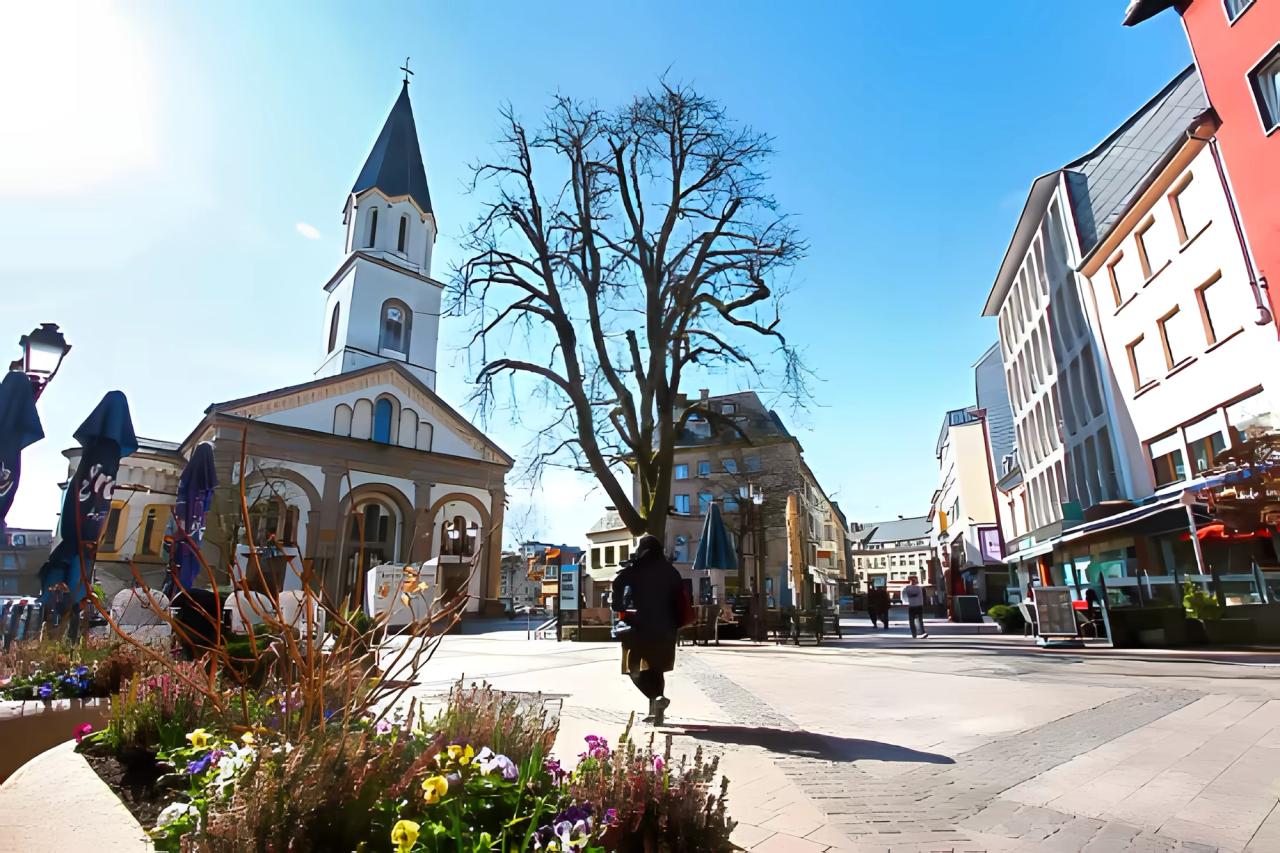

Ettelbruck sits at the confluence of the Sûre (Sauer), Wark, and Alzette rivers in northern Luxembourg, serving as the principal commercial and administrative hub of the Ëlzewelt (Éislek) region. With roughly 10,000 residents, it punches well above its weight: a major railway junction, a hospital campus, a respected technical lycée, and the annual Foire Agricole that draws visitors from across the country. Expats choose Ettelbruck for rents roughly 30-40% below Luxembourg City, a 30-minute train commute to the capital, and immediate access to the Ardennes landscape. It suits cross-border commuters, families wanting space and nature, and anyone who prefers a small-town rhythm without giving up solid infrastructure.
Ettelbruck at a Glance

- Population
- ~10,000 (commune); ~22,000 in the broader Nordstad functional area
- Region
- Canton of Diekirch, Ëlzewelt / Éislek (Luxembourg Ardennes)
- Known For
- Regional transport hub, Centre Hospitalier du Nord (CHdN), Foire Agricole, General Patton Memorial Museum
- Average Rent (1BR)
- €800–€1,100
- Average Salary
- ~€4,200/month net (aligned with national average; local jobs may trend slightly lower)
- Expat Community
- Small but growing; largely French, German, Belgian, and Portuguese nationals working in healthcare, education, and logistics
Why Move to Ettelbruck
- Affordable by Luxembourg standards: Rents run 30-40% cheaper than comparable apartments in Luxembourg City, with more square meterage per euro.
- Fast capital connection: CFL trains reach Luxembourg City in around 30 minutes, making daily commuting realistic without a car.
- Gateway to the Éislek: Hiking trails, Bourscheid Castle, the Mullerthal Trail, and the Our and Sûre river valleys are all within a short drive.
- Regional services on your doorstep: The CHdN hospital campus, multiple supermarkets, specialist shops, and secondary schools mean you rarely need to leave town for essentials.
- Genuine community feel: With a population under 10,000, neighbours know each other, local associations are active, and the pace of life is noticeably calmer than the capital.
Visas and Residency
Luxembourg handles immigration at the national level, so the process is the same whether you settle in Ettelbruck or the capital. EU/EEA/Swiss citizens may move freely but must complete a Déclaration d'arrivée (declaration of arrival) at the local Administration Communale (communal administration office) within 90 days of establishing residence. Non-EU nationals need a temporary authorisation to stay from the Ministry of Foreign Affairs before arriving, followed by a residence permit application after entry. Proof of accommodation in Ettelbruck, sufficient income, and health-insurance coverage are required in both cases. The Ettelbruck Administration Communale is located on Place de l'Hôtel de Ville and handles all registration appointments.
Finding Housing in Ettelbruck
Average Rents
| Neighborhood | 1-Bedroom | 3-Bedroom | Character |
|---|---|---|---|
| Centre-Ville | €900–€1,150 | €1,500–€1,900 | Apartments above shops, walking distance to station and market square |
| Gare (Station Quarter) | €800–€1,050 | €1,350–€1,750 | Mix of newer builds and converted houses near CFL station |
| Warken | €750–€1,000 | €1,300–€1,650 | Quiet residential streets, family houses with gardens, slight hill |
| Nord / Bebbour | €700–€950 | €1,250–€1,600 | Green outskirts, detached homes, popular with families |
| Schieren (adjacent commune) | €700–€900 | €1,200–€1,500 | Village atmosphere across the river, short drive or bus to town centre |
How to Find Housing
- Athome.lu and Immotop.lu: The two dominant Luxembourg property portals. Filter by postcode L-9080 for Ettelbruck-specific listings.
- Wort Immo: The classifieds section of the daily newspaper Luxemburger Wort; older listings but sometimes landlord-direct.
- Administration Communale notice board: The communal office occasionally posts local rental notices, especially for apartments in municipally owned buildings.
- Word of mouth: In a town this size, letting agents and landlords often fill vacancies through personal networks before advertising online. Ask colleagues at work or the school.
Tips for Expats
- Landlords require proof of income (typically the last three pay slips or a work contract) and a security deposit of one to two months' rent, held in a blocked bank account.
- Furnished apartments are less common than in Luxembourg City; budget for basic furnishings or negotiate inclusion.
- Rental contracts in Luxembourg typically run for a minimum of one year with three months' notice. Shorter lets exist but command a premium.
- Google Maps street view is less comprehensive for Ettelbruck's residential side streets than for the capital; visit in person before signing.
Neighborhoods Guide
- Centre-Ville: Best for singles and couples who want to walk everywhere. Close to the market square (Place du Marché), shops, restaurants, and the CFL station. Apartments tend to be smaller and older but have character. Rent is the highest in town but still modest by national standards.
- Gare (Station Quarter): Ideal for daily commuters to Luxembourg City. A mix of small apartment blocks and townhouses within a ten-minute walk of the platforms. Slightly more affordable than the centre and well served by RGTR regional buses.
- Warken: The largest residential quarter, stretching south from the centre. Popular with families for its quieter streets, larger homes, and proximity to the Lycée technique d'Ettelbruck. The area climbs gently uphill, so some addresses have open views over the Alzette valley.
- Nord / Bebbour: The green northern fringe where detached houses with gardens are the norm. Suited to families wanting outdoor space and those who do not mind a short drive or bus ride into town. Rents are the lowest in the commune.
- Schieren (adjacent): Technically a separate commune across the Alzette river, but functionally part of the Ettelbruck urban area. Ultra-quiet, very affordable, and connected by a single RGTR bus line. Good for budget-conscious renters who work from home.
Cost of Living in Ettelbruck
Monthly Budget Breakdown
| Category | Budget Range |
|---|---|
| Rent (1BR, centre) | €900–€1,150 |
| Utilities (electricity, water, heating) | €150–€220 |
| Internet + mobile | €40–€65 |
| Groceries | €300–€450 |
| Transport (national public transport is free) | €0 |
| Dining out (4x/month) | €80–€160 |
| Leisure / gym / sports | €40–€80 |
| Health insurance contribution (CNS) | deducted at source (~3.05% of salary) |
| Total (excl. rent) | €610–€975 |
Day-to-Day Costs
- Coffee: €2.50–€3.50
- Lunch (daily special at a local café): €12–€18
- Monthly transport pass: free (all public transport in Luxembourg is fare-free since 2020)
- Beer (bar): €4–€6
- Cinema ticket (Ciné-Cité Diekirch, nearest multiplex): €10–€12
Banking
Opening a Luxembourg bank account is straightforward. Bring a valid passport or ID card, proof of Ettelbruck address (rental contract or Attestation d'hébergement from your landlord), and a recent pay slip or work contract. Major banks with branches in or near Ettelbruck include BGL BNP Paribas, Spuerkeess (BCEE), and POST Luxembourg. Most offer English-language online banking. A Luxembourg bank account is required for salary deposits and for setting up the blocked deposit account that landlords require.
Your matricule (social-security number) is issued automatically when you register for employment or as a resident with the Centre Commun de la Sécurité Sociale (CCSS). Your employer typically handles this registration, but self-arriving expats should contact the CCSS directly after registering at the Administration Communale.
Get a personalised relocation plan
Drop your email and we'll send a tailored checklist plus three quotes from vetted movers.
Getting Around Ettelbruck
- Public transport: All public transport in Luxembourg is free. CFL trains from Ettelbruck station run to Luxembourg City (approx. 30 min), Diekirch (10 min), Kautenbach (15 min, with connections to Liège-Guillemins in Belgium), and Wiltz (25 min). RGTR regional buses (lines 120, 137, 155, and others) link Ettelbruck to surrounding villages and Diekirch.
- Cycling: Ettelbruck connects to national cycle route PC16, which follows the Sûre valley. The town centre is compact and mostly flat, making short errands easy by bike. Dedicated bike lanes are limited but traffic is light.
- Driving: Parking in the centre is generally easy and inexpensive compared to the capital. The N7 and N15 national roads connect Ettelbruck to the A7 motorway (E421), linking south to Luxembourg City and north to the Belgian border at Troisvierges.
- Nearest airport: Luxembourg Findel Airport (LUX) is about 35 minutes by car or 45 minutes by train-plus-bus. Alternatively, Liège Airport (LGG) in Belgium is roughly 90 minutes north.
- Intercity: CFL Ettelbruck is a junction station. Direct trains serve Luxembourg City, Diekirch, Wiltz, and Kautenbach (for Liège connections). Bus routes extend to Vianden and Echternach.
- Car sharing and taxis: CFL operates a Flexibus on-demand service in the Nordstad region for evening and weekend trips. Local taxi firms serve the hospital and station. The national car-sharing platform Copilot is available for occasional vehicle needs.
Healthcare in Ettelbruck
- Centre Hospitalier du Nord (CHdN) — Ettelbruck campus: The town's hospital is one of four CHdN sites in northern Luxembourg. It offers emergency services, surgery, maternity, and outpatient clinics. The main CHdN administrative headquarters are also in Ettelbruck.
- General practitioners: Several GP practices operate in the town centre and Warken quarter. English-speaking doctors are available but not universal; ask at the reception or check the CNS provider directory.
- CNS (Caisse Nationale de Santé): Luxembourg's public health-insurance fund. Registration is automatic when you start employment. The CNS reimburses approximately 85-90% of standard medical costs. Many residents also take out supplementary insurance (mutuelle) to cover the remaining co-pays and extras such as dental work or private hospital rooms.
- Pharmacies: Two pharmacies serve the commune (Pharmacie Centrale on Grand-Rue and Pharmacie du Nord near the hospital). Luxembourg pharmacies operate a night and weekend on-call rota; the duty pharmacy is listed on the door of every pharmacy and online.
- Emergency number: 112 (pan-European). For the CHdN Ettelbruck emergency department, call +352 26 33 31.
Education in Ettelbruck
- Primary schools: Ettelbruck has several fundamental schools (enseignement fondamental) covering cycles 1–4 (ages 3–12). Instruction is in Luxembourgish with German and French introduced progressively. The Administration Communale can advise on school-zone assignments.
- Lycée technique d'Ettelbruck (LTE): The main secondary institution, offering technical and vocational programmes from classes inférieures through BTS (brevet de technicien supérieur). Strong programmes in mechanics, electronics, and business. Some modules are taught in French or German.
- International options: Ettelbruck does not have its own international school. Families seeking English-language or European-curriculum schooling typically commute to the European School Luxembourg II in Bertrange/Mamer (about 40 min by car) or the International School Michel Lucius in Luxembourg City.
- Adult language courses: The National Language Institute (INL) runs Luxembourgish, French, and German courses across the country, including at regional centres in the north. The commune occasionally organises free Luxembourgish conversation evenings for newcomers.
- Childcare (Maison Relais): Ettelbruck has a Maison Relais (state-subsidised after-school and holiday childcare) and several crèches. Spaces fill quickly; register as early as possible through the Administration Communale.
- University: There is no university campus in Ettelbruck. The University of Luxembourg (Belval campus) is reachable in about 50 minutes by train via Luxembourg City.
Culture and Lifestyle
- Foire Agricole d'Ettelbruck: Held every July, this is Luxembourg's largest agricultural fair, showcasing livestock, horticulture, regional food, and fairground attractions. It transforms the town for a long weekend and draws tens of thousands of visitors.
- General Patton Memorial Museum: Located in the former cavalry barracks, the museum covers the 1944 Battle of the Bulge with a focus on General Patton's Third Army and the liberation of Ettelbruck. A key stop on Luxembourg's WWII trail.
- Outdoor recreation: The Éislek region surrounding Ettelbruck is criss-crossed by marked hiking and mountain-biking trails. Bourscheid Castle, one of Luxembourg's most dramatic medieval ruins, is a 15-minute drive north. The Mullerthal Trail (Little Switzerland) starts about 25 km east.
- Diekirch next door: The neighbouring brewery town is a ten-minute train ride away and home to the National Museum of Military History and the Diekirch brewery (known for its Export brand). The two towns function as a single urban area for day-to-day purposes.
- Weekly market: Ettelbruck holds a weekly outdoor market (typically Saturday mornings) on and around Place du Marché, selling fresh produce, bread, cheese, and flowers from local farms. It doubles as a social gathering point and a good way to meet neighbours.
- Annual calendar highlights: Beyond the Foire Agricole in July, the town hosts a Christmas market in December, a carnival procession (Fuesent) in February or March, and summer concerts in the park near the Alzette riverbank. The cultural calendar is modest compared to the capital but consistently well attended.
Food and Dining
- Local staples include Judd mat Gaardebounen (smoked pork neck with broad beans), Kachkéis (soft cheese spread), and Gromperekichelcher (potato fritters) at the weekly market.
- Grand-Rue and Place du Marché host the majority of restaurants, ranging from Luxembourgish and French bistros to Italian and Portuguese options reflecting the local expat population.
- Budget-friendly lunch specials (plat du jour) at around €12–€15 are common at mid-range restaurants and at the lycée canteen (open to staff and visitors).
- The Cactus and Auchan supermarkets on the outskirts of town stock international products, but for specialist ingredients (Asian, Middle Eastern, or gluten-free) you may need to order online or visit larger stores in Luxembourg City.
- Diekirch's café scene, a short train hop away, offers additional dining variety including a craft-beer bar at the brewery itself.
Expat Community
- Ettelbruck's expat scene is smaller and less formalised than in the capital. Most social connections form through the workplace (particularly the hospital and the lycée), children's schools, and sports clubs.
- The Nordstad region has active running clubs, a football club (FC Etzella Ettelbruck), and a shooting club (Société de Tir), all of which welcome new members regardless of nationality.
- The Integration and Citizenship Office at the Administration Communale organises welcome events for new residents, including guided town walks and information sessions in French, German, and English.
- For a larger expat network, many Ettelbruck residents participate in Luxembourg City-based groups (Meetup, International Women's Club, etc.) and attend events in the capital on weekends.
Job Market in Ettelbruck
- Main industries: Healthcare, public administration, education, retail, agriculture and agri-tech, logistics.
- Major employers: Centre Hospitalier du Nord (CHdN), Administration Communale d'Ettelbruck, Lycée technique d'Ettelbruck, CFL (railway infrastructure), and regional branches of national retailers.
- Commuting pattern: A significant share of working residents commute south to Luxembourg City or the Kirchberg business district by train. Cross-border commuters from Belgium and Germany also pass through Ettelbruck daily.
| Sector | Approx. Monthly Net Salary |
|---|---|
| Healthcare (nurse, CHdN) | €3,500–€4,500 |
| Public administration | €4,000–€5,500 |
| Teaching (secondary) | €4,200–€5,800 |
| Retail / hospitality | €2,500–€3,200 |
| IT (commuting to capital) | €4,500–€6,500 |
- Job search resources: ADEM (Administration de l'Emploi) has a regional office covering the north. Jobs.lu, Indeed Luxembourg, and the Luxembourg government's GOVJOBS portal list positions across the country. For healthcare roles specifically, the CHdN website posts vacancies directly.
Pros and Cons of Living in Ettelbruck
Pros
- Rents 30-40% cheaper than Luxembourg City with more living space.
- Excellent train connection to the capital (30 minutes, free).
- Direct access to the Ardennes countryside for hiking, cycling, and weekend exploration.
- Full hospital and secondary-school infrastructure means no need to travel for basics.
- Genuinely low stress and low noise compared to the capital region.
- Strong sense of local identity and active community associations.
Cons
- Limited nightlife and entertainment; most evenings are quiet.
- No international school in town; families need to commute south.
- Smaller expat community can feel isolating at first.
- Fewer dining and shopping options than Luxembourg City or Esch-sur-Alzette.
- Car ownership is still helpful for errands in surrounding villages and for weekend trips.
- Winter weather in the Éislek can be noticeably colder and wetter than in the south of the country.
Moving Checklist for Ettelbruck
- Confirm passport validity (at least six months beyond your planned arrival date).
- Non-EU nationals: apply for a temporary authorisation to stay via the Luxembourg Ministry of Foreign Affairs.
- EU/EEA nationals: prepare valid ID or passport; no visa required but bring proof of employment or self-sufficiency.
- Research and book a removal company familiar with Luxembourg; request quotes via ReloAdvisor for volume-based pricing.
- Arrange pet travel documents (EU pet passport, microchip, rabies vaccination) if applicable; Luxembourg follows standard EU pet-entry rules.
- Request a certificate of deregistration from your current country of residence (if applicable).
- Gather apostilled copies of birth certificates, marriage certificates, and diplomas.
- Arrange initial health-insurance coverage valid from your arrival date (travel insurance or early CNS registration through your employer).
- Book temporary accommodation in Ettelbruck for your first two to four weeks while flat-hunting.
- Register at the Administration Communale d'Ettelbruck (Place de l'Hôtel de Ville) and complete your Déclaration d'arrivée (declaration of arrival). Bring your ID, rental contract or host's attestation, and proof of income.
- Open a Luxembourg bank account (BGL BNP Paribas, Spuerkeess, or POST Luxembourg). Bring ID and proof of address.
- Visit the CHdN Ettelbruck campus or a local GP to register with a primary-care doctor.
- If you have children, contact the Administration Communale's school-service desk to enrol them in the appropriate fundamental school cycle.
- Set up a Luxembourg mobile number (POST, Tango, or Orange; available at the Ettelbruck shopping centre).
- Receive your matricule (social-security number) from the CCSS; confirm CNS health-insurance activation with your employer.
- Complete the three-month commune registration to formalise your legal residence.
- Exchange your foreign driving licence at the SNCA (Société Nationale de Circulation Automobile) in Sandweiler if required (EU licences within one year; some non-EU licences within one year with possible test).
- Register for Luxembourgish language classes through INL or the commune's integration programme.
- Set up utility accounts if not included in your rent (electricity via Enovos or Sudstroum, internet via POST or Tango).
- Purchase a bicycle for local errands (cycle route PC16 connects to the national network).
- Explore the Ettelbruck and Diekirch town centres on foot to locate your nearest pharmacy, bakery, post office, and the CFL station.
- Visit the General Patton Memorial Museum to understand the town's WWII history and orient yourself with the local street layout.
- If you imported a vehicle, register it with the SNCA and obtain Luxembourg plates (required within six months for residents).
Related Guides
- Moving to Luxembourg — comprehensive country guide with visa, tax, and residency details
- Moving to Luxembourg City — the capital, 30 minutes south by train
- Moving to Esch-sur-Alzette — Luxembourg's second city, with a larger industrial base