
Galway sits on Ireland's wild west coast, facing directly out to the Atlantic. Known as Ireland's cultural capital, the city pulses with live music, street performance, and a festival calendar that runs year-round. The Spanish Arch marks the edge of the medieval old town, Salthill's promenade draws walkers every evening, and Connemara's raw landscape begins just beyond the city limits. Expats choose Galway for its creative energy, strong university presence, and a quality of life that trades big-city salaries for genuine community and scenery. If you want an Irish city that feels alive in every pub and on every corner, Galway is it.
Galway at a Glance
- Population
- ~85,000 (Greater Galway Area ~120,000)
- Region
- Connacht, west coast
- Known For
- Arts and music, Spanish Arch, gateway to Connemara
- Average Rent (1BR)
- €1,300–€1,600
- Average Salary
- ~€41,000 per year (net ~€2,750/month)
- Expat Community
- Strong; large student population, growing international community
- Climate
- Mild Atlantic; winters 4–9°C, summers 13–19°C
- Language
- English and Irish (bilingual signs, Gaeltacht areas nearby)
- Currency
- Euro (€)
Why Move to Galway
- Cultural heartbeat: Galway has more live music venues, theatres, and festivals per capita than anywhere else in Ireland. The Galway International Arts Festival (July), Races week (late July/early August), Macnas Halloween parade, Cúirt Literature Festival, and Galway Film Fleadh fill the calendar year-round.
- Gateway to Connemara: Some of Europe's most dramatic scenery — mountains, lakes, bogland, and rugged Atlantic coastline — is on your doorstep. Kylemore Abbey, the Twelve Bens, and the Sky Road are all within an hour's drive.
- Compact and walkable: The entire city centre is walkable in 15 minutes. You can live car-free more easily here than in most Irish cities. Salthill's beach is a 20-minute walk along the promenade.
- Strong university presence: University of Galway (formerly NUIG, ranked in the global top 250) and Atlantic Technological University (ATU) bring research jobs, international students, and a youthful energy.
- Bilingual culture: Galway is the gateway to the Connemara Gaeltacht — Ireland's largest Irish-speaking region. Bilingual street signs and Irish-language cultural events add a distinctive character.
- Friendly reputation: Galway consistently ranks as one of Ireland's friendliest cities. Locals are known for striking up conversations and making newcomers feel welcome.
- Aran Islands: Three islands off Galway's coast — Inis Mór, Inis Meáin, and Inis Oírr — offer a glimpse into traditional Irish-speaking life. Ferries run daily from Rossaveal and you can visit as a day trip.
Finding Housing in Galway
Average Rents
| Neighborhood | 1-Bedroom | 3-Bedroom | Character |
|---|---|---|---|
| City Centre / Latin Quarter | €1,400–€1,700 | €2,200–€3,000 | Walkable, nightlife, Shop Street |
| Salthill | €1,300–€1,600 | €2,100–€2,800 | Seaside, promenade, families |
| Knocknacarra | €1,200–€1,400 | €1,800–€2,400 | Suburban, newer builds, quiet |
| Oranmore | €1,100–€1,400 | €1,700–€2,300 | Village feel, commuter-friendly |
| Newcastle / Dangan | €1,200–€1,500 | €1,900–€2,500 | Near university, mixed residents |
| Rahoon | €1,100–€1,350 | €1,700–€2,250 | Affordable, families, bus routes |
| Renmore | €1,200–€1,450 | €1,800–€2,400 | Near GMIT/ATU, quiet, practical |
How to Find Housing
- Daft.ie: The primary portal for Galway rentals — check daily as good listings go fast, especially in August–September when students arrive.
- Rent.ie: Useful for alerts and neighborhood filtering.
- Facebook groups: "Galway Accommodation," "Galway Rentals," and "Galway House Hunting for Sound People" are active community groups.
- Estate agents: DNG Galway, O'Donnellan & Joyce, and Rooney handle managed rentals and longer-term lets.
- Room shares: Renting a room in a shared house (€550–€850/month) is common and a good way to settle in quickly and affordably.
- Short-term lets: Airbnb and Booking.com offer monthly discounts for initial stays while you search for permanent housing.
- Viewing tips: Bring printed references and be ready to commit quickly. Galway's market moves fast, especially near the university.
- Beware of scams: Never transfer money without viewing a property in person. Report suspicious listings to the RTB.
Tips for Expats
- Student demand peaks in August–September. If possible, secure housing before or after this window to avoid the worst competition.
- Salthill offers a seaside lifestyle just 20 minutes' walk from the centre — a popular compromise for professionals who want quieter evenings.
- Have deposit (one month's rent), references, and employment letter ready. Landlords often choose the first qualified applicant who can show up with paperwork.
- Ensure the property is registered with the Residential Tenancies Board (RTB).
- Be wary of rental scams — never transfer money without viewing a property in person first.
Neighborhoods Guide
- City Centre / Latin Quarter: The heart of Galway — cobblestone streets, Shop Street, Quay Street, pubs, and restaurants. Best for singles and young professionals who want to be in the middle of everything. Rents are highest but everything is walkable.
- Salthill: A seaside suburb connected by a beautiful promenade along Galway Bay. Families and professionals love it for the beach, restaurants, and quieter pace. Very popular with expats. The prom is a daily ritual for walkers and swimmers.
- Knocknacarra: A large modern suburb west of the city with newer housing estates, supermarkets (Dunnes, Aldi), and good bus links via the 401/402 routes. Popular with families seeking space and better value.
- Newcastle / Dangan: Close to the University of Galway campus and University Hospital Galway. Mixed residential area with students, families, and staff. Handy for university workers and medics.
- Oranmore: A separate village 10 km east, connected by road and the 404 bus. Village charm with local shops, restaurants, and more affordable rents. Good for commuters who want a quieter base.
- Rahoon: West of the centre, more affordable than Salthill with good bus connections. Popular with families and workers in the medtech sector.
- Renmore: East of the city, close to ATU (formerly GMIT) and Ballyloughane Beach. Quiet, practical, and affordable.
Cost of Living in Galway
Monthly Budget Breakdown
| Category | Budget Range |
|---|---|
| Rent (1BR, center) | €1,300–€1,600 |
| Utilities (electricity, gas, waste) | €160–€200 |
| Internet (broadband) | €45–€60 |
| Groceries | €330–€420 |
| Transport (bus pass) | €80–€110 |
| Dining out (4x/month) | €100–€160 |
| Leisure/Gym membership | €35–€55 |
| Health insurance (basic) | €75–€110 |
| Mobile phone plan | €20–€30 |
| Total | €2,145–€2,745 |
Day-to-Day Costs
- Coffee (flat white): €3.60
- Lunch (casual restaurant): €11–€14
- Monthly transport pass (Bus Éireann): ~€90
- Pint of beer (pub): €5.50–€6.50
- Cinema ticket: €11
- Gym membership (monthly): €35–€55
- Loaf of bread: €1.70
- Litre of milk: €1.25
- Dozen eggs: €3.20
- Takeaway dinner for two: €20–€28
Getting Around Galway
- Public transport: Bus Éireann operates city routes. Coverage is reasonable in the city but limited in outer suburbs. The main routes connect the centre to Salthill, Knocknacarra, Oranmore, and the university. A monthly pass is around €90.
- Cycling: Galway is flat and compact — cycling is popular and practical for commuting. Dedicated lanes exist but infrastructure is still developing. The city's bike-to-work scheme is growing.
- Driving: Traffic congestion crossing the River Corrib is a known issue, especially at rush hour. Parking in the centre is limited (multi-storey from €2.50/hour). Many residents cycle or walk instead.
- Airport: Shannon Airport (SNN) is about 1 hour by bus and offers European and some transatlantic flights. Dublin Airport is 2.5–3 hours by road. Ireland West Airport Knock is also an option at 1.5 hours.
- Intercity: Dublin is 2.5 hours by car or 2 hours 30 minutes by Irish Rail (Galway–Dublin Heuston line). Bus Éireann and Citylink connect Galway to Cork (3.5 hours), Limerick (1 hour), and Dublin (3 hours by bus).
- Taxis: Free Now and local firms operate. A city-centre ride costs €7–€12. Taxis are readily available on weekend nights.
Healthcare in Galway
- Hospitals/Clinics: University Hospital Galway (UHG) is the main regional hospital and a teaching hospital linked to the university. Bon Secours Hospital Galway offers private care. Merlin Park University Hospital covers additional public services.
- English-speaking doctors: All doctors in Galway speak English. GP visits cost €50–€70 without a medical card. The HSE provides a GP finder on hse.ie.
- Pharmacies: Boots, Hickey's, McCauley, and independent pharmacies are found throughout the city. Most open Monday–Saturday.
- Dental: Private dentists are the norm. A check-up costs €40–€60. HSE dental care is available for children and medical card holders.
- Emergency number: 999 or 112 (both work across Ireland).
Planning your move?
Tell us about your move to compare quotes from international moving companies.
Culture & Lifestyle
- Live music: Galway is unmatched for traditional music sessions. Taaffes and Tigh Chóilí on Shop Street host nightly trad. The Crane Bar in the West End is legendary for sessions. Buskers fill Shop Street and Quay Street year-round, giving the city a constant soundtrack.
- Festivals: Galway International Arts Festival (July, one of Europe's leading arts festivals), Galway Races (late July/early August, a major social event), Macnas Halloween parade (spectacular street theatre), Cúirt International Festival of Literature (April), and Galway Film Fleadh (July).
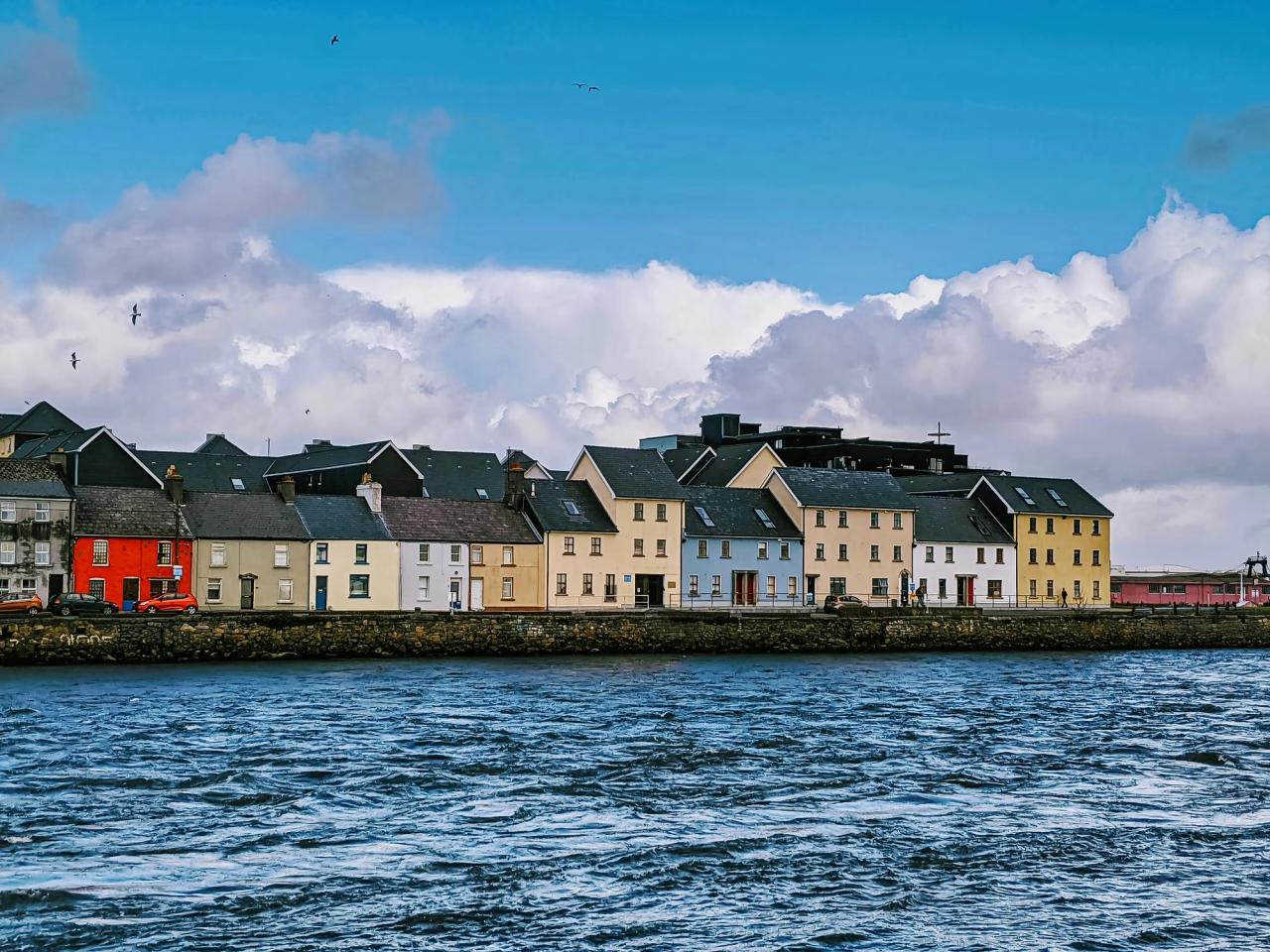
- Spanish Arch and the Long Walk: The Spanish Arch is a remnant of the 16th-century city walls, built to protect ships trading with Spain and Portugal. The colourful Long Walk along the river is one of Galway's most photographed spots and a perfect starting point for exploring.
- Sport: GAA (hurling is king in Galway — the county is one of the traditional powers), rugby (Galwegians RFC), soccer (Galway United), and sailing from Galway Bay Sailing Club. Connemara offers trail running and adventure sports.
- Outdoor life: Salthill promenade is a daily ritual for walkers and sea swimmers. Connemara National Park, the Burren, and the Aran Islands are all within day-trip distance.
Food & Dining
- Local specialties: Connemara lamb, Galway Bay oysters (the city hosts the International Oyster Festival in September), artisan breads from local bakeries, and craft beer from Galway Bay Brewery and Western Herd.
- Best areas for dining: The Latin Quarter (Quay Street, High Street), Dominick Street (the West End, Galway's coolest dining strip), and Salthill promenade.
- Budget options: The Galway Market (Saturdays on Church Lane and Sundays on the prom) offers street food, local produce, and affordable lunches. Many pubs serve good-value food.
Expat Community
- University of Galway's international office hosts orientation events, language exchanges, and social programmes for international students and staff.
- Meetup groups (Galway International Meetup, Galway Social) and InterNations Galway connect expats socially.
- Active communities include Brazilian, Indian, French, German, and Spanish groups, often linked to the university and medtech sector.
- The Galway Film Fleadh and Arts Festival attract creative professionals from around the world.
Job Market in Galway
- Main industries: Medical devices, IT/software, tourism/hospitality, education, marine science, fintech.
- Major employers:
- Medtronic (major manufacturing campus)
- Boston Scientific (medical devices)
- Cisco (tech, cybersecurity)
- SAP (enterprise software)
- Fidelity Investments (fintech)
- University of Galway (education and research, one of the city's largest employers)
- Creganna / TE Connectivity (medical devices)
- Average salaries by sector:
| Sector | Average Annual Salary |
|---|---|
| IT / Software | €48,000–€72,000 |
| Medtech / Engineering | €45,000–€65,000 |
| Finance / Fintech | €40,000–€58,000 |
| Tourism / Hospitality | €25,000–€34,000 |
| Education / Research | €35,000–€55,000 |
- Job search resources: IrishJobs.ie, Jobs.ie, LinkedIn, Indeed Ireland. The Galway Chamber of Commerce and Western Development Commission also list local opportunities.
Education in Galway
- International schools: Galway does not have a full IB World School, but Galway Educate Together Secondary School and Coláiste na Coiribe (Irish-medium) offer progressive, inclusive approaches. Several fee-paying schools accept international students.
- Universities: University of Galway (research-intensive, top 250 globally, strong in medicine, arts, and engineering) and Atlantic Technological University (ATU Galway, strong in engineering, design, and business).
- Language schools: Galway Cultural Institute, Atlantic Language Galway, and Bridge Mills Galway Language Centre offer general and exam-preparation English courses.
Moving Checklist for Galway
- Secure temporary accommodation (Airbnb or serviced apartment) for 2–4 weeks.
- Confirm visa or EU/EEA residency status.
- Begin PPS number application online at MyWelfare.ie.
- Research school places if moving with children — apply early as places fill quickly.
- Arrange health insurance (VHI, Laya, or Irish Life Health).
- Notify your bank and employer of the move.
- Register with a GP near your home — bring ID and proof of address.
- Open a bank account at AIB, Bank of Ireland, or Permanent TSB (requires PPS number and proof of address).
- Get a Leap Card for discounted bus travel.
- Walk the city centre, Latin Quarter, and Salthill promenade to get your bearings.
- Get an Irish SIM card (Three, Vodafone, or Eir — plans from €20/month).
- Register for tax with Revenue online (revenue.ie).
- Set up utilities (electricity via Electric Ireland or Bord Gáis Energy, gas, and internet) if not included in rent.
- Join local groups — Galway expat meetups, sports clubs, or volunteering.
- Explore Connemara and the Aran Islands on a weekend trip — Inis Mór is a 40-minute ferry from Rossaveal.
- Visit the Saturday market on Church Lane for local food and a sense of community.
Yes, significantly. Rents are roughly 30–40% lower than Dublin for comparable properties. Groceries and dining are also somewhat cheaper, though Galway's popularity with tourists can push summer accommodation and restaurant prices up slightly.
Yes. Galway is compact, safe, and has good schools. Salthill and Knocknacarra are particularly popular with families for their beaches, parks, and quieter pace. The proximity to Connemara makes it ideal for outdoor-oriented families.
Galway gets more rain than most Irish cities — expect 150+ wet days per year. Winters are mild (4–9°C) and summers are cool (13–19°C). The flip side is dramatic Atlantic light, frequent rainbows, and some of the best sunsets in Europe. Invest in a good rain jacket and layers rather than an umbrella (the wind will destroy it).
No. English is the everyday language. Galway is near the Connemara Gaeltacht (Irish-speaking region), and bilingual signs are common, but you do not need Irish for daily life, work, or socializing. Learning a few phrases is appreciated socially and shows respect for the local culture.
Within the city centre, absolutely — Galway is very walkable. For exploring Connemara, the Burren, or the Aran Islands, a car is very helpful. Bus services to rural areas exist (Bus Éireann routes) but are infrequent, especially on Sundays.
The Spanish Arch is a remnant of Galway's medieval city walls, built in the 1500s to protect the quays where Spanish and Portuguese trading ships docked. It sits on the River Corrib near the Claddagh and is one of Galway's most iconic landmarks. The adjacent Long Walk — a row of colourful houses along the water — is one of the most photographed spots in the west of Ireland.
Salthill and Knocknacarra are popular with medtech workers because they offer good bus routes to the Ballybrit/Dangan industrial areas where Medtronic and Boston Scientific are based, while also providing a seaside lifestyle. Newcastle is also practical for workers at companies near the university.
Yes — Galway is arguably the best city in Ireland for artists, musicians, writers, and performers. The Arts Festival, Macnas, Druid Theatre, and Galway's many galleries provide a rich ecosystem. The cost of living is lower than Dublin, and the creative community is tight-knit and welcoming.
The West End (centered on Dominick Street) is Galway's coolest neighborhood for dining and nightlife. It is home to the Crane Bar (trad sessions), the Roisín Dubh (live music venue), and some of the city's best restaurants. It has a bohemian, creative atmosphere and slightly lower rents than the Latin Quarter.
Factor: 1BR Rent (center); Galway: €1,300–€1,600; Dublin: €2,000–€2,500; Cork: €1,500–€1,800; Limerick: €1,100–€1,400; Waterford: €1,000–€1,300
Factor: Avg. Salary; Galway: ~€41,000; Dublin: ~€50,000; Cork: ~€44,000; Limerick: ~€38,000; Waterford: ~€39,000
Factor: Cultural Scene; Galway: Best in Ireland; Dublin: Excellent; Cork: Strong; Limerick: Growing; Waterford: Historic
Factor: Coastal Access; Galway: Direct Atlantic; Dublin: Dublin Bay; Cork: South coast; Limerick: River Shannon; Waterford: SE coast
Factor: Expat Community; Galway: Strong; Dublin: Largest; Cork: Growing; Limerick: Growing; Waterford: Smaller
Key Contacts and Useful Links
- PPS number: MyWelfare.ie — apply online, then attend your local Intreo office.
- Tax registration: revenue.ie — register for PAYE, USC, and PRSI.
- Health Service Executive (HSE): hse.ie — GP finder, medical card, and public healthcare.
- Residential Tenancies Board (RTB): rtb.ie — check if your landlord is registered.
- Citizens Information: citizensinformation.ie — comprehensive guide to Irish services and entitlements.
- Galway City Council: galwaycity.ie — local authority services and information.
- Galway Chamber of Commerce: galwaychamber.ie — business networking and local opportunities.
- University of Galway International Office: universityofgalway.ie/international — student and staff support.
Related Guides
- Moving to Ireland — comprehensive country guide
- Moving to Dublin — Ireland's capital
- Moving to Cork — south coast tech hub
- Moving to Limerick — midwest Treaty City
- Moving to Waterford — Ireland's oldest city