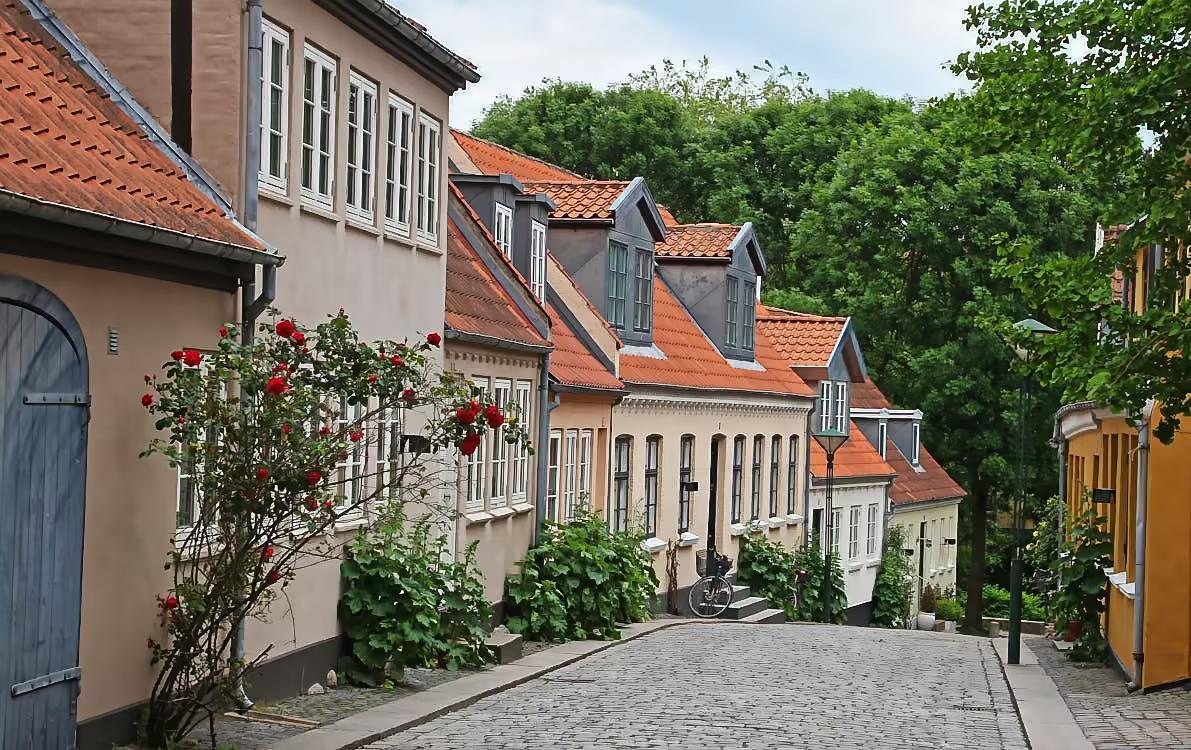

Odense is the birthplace of Hans Christian Andersen and the largest city on the island of Funen — often called the "garden island" of Denmark for its rolling green landscapes and thatched-roof farmhouses. The city has undergone major urban renewal in recent years, with a new light rail, a pedestrianised centre, and a revitalised harbour district that has turned old industrial buildings into cultural venues and restaurants. Odense offers a relaxed, mid-sized Danish city lifestyle with affordable housing, good schools, and a strategic central position between Copenhagen and Jutland. Expats come here for the University of Southern Denmark, the booming robotics sector, and a quieter alternative to the bigger cities.
Odense at a Glance
- Population
- ~185,000 (city) / ~210,000 (municipality) / ~500,000 (metro)
- Region
- Region of Southern Denmark (Syddanmark)
- Known For
- Hans Christian Andersen's birthplace, Odense Zoo, robotics hub, Funen's island charm
- Average Rent (1BR)
- DKK 6,000–8,500/month (city centre)
- Average Salary
- DKK 27,000+/month net (varies by sector; see Job Market)
- Expat Community
- Smaller and close-knit — university students, healthcare workers, and tech engineers
- Currency
- Danish Krone (DKK)
- Language
- Danish (English widely spoken)
Why Move to Odense
- Affordable and liveable: Rent is among the lowest of Denmark's major cities, and daily costs are noticeably cheaper than Copenhagen or Aarhus. A single person can live on DKK 10,500–15,000/month.
- Central location on Funen: Strategically placed between Copenhagen (~1h15 by direct IC train) and Jutland — ideal for exploring all of Denmark. The Great Belt Bridge connects Funen to Zealand.
- Robotics and tech hub: Odense is a leading European centre for collaborative robotics. Universal Robots and Mobile Industrial Robots (MiR) are both headquartered here, attracting international engineers and researchers.
- Hans Christian Andersen legacy: The city's cultural identity is shaped by its most famous resident — the H.C. Andersen Museum, his childhood home, and fairy-tale sculptures and landmarks are woven into daily life.
- New infrastructure: The Odense Letbane (light rail, opened November 2022) and extensive cycling network make getting around easy and sustainable.
Finding Housing in Odense
The Odense rental market is calmer than Copenhagen or Aarhus, making it easier to find housing. Standard contracts require 3 months' deposit plus 1 month prepaid rent. The new light rail has made neighborhoods along its route more attractive.
Average Rents
| Neighborhood | 1-Bedroom | 3-Bedroom | Character |
|---|---|---|---|
| Odense C (Centre) | DKK 6,500–9,000 | DKK 10,000–14,000 | Lively, historic, close to shops and cultural venues |
| Dalum | DKK 5,500–7,500 | DKK 9,000–12,500 | Family-friendly, residential, good schools |
| Skibhus | DKK 5,500–7,500 | DKK 9,000–12,000 | Older houses and modern flats, near the harbour |
| Bolbro | DKK 5,000–7,000 | DKK 8,000–11,000 | Affordable, popular with students and young professionals |
| Hunderup | DKK 7,000–9,500 | DKK 11,500–16,000 | Upscale, spacious villas, quiet green streets |
| Tarup | DKK 5,000–7,000 | DKK 8,500–11,500 | Northern suburb, newer housing, shopping centres |
How to Find Housing
- BoligPortal: The main rental platform — subscription required for landlord contact.
- Findbolig.nu: University and institution-linked listings.
- SDU Housing: The University of Southern Denmark helps international students find accommodation through its housing office.
- Facebook groups: "Bolig i Odense", "Odense Lejlighed", and "Roommate Odense" are active for private and shared listings.
- Odense Boligforening: Housing associations with affordable rentals — often have waiting lists but offer good value.
- Local tips: The market is less pressured than in Aarhus, but start searching at least 2 months before arrival. Student housing fills up before the September semester.
Tips for Expats
- Standard deposit is 3 months' rent plus 1 month prepaid.
- Odense's new light rail (Odense Letbane) connects many neighborhoods — consider proximity to a stop when choosing housing for easy commuting.
- Many rentals are in older buildings — check heating type (district heating vs. gas), insulation, and energy labels before signing.
- Funen's central location means you can commute to Copenhagen or Jutland if needed, though the daily train fare adds up.
Neighborhoods Guide
- Odense C (City Centre): The pedestrianised heart around Flakhaven square and the Hans Christian Andersen Museum. Cafés, shops, and the cathedral are all within walking distance. Best for singles and couples who want central convenience. Rents are the highest in Odense but still well below Copenhagen levels.
- Dalum: A southern residential area with good schools, parks, and a village-like atmosphere. Popular with families who want a safe, green environment with easy access to the city centre.
- Skibhus: North of the centre near the harbour — a mix of older charm and newer developments. Increasingly popular with young professionals as the harbour area develops.
- Bolbro: West of the centre with the most affordable rents in Odense. Good bus and light rail connections, close to the university campus, and popular with students.
- Hunderup: The most prestigious address in Odense — large houses, tree-lined streets, and proximity to Hunderup Skov forest. Ideal for families seeking space and quiet.
- Tarup: Northern suburb with newer housing, Tarup Center shopping mall, and easy access to the ring road. Car-friendly with good bus connections.
Cost of Living in Odense
Odense is one of Denmark's most affordable cities for its size. The budget below reflects a comfortable single-person lifestyle.
Monthly Budget Breakdown
| Category | Budget Range |
|---|---|
| Rent (1BR, centre) | DKK 6,000–8,500 |
| Utilities (heating, water, electricity) | DKK 800–1,200 |
| Internet | DKK 200–300 |
| Groceries | DKK 2,000–2,500 |
| Transport (monthly pass) | DKK 400–500 |
| Dining out (4x/month) | DKK 1,000–1,500 |
| Leisure/Gym | DKK 200–350 |
| Total | DKK 10,600–14,850 |
Day-to-Day Costs
- Coffee (latte): DKK 38–48
- Lunch (casual restaurant): DKK 75–100
- Monthly transport pass: DKK 400–500
- Beer (bar): DKK 40–55
- Cinema ticket: DKK 95–120
- Grocery basket (bread, milk, eggs, chicken, vegetables): DKK 130–170
Getting Around Odense
- Cycling: Odense is flat and has invested heavily in cycling infrastructure with an extensive network of dedicated bike paths throughout the city. It is one of Denmark's best cycling cities, and most residents bike daily.
- Public transport: Buses and the Odense Letbane (light rail, opened 2022) connect the city. A monthly pass costs around DKK 400–500. The Letbane runs through the city centre and connects to the university and suburbs.
- Driving: Easy to navigate with light traffic and available parking. A car is useful for exploring Funen's countryside, coastal villages, and weekend trips to other parts of Denmark.
- Airport: Odense Airport (Hans Christian Andersen Airport) has very limited commercial flights. Most residents use Billund Airport (~1 hr by car, ~1.5 hrs by public transport) or Copenhagen Airport (~1h15 by direct train) for international travel.
- Intercity: Direct Intercity trains to Copenhagen (~1h15 via the Great Belt Bridge), Aarhus (~1h40–2h), and Fredericia (~30 min). Funen's central position makes weekend trips to any part of Denmark easy.
Healthcare in Odense
Denmark has a tax-funded public healthcare system. All residents with a CPR number receive free medical care, including GP visits, hospital treatment, and specialist referrals.
- Hospitals/Clinics: Odense University Hospital (OUH) — one of Denmark's largest hospitals and the main teaching hospital for the University of Southern Denmark. Specialist departments and a trauma centre.
- English-speaking doctors: Available, especially through the university hospital and municipal clinics. The international research community ensures English is common in medical settings.
- Pharmacies (Apotek): Several locations in the centre and suburbs.
- Emergency number: 112 (ambulance, fire, police). For non-emergency medical advice, call 1813 (Lægevagten).
Planning your move?
Tell us about your move to compare quotes from international moving companies.
Culture & Lifestyle
Odense combines fairy-tale charm with modern ambition. The city's identity is deeply connected to Hans Christian Andersen, but it is also a forward-looking tech hub with a growing cultural scene.
- H.C. Andersen Museum: A world-class museum redesigned in 2021, set in an underground architectural space that brings his fairy tales to life through immersive installations.
- Andersen's childhood home: The small yellow house in the old town where the author grew up — now a museum with original furnishings and personal items.
- Brandts cultural centre: A museum and art gallery complex in a former textile mill — hosts contemporary art exhibitions, a cinema, and cultural events.
- Odense Zoo: One of Denmark's most popular family attractions, set along the Odense River with animals from every continent.
- Funen's countryside: Rolling hills, thatched-roof farmhouses, orchards, and coastal villages are all within a short bike or car ride. Egeskov Castle (a Renaissance water castle) is 30 minutes south.
Food & Dining
- Traditional Danish cooking, local Funen produce (apples, pork, dairy), and a growing international restaurant scene around the harbour and Flakhaven.
- Odense Havn (harbour) has been transformed into a dining and cultural quarter with restaurants, cafés, and street food vendors.
- The Flakhaven square area has outdoor dining in summer.
- Budget options: bakeries, student canteens at SDU, and supermarket meal deals from Netto and Rema 1000.
Expat Community
- SDU International Office organises welcome programmes, buddy systems, and social events for international students and researchers.
- Internations Odense and Facebook expat groups for the Odense/Funen area.
- Language cafés and volunteer-run Danish conversation groups at Borgernes Hus (the main library).
- The expat community is smaller and close-knit — easy to build genuine connections.
Job Market in Odense
Odense's economy has pivoted from traditional manufacturing to robotics, medtech, and education. The city markets itself as "RoboValley" — a European centre for collaborative robotics.
- Main industries: Robotics and automation (Universal Robots, Mobile Industrial Robots), healthcare and medtech, education, manufacturing, agriculture.
- Major employers: University of Southern Denmark (SDU), Odense University Hospital (OUH), Universal Robots, Terma (defence and aerospace), Danish Crown (food production).
- Average salaries by sector:
| Sector | Average Monthly Net (DKK) |
|---|---|
| Robotics / Engineering | 28,000–42,000 |
| Tech / IT | 27,000–38,000 |
| Healthcare | 26,000–35,000 |
| Education / Research | 25,000–33,000 |
| Service / Hospitality | 19,000–24,000 |
- Job search resources: Jobindex.dk, Work in Denmark (workindenmark.dk), SDU Job Bank, LinkedIn, Odense Robotics cluster network.
Education in Odense
- International schools: Odense International School (primary and secondary), Sct. Knuds Gymnasium (IB programme).
- Universities: University of Southern Denmark (SDU) — strong in engineering, health sciences, robotics, and social sciences. SDU has a significant international student population across all its campuses.
- Language schools: Lærdansk Odense (free Danish courses for CPR holders), Odense Sprogcenter.
Moving Checklist for Odense
- Confirm residence permit or EU/EEA status.
- Apply for SDU student housing or search BoligPortal 2–3 months in advance.
- Prepare certified translations of key documents.
- Arrange health insurance (EHIC for EU citizens, private otherwise).
- Register at Borgerservice to get your CPR number.
- Open a Danish bank account (Danske Bank, Nordea, or Jyske Bank).
- Buy a used bike or get a Rejsekort for public transport.
- Set up MitID for digital public services.
- Register with a local doctor via sundhed.dk.
- Enrol in free Danish language courses (Lærdansk).
- Cycle the city — Odense is flat and easy to learn by bike.
- Visit the H.C. Andersen Museum and explore the harbour district.
- Set up MobilePay linked to your Danish bank account.
Bringing Your Belongings to Denmark
If you are relocating from outside the EU, you may qualify for duty-free and VAT-free import of used household goods under Danish Customs rules:
- Items must have been owned and used for at least 6 months.
- You must have lived outside the EU for 12 consecutive months.
- Goods must arrive within 6 months before or 12 months after your move.
At customs, present your inventory list, proof of residency abroad, and passport or residence permit. New items, vehicles, or high-value goods may be subject to 25% VAT and import duties. EU citizens moving within the EU generally face no customs requirements for personal belongings.
Learning Danish
Danish is not essential for daily life in Odense, especially at SDU, but learning it helps with social integration and local job prospects. The Danish government offers free language courses to all residents with a CPR number.
- Lærdansk Odense: The main provider — in-person and online courses at all levels.
- Odense Sprogcenter: Another option for Danish language instruction.
- Duolingo and Babbel: Good for basics before arriving.
- Practical tip: SDU's International Office organises language exchange events — a good way to practice Danish and meet locals.
Danish Culture and Social Norms
Understanding Danish social norms helps newcomers settle in faster. Danes are friendly but reserved at first — building deeper connections takes time.
- Hygge: The famous Danish concept of cozy togetherness — candles, warm drinks, and quality time with friends. It is not just a trend but a core part of Danish social life.
- Direct communication: Danes tend to be straightforward and honest. This is not rudeness — it is valued efficiency. Do not take direct feedback personally.
- Equality: Danish culture emphasises flat hierarchies. Bosses and employees often socialise as equals. Showing off wealth or status is generally frowned upon.
- Punctuality: Being on time matters. Arriving late without notice is considered disrespectful.
- Work-life balance: The standard work week is 37 hours. Leaving on time to pick up children or attend hobbies is normal and respected.
- Funen pride: Funen locals (fynboer) are known for being warm, welcoming, and a bit more relaxed than people from Copenhagen or Jutland. Odense retains a strong local identity.
What to Expect: Climate and Seasons
Odense has a temperate oceanic climate, sheltered somewhat by Funen's position between Jutland and Zealand.
- Winter (Dec–Feb): Average temperatures 0–4°C. Short days (7 hours of daylight in December). Occasional snow but mostly grey and damp. Frost is common at night.
- Spring (Mar–May): Temperatures rise from 4°C to 14°C. Days lengthen rapidly. Funen's orchards blossom in late April.
- Summer (Jun–Aug): Average 17–21°C, occasionally warmer. Long days with 17+ hours of daylight. Ideal for cycling and exploring the island.
- Autumn (Sep–Nov): Cooling from 14°C to 4°C. Rainy. Beautiful autumn colours in Hunderup Skov and along the Odense River.
Settling In: Daily Life Tips
- MobilePay: Denmark's dominant payment app — linked to your Danish bank account. Used for everything from splitting bills to paying at markets. Set it up immediately after opening a bank account.
- MitID/NemID: Your digital identity for accessing public services, banking, tax returns (SKAT), and healthcare (sundhed.dk). Essential for daily life in Denmark.
- Recycling: Denmark takes waste sorting seriously. Every building has bins for residual waste, bio/food waste, plastic, paper, glass, and metal. Sorting correctly is expected.
- Deposit system (Pant): Most bottles and cans carry a deposit (DKK 1–3). Return them at reverse vending machines in supermarkets.
- Quiet hours: Danish culture values quiet. Most buildings enforce quiet hours after 22:00.
- Tipping: Not expected in Denmark — service staff are paid fair wages. Rounding up the bill is appreciated but not required.
- Day trips from Odense: Funen's central location makes it easy to visit Egeskov Castle (30 min), the beaches of the south Funen archipelago, and Legoland in Billund (1.5 hrs).
Odense is the birthplace of Hans Christian Andersen, one of the world's most beloved fairy-tale authors (The Little Mermaid, The Ugly Duckling, The Snow Queen). The city celebrates his legacy with a world-class museum, his childhood home, and sculptures and landmarks scattered throughout the centre. Funen's gentle landscape also inspired many of his stories.
Yes — rent in Odense is roughly 30–40% lower than in Copenhagen. A single person can live comfortably on DKK 10,500–15,000 per month including rent, making it one of the most affordable major cities in Denmark. Salaries are slightly lower, but the cost savings are significant.
Odense has a strong and growing job market in robotics and automation — it is home to Universal Robots, a global leader in collaborative robots, and Mobile Industrial Robots. The city calls itself "RoboValley" and actively recruits international engineers. Healthcare (OUH is a major employer), education (SDU), and manufacturing also offer opportunities.
Direct trains run from Odense to Copenhagen every 20–30 minutes, crossing the Great Belt Bridge. The journey takes about 1 hour 15 minutes. Odense's central location on Funen also makes Aarhus reachable in 1.5 hours by train, and Fredericia in 30 minutes.
Yes — Odense is safe, green, and has excellent schools and family-friendly neighborhoods like Dalum and Hunderup. The city is compact enough that children can bike to school, and there are parks, the zoo, and the beautiful Funen countryside nearby. Egeskov Castle is a popular family day trip.
English is widely spoken in daily life, and the university and many companies operate in English. However, Danish is useful for deeper social integration and some local employers, particularly in the public sector. Free courses are available to all CPR holders through Lærdansk.
Related Guides
- [Moving to Denmark] — comprehensive country guide
- [Moving to Copenhagen] — Denmark's capital city
- [Moving to Aarhus] — Denmark's second city
- [Moving to Aalborg] — affordable living in North Jutland
- [Moving to Esbjerg] — Denmark's wind energy capital
Odense blends fairy-tale charm with cutting-edge technology — a city where Andersen's legacy meets the future of robotics.