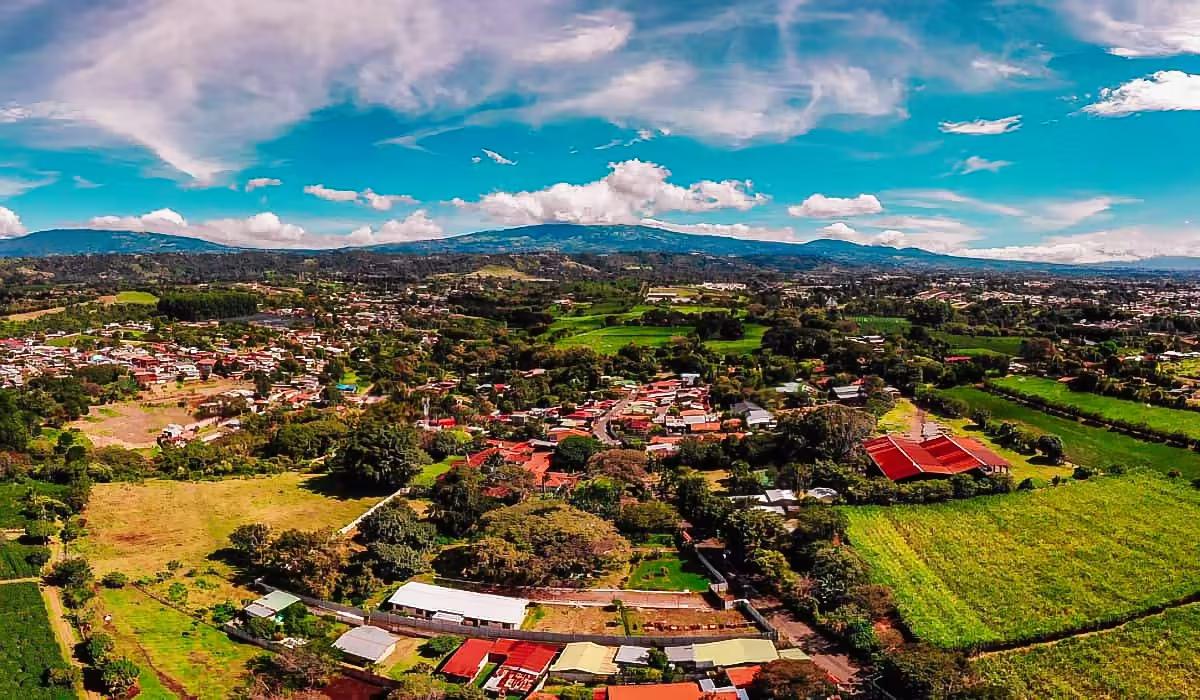

Alajuela is the capital of Alajuela Province and the second-largest city in Costa Rica, sitting in the Central Valley roughly 19 km northwest of San José. It is home to Juan Santamaría International Airport (SJO) — Costa Rica's main international gateway, which despite its "San José" name is actually located in the Río Segundo district of Alajuela. The city sits at roughly 950 m elevation, making it noticeably warmer and sunnier than the capital, with a more traditional Tico character and significantly lower living costs than San José or Escazú.
Alajuela is the birthplace of national hero Juan Santamaría, widely known as the "Capital of Mangoes" for its abundant mango orchards and annual Mango Festival, and it hosts one of Costa Rica's two biggest football clubs, LD Alajuelense, whose red-and-black colors dominate the city on match days. The surrounding province stretches from Poás Volcano in the north to the Pacific coast near Orotina in the south, placing Alajuela city at a strategic crossroads between mountains, beaches, and the greater San José metropolitan area.
For expats, Alajuela offers an affordable, authentic base with excellent airport access, a growing international community, and easy reach to volcanoes, cloud forests, coffee plantations, and the crafts town of Sarchí. It appeals particularly to remote workers, retirees, and families who want Central Valley infrastructure without Escazú-level prices — and to anyone who values being 15 minutes from the check-in counter at SJO.
Alajuela at a Glance

- Population
- ~44,400 (city, 2022 census); ~322,000 (Alajuela canton est.); ~950,000 (Alajuela Province est.)
- Region
- Central Valley, Alajuela Province, Costa Rica
- Known For
- Juan Santamaría International Airport (SJO), Poás Volcano, mango production, LD Alajuelense football
- Average Rent (1BR)
- ₡250,000–₡450,000/month (city center)
- Average Salary
- ₡600,000–₡900,000/month (net)
- Expat Community
- Growing; smaller and more integrated than San José/Escazú, mix of retirees and remote workers
Why Move to Alajuela
- Airport on your doorstep: Juan Santamaría International Airport (SJO) is in Río Segundo, within Alajuela's urban area — most neighborhoods are 10–20 minutes from the terminal, making international travel and visitor arrivals far simpler than from San José proper, where the drive can take 45–60 minutes in traffic.
- Lower cost of living: Rent in Alajuela runs 20–35% cheaper than comparable areas in San José, Escazú, or Santa Ana, with groceries, dining, and services also priced lower while still offering Central Valley infrastructure quality and hospital access.
- Warmer, sunnier climate: At ~952 m elevation (roughly 200 m lower than San José), Alajuela is noticeably warmer and gets more sunshine hours, which many expats prefer — daytime highs average 27–30°C year-round (annual mean 23–26°C) with a dry season that feels distinctly drier and more predictable than in the capital.
- Authentic Tico culture: Alajuela retains a more traditional Costa Rican character than the increasingly internationalized western suburbs of San José — the Mercado Central, the annual Mango Festival, and neighborhood sodas (small local eateries serving traditional food) reflect a pace of life that feels genuinely local rather than curated for foreigners.
- Gateway to nature: Poás Volcano National Park is a 30-minute drive north, La Paz Waterfall Gardens sits nearby in Vara Blanca, and the coffee-growing highlands around Doka Estate and the crafts town of Sarchí are within easy day-trip range, with Arenal Volcano and the northern coast accessible via Route 1 in roughly 3.5–4 hours.
- Growing but not overcrowded expat scene: The international community in Alajuela is large enough to provide support and social connections but small enough that you will interact with Tico neighbors daily, shop at local markets, and develop genuine Spanish-language skills rather than retreating into an English-speaking enclave.
Finding Housing in Alajuela
Alajuela's housing market is less formalized than San José's western suburbs — more listings appear as hand-painted signs on gates than on slick websites, and personal relationships with landlords matter. The city's residential stock ranges from 1960s concrete block homes in the center to modern gated condominiumios in San Rafael, with semi-rural fincas (farms/estates) on the outskirts. Foreign renters are increasingly common but still a minority of the market, so expect to conduct most of your search in Spanish.
Average Rents
| Neighborhood | 1-Bedroom | 3-Bedroom | Character |
|---|---|---|---|
| Alajuela Centro | ₡250,000–₡400,000 | ₡450,000–₡700,000 | Traditional grid streets, walkable, older construction, close to Cathedral and Mercado Central |
| San Rafael | ₡300,000–₡500,000 | ₡550,000–₡850,000 | Suburban, newer condos and gated developments, popular with middle-class Tico families |
| Río Segundo | ₡280,000–₡450,000 | ₡500,000–₡780,000 | Near SJO airport, mix of residential and airport-related businesses, convenient for frequent travelers |
| Carrizal | ₡220,000–₡380,000 | ₡400,000–₡650,000 | Quieter, greener, more rural feel on Alajuela's northern edge toward Poás |
| Turrúcares | ₡200,000–₡350,000 | ₡380,000–₡600,000 | Semi-rural outskirts, larger lots, popular with expats seeking space and quiet |
| San José de Alajuela | ₡260,000–₡420,000 | ₡480,000–₡720,000 | Residential district south of center, family-oriented, good local amenities |
How to Find Housing
- Encuentra24 and Craigslist Costa Rica: The two most-used online platforms for rental listings in the Central Valley; filter by "Alajuela" province and cross-reference neighborhood names to avoid confusion with San José.
- Facebook groups: "Alajuela Costa Rica Real Estate" and "Costa Rica Expats Housing" are active groups where landlords post directly — response times are faster than formal platforms and negotiation is expected, though verify listings carefully as scams do occur.
- Local real estate agents: REMAX and Coldwell Banker have Alajuela offices; agents typically charge the landlord (not the tenant) one month's rent as commission, but they can navigate Spanish-language contracts, verify property legitimacy, and identify issues like unclear land titles.
- Walking the neighborhood: In Alajuela Centro and surrounding barrios, "Se Alquila" (for rent) signs in windows and on gates are common — many landlords, especially older Ticos, never list online and prefer local tenants who show up in person to inquire.
- Word of mouth: Once you are in Alajuela, tell everyone you are looking — your taxi driver, the person at the pulpería (corner store), and neighbors all know someone with a place for rent. Personal recommendations still drive a significant share of housing transactions in Alajuela.
Tips for Expats
- Costa Rican landlords almost always require a fiador (guarantor) — a Costa Rican citizen or permanent resident who owns property and co-signs the lease. If you cannot find one, some landlords accept a depósito en garantía of 2–3 months' rent held in escrow instead, but negotiate this before signing anything.
- Leases are typically 12 months, written in Spanish, and require 1 month's deposit plus first month upfront; have a local attorney review the contract — standard fee is ₡50,000–₡100,000 and can save you from unfavorable clauses.
- Utilities are almost never included: budget separately for electricity (ICE, ₡15,000–₡45,000/month depending on air conditioning use), water (AyA or local ASADA, ₡5,000–₡12,000), and internet (₡18,000–₡35,000 for fiber through ICE or private providers like Tigo and Claro).
- Alajuela's older city-center buildings may lack hot water in some units or use inline gas heaters (calentadores de paso) — check this specifically when viewing, as retrofitting can be expensive.
- Rental scams targeting foreigners exist — never send deposits before viewing a property in person, and verify the landlord's identity against their cédula (national ID) or the property's catastro (land registry) entry.
- Furnished apartments command a 20–40% premium over unfurnished units in Alajuela. If you plan to stay long-term, buying basic furniture from local stores (Gollo, Almacenes El Rey) or the used furniture market in Barrio San José can be cheaper within a few months.
Neighborhoods Guide
- Alajuela Centro: Best for expats who want walkable urban living without a car. Grid streets radiate from the Cathedral and Central Park, with the Mercado Central, dozens of sodas, banks, and the Juan Santamaría Cultural Historical Museum all within walking distance. Rents are the lowest in the city but buildings tend to be older, and noise from the central bus terminal and market area can be significant, especially on weekends.
- San Rafael: Best for families and those wanting modern condo living. This area east and southeast of the center has seen the most recent residential development, with gated communities (condominios), small shopping plazas, and newer construction. Slightly more expensive but offers amenities like pools, 24-hour security, and covered parking. Good access to Route 1 and a 15-minute drive to the airport.
- Río Segundo: Best for frequent flyers and airport workers. Located immediately south of SJO, this district is packed with airport hotels, rental car agencies, and logistics companies. Residential pockets exist between the commercial strips and rents are moderate. Aircraft noise is the main drawback — spend time in the area at different hours before committing to a lease.
- Carrizal: Best for nature-oriented expats and those seeking quiet. On the northern slopes toward Poás Volcano, Carrizal is cooler and greener than central Alajuela, with larger properties, gardens, and views of the Central Valley. Commute to the center is 15–20 minutes by car. Limited public transit means a vehicle is essentially required here.
- Turrúcares: Best for budget-conscious expats wanting space. This semi-rural area west of the city offers the cheapest rents and largest lots in the Alajuela metro area. It sits along Route 27, giving fast access to San José (30 min) and the Pacific coast (90 min to Jacó). Infrastructure is more basic — expect occasional water pressure issues, fewer paved side roads, and limited street lighting at night.
- San Miguel: Best for a middle ground between urban and suburban. Located northeast of the center, San Miguel has a mix of older Tico homes and newer builds, with good bus connections to both Alajuela Centro and neighboring Heredia. It's slightly elevated, so temperatures are a degree or two cooler than downtown. Local shops and small restaurants give it a self-contained neighborhood feel.
Cost of Living in Alajuela
Alajuela is one of the most affordable cities in Costa Rica's Central Valley for expats, offering lower prices than San José, Escazú, Santa Ana, and even neighboring Heredia on many items. The trade-off is slightly fewer international dining and entertainment options, but daily essentials — housing, food, transport, healthcare — cost meaningfully less.
Monthly Budget Breakdown
| Category | Budget Range |
|---|---|
| Rent (1BR, center) | ₡250,000–₡400,000 |
| Rent (1BR, outskirts) | ₡200,000–₡320,000 |
| Utilities (electricity, water, gas) | ₡25,000–₡55,000 |
| Internet | ₡18,000–₡35,000 |
| Groceries | ₡150,000–₡250,000 |
| Transport | ₡20,000–₡40,000 |
| Dining out (8x/month) | ₡48,000–₡96,000 |
| Leisure/Gym | ₡25,000–₡65,000 |
| CCSS health insurance contribution | ₡30,000–₡120,000 (income-based) |
| Total (single person, center) | ₡566,000–₡1,061,000 |
Day-to-Day Costs
- Coffee (soda or café local): ₡800–₡2,000
- Casado (traditional lunch plate with rice, beans, salad, plantain, and protein): ₡2,500–₡4,500
- Monthly bus pass (Alajuela–San José route): ₡30,000–₡35,000
- Imperial or Pilsen beer at a bar: ₡1,500–₡3,000
- Cinema ticket (CitiCinemas Alajuela at City Mall): ₡3,500–₡5,000
- Mango in season (per kg, Mercado Central): ₡500–₡1,200
- Taxi within city limits: ₡2,000–₡5,000
- Uber/InDriver within Alajuela: ₡1,500–₡4,000 (often cheaper than taxis)
- Gallon of regular gasoline: ₡3,300–₡3,800
- Gym membership (mid-range): ₡20,000–₡45,000/month
- Movie night at CitiCinemas City Mall: ₡3,500 (ticket) + ₡2,500 (popcorn + drink)
Getting Around Alajuela
- Public transport: Alajuela relies on a network of privately operated bus routes rather than rail. The central bus terminal near the Mercado Central connects all local barrios, with buses running every 10–30 minutes on main corridors. The Alajuela–San José route (operated by TUASA and Station Wagon buses) runs every 5–10 minutes from 4:30 AM to 11:00 PM, takes roughly 40 minutes in normal traffic, and costs ₡650–₡770 one way. Fares within the city are ₡350–₡500.
- Cycling: Alajuela is moderately bike-friendly in the flat center, but dedicated bike lanes are limited and drivers are not accustomed to sharing the road. The roads toward Carrizal and through Turrúcares are popular with recreational road cyclists on weekend mornings. Bike theft is a real concern — always use a heavy U-lock and avoid leaving bikes unattended in the center overnight.
- Rideshare: Uber operates throughout Alajuela and is generally cheaper than traditional red taxis. InDriver is also widely used and allows you to negotiate the fare. Both are reliable for trips within the city and to the airport. Traditional taxis are red with a yellow triangle on the door; always use licensed taxis or app-based services rather than informal piratas (unlicensed cabs).
- Driving: Route 1 (Interamericana Norte) passes through Alajuela, connecting it to San José to the east and Guanacaste, Arenal, and northern Costa Rica to the north. Route 27 provides faster access to San José and the Pacific coast via toll road (₡710–₡1,200 per toll plaza). Traffic on Route 1 between Alajuela and San José can be heavy during rush hours (6:30–8:30 AM, 4:30–6:30 PM), turning the 20 km stretch into a 60–90 minute crawl. Parking in the center is primarily street-side; newer malls like City Mall (adjacent to SJO) offer free parking.
- Airport: Juan Santamaría International Airport (SJO) is in Río Segundo within Alajuela — 10–20 minutes from most neighborhoods by car or taxi. It is Costa Rica's busiest airport, with direct flights to Miami, New York (JFK and EWR), Los Angeles, Madrid, Panama City, Mexico City, Toronto, Fort Lauderdale, Houston, Atlanta, and dozens of other cities across the Americas and Europe. A taxi from the city center to SJO costs ₡5,000–₡10,000; the TUASA bus from the central terminal costs ₡650.
- Intercity: Direct buses from Alajuela's terminal serve Grecia (45 min), Sarchí (1 hr), Naranjo (45 min), Atenas (40 min), Palmares (30 min), San Ramón (50 min), and connect onward to Arenal/La Fortuna (~4 hrs) and Guanacaste beaches (~5 hrs to Tamarindo). There is no passenger rail service from Alajuela. For the Pacific coast, Route 27 connects to Route 34 at Orotina for Jacó (1.5 hrs), Quepos (3 hrs), and Manuel Antonio (3.5 hrs). The Tuasa Bus terminal on Calle 6 and the Terminal de Buses Colectivos on the city's eastern edge are the two main departure points — check which terminal serves your destination before heading out, as they are a 15-minute walk apart.
Healthcare in Alajuela
Costa Rica's healthcare system is consistently ranked among the best in Latin America, and Alajuela residents benefit from proximity to both public CCSS hospitals and San José's private healthcare corridor. The public system (CCSS) covers all legal residents for a monthly contribution based on income, while private care is available at a fraction of US or European prices.
- Hospitals and clinics: Hospital México, one of the CCSS (Caja Costarricense de Seguro Social — Costa Rica's public health insurance and hospital system) flagship hospitals, is located in La Uruca on the road toward San José and serves as the primary referral hospital for Alajuela residents. Within Alajuela itself, the CCSS operates Hospital San Rafael de Alajuela and multiple EBAIS (Equipo Básico de Atención Integral en Salud — community-level primary care clinics) across every district. Private options include Clínica San Rafael and several specialist practices near the center.
- English-speaking doctors: More available at private clinics than at public CCSS facilities. Several doctors at Clínica San Rafael and in the San Rafael neighborhood speak English, and several dentists in the center cater specifically to international patients. San José's private hospitals (Hospital CIMA in Escazú, Clínica Bíblica) are 30–45 minutes away and have extensive English-speaking staff; many Alajuela expats use these for specialist care, surgeries, and emergencies requiring clear English communication. Dental tourism is common — a crown that costs $1,500–$2,000 in the US runs $400–$700 at a good Alajuela clinic.
- Pharmacies: Abundant throughout Alajuela. The Mercado Central area has several, and every major neighborhood has at least one farmacia. Many medications that require prescriptions in North America or Europe (including some antibiotics) can be purchased over the counter in Costa Rica, though regulations have tightened in recent years and controlled substances always require a prescription.
- Emergency number: 911 (nationwide). CCSS emergency line: 111. The Cruz Roja (Red Cross) station in Alajuela Centro responds to local emergencies and traffic accidents.
Get a personalised relocation plan
Drop your email and we'll send a tailored checklist plus three quotes from vetted movers.
Culture and Lifestyle
Alajuela's cultural identity is deeply tied to its history as a provincial capital, its agricultural roots, and its role in Costa Rica's defining 19th-century conflict. The city feels less cosmopolitan than San José and less resort-oriented than the coast — it is a working city where tradition is visible in daily life, from the market vendors who have occupied the same stalls for decades to the football fans who pack the Morera Soto stadium every other Sunday.
- Juan Santamaría heritage: Alajuela is the birthplace of Juan Santamaría, the national hero who died in the 1856 Battle of Rivas fighting against the American filibuster William Walker. The Juan Santamaría Cultural Historical Museum on Calle 2 near Central Park preserves his story with artifacts, paintings, and rotating cultural exhibits. The city celebrates Juan Santamaría Day every April 11 with a parade through downtown, open-air concerts in Central Park, and civic ceremonies — it is the biggest non-religious holiday on the local calendar.
- Mango Festival (Festival del Mango): Held annually in June or July, this celebration of Alajuela's nickname "Capital of Mangoes" fills Central Park with mango tastings, cooking competitions, live music, craft vendors, and a mango-themed parade. It draws visitors from across the Central Valley and is the city's signature cultural event. Dozens of mango varieties are on display and for sale, many unique to the Alajuela area.
- Football culture: LD Alajuelense (La Liga), one of Costa Rica's two dominant football clubs alongside Deportivo Saprissa, plays at the Alejandro Morera Soto Stadium in Barrio Trinidad. The rivalry with Saprissa (based in Tibás, San José) divides the entire country — match days against Saprissa transform the city, with red-and-black flags on every balcony and car. Attending a home match costs ₡3,000–₡15,000 depending on the section, and the atmosphere is intense and family-friendly.
- Mercado Central de Alajuela: Smaller and less touristy than San José's Mercado Central, this covered market on Calle 4 is where Alajuela residents have bought fresh produce, meats, cheeses, spices, and prepared food for generations. It's the best place to find local fruits in season — mangoes, starfruit, cas, jocotes, and mamón chino — at the lowest prices in the city. The comedores (small eat-in stalls) inside serve some of the best traditional food in Alajuela. Arrive before 10 AM on Saturdays for the freshest selection, as many vendors sell out by early afternoon.
- Nearby attractions as part of daily life: Poás Volcano, Zoo Ave, and the coffee estates are not just tourist destinations — many Alajuela residents visit Poás on weekend mornings the way city dwellers elsewhere visit a park. The entrance to Poás Volcano National Park is ₡1,100 for residents (versus ₡15,000 for foreign tourists), a significant discount you get once you have your DIMEX card. La Garita and Atenas, both within 30 minutes, are popular Sunday lunch destinations with roadside restaurants serving traditional food amid ornamental plant nurseries.
Food and Dining
- Local specialties center on casados (₡2,500–₡4,500 at neighborhood sodas), olla de carne (beef and root vegetable stew, especially popular during the rainy season), gallo pinto (rice and beans, the standard breakfast), and mango-based dishes, preserves, and fresh juices sold throughout the city and especially during the Festival del Mango.
- The blocks around Central Park and the Cathedral have the densest concentration of sodas and small restaurants in the city, with everything from traditional Costa Rican fare to Chinese-Costa Rican fusion (chifas). Calle Central is the main restaurant strip.
- For higher-end dining, the San Rafael area offers sushi, Argentine-style grilled meats, Italian food, and craft beer at prices 20–40% below equivalent restaurants in Escazú or Santa Ana.
- Budget dining at the Mercado Central comedores is unbeatable — a full casado lunch with natural fruit drink runs ₡2,500–₡3,500, and fresh fruit batidos (smoothies made with water or milk) are ₡1,000–₡1,800.
- The coffee culture is strong given Alajuela's location in Costa Rica's coffee-growing highlands. Several cafés in the center serve locally grown beans from nearby plantations, and the Doka Estate coffee tour (20 minutes north) is one of the most popular half-day excursions from the city.
Expat Community
- The Alajuela expat community is smaller and more dispersed than in Escazú or Santa Ana but is growing steadily as remote workers and retirees discover the cost advantages over San José's western suburbs. Facebook groups like "Expats in Alajuela Costa Rica" and "Costa Rica Alajuela Expats" are the primary gathering points online, with regular posts about housing, services, and social events.
- Language exchange meetups happen informally at cafés near the Universidad Técnica Nacional campus and at some of the craft breweries that have opened on the city's eastern edge. The Intercambio de Idiomas Alajuela group meets weekly.
- Many expats in Alajuela connect through volunteer work at Zoo Ave (a wildlife rescue center and botanical garden in La Garita, 15 minutes west of the center), at local animal welfare organizations, or through church groups. The community skews toward people who want deeper integration with Tico neighbors rather than an insulated expat bubble.
- Annual expat gatherings coincide with the Mango Festival and Juan Santamaría Day, where the international community mixes freely with local residents at the public celebrations in Central Park.
Job Market in Alajuela
- Main industries: Aviation and airport logistics (SJO supports thousands of jobs in airlines, ground handling, freight, customs, and duty-free retail), tourism and hospitality, agriculture (coffee, mangoes, sugarcane, and ornamental plants in the surrounding province), manufacturing (several industrial parks and free-trade zones in the Alajuela metro area), call centers and BPO operations, and retail.
- Major employers: Copa Airlines, Alaska Airlines, Spirit, and other carriers with SJO crew and operations bases; DHL and FedEx logistics hubs near the airport; Doka Estate and other coffee producers; Walmart México y Centroamérica (multiple locations); Florida Bebidas (Costa Rica's largest beverage company); Sykes and other call center operators; and numerous CCSS and government offices serving the provincial capital.
- Average salaries by sector:
| Sector | Monthly Net (approx.) |
|---|---|
| Aviation/airport services | ₡650,000–₡1,200,000 |
| Tourism/hospitality | ₡400,000–₡700,000 |
| Teaching (bilingual school) | ₡700,000–₡1,300,000 |
| IT/remote work (foreign employer) | ₡1,500,000–₡4,000,000+ |
| Call center/BPO (bilingual) | ₡550,000–₡900,000 |
| Retail/services | ₡350,000–₡550,000 |
- Job search resources: LinkedIn and Computrabajo are the primary online platforms for professional positions. The English-language Tico Times classifieds occasionally list positions at bilingual schools and tourism companies. Airport-area jobs are often posted directly on airline career pages and at the SJO employment board near the terminal. Many expats in Alajuela work remotely for foreign employers — the city's fiber internet infrastructure and airport proximity make this practical, and coworking spaces have begun opening in the San Rafael area. If you are seeking local employment, note that most positions require at least conversational Spanish, and salaries are significantly lower than in North America or Europe for equivalent roles.
Education in Alajuela
- International and bilingual schools: Green Valley School in nearby Atenas (30 minutes west) offers a U.S.-accredited bilingual program and is popular with Alajuela-based expat families. Within Alajuela itself, Colegio Bilingüe de Alajuela provides bilingual education from preschool through high school. Several smaller bilingual preschools and elementary programs operate in the San Rafael area, including Montessori-based options. For families considering long-term relocation, the availability of bilingual education through secondary school is a significant advantage of Alajuela over smaller Central Valley towns like Grecia or Atenas, where options are more limited.
- Universities: Universidad Técnica Nacional (UTN) has its main campus in Alajuela, offering engineering, tourism, information technology, and business programs. The Universidad de Costa Rica (UCR) in San Pedro and Universidad Nacional (UNA) in Heredia, both top-tier public universities, are accessible by bus in 30–45 minutes. Universidad Latina and Universidad Hispanoamericana also maintain satellite campuses in the Alajuela area, primarily for business and law degrees.
- Language schools: Several private Spanish schools in the center offer intensive courses for ₡80,000–₡200,000 per week, including homestay options with local families that accelerate learning. Conversational exchange with university students at UTN is a free alternative. The Centro Cultural Costarricense-Norteamericano in Barrio México, San José (30 min by bus) offers formal English and Spanish programs with certified instructors. For self-study, the Biblioteca Municipal de Alajuela (municipal library) near Central Park has a small Spanish-language learning section and free Wi-Fi.
- Extracurriculars for children: The Alejandro Morera Soto Stadium area has youth football programs, and the Municipalidad de Alajuela runs affordable arts and swimming programs (₡5,000–₡15,000/month). Several private dance academies in the center teach ballet and Latin dance to children. The proximity to nature reserves and Zoo Ave makes environmental education programs readily available for school-age kids.
Moving Checklist for Alajuela
- Research and apply for the correct residency category through the Dirección General de Migración y Extranjería (Costa Rican Immigration) — options include Pensionado (retiree with ₡1,000,000+ monthly verified pension), Rentista (₡2,500,000+ guaranteed monthly income for 2 years), Investor (minimum ₡150,000,000 investment), or work-permit-based Temporary Residence. Processing takes 6–18 months; your tourist visa (90 days for most nationalities) covers you in the interim.
- Gather apostilled documents: birth certificate, police background check (from every country you've lived in for 3+ years in the last 10), marriage certificate if applicable. Costa Rica requires Hague apostilles (not notarizations), and documents must be translated into Spanish by an official translator if not already in Spanish. All documents must be no more than 6 months old when submitted to Migración.
- Book temporary accommodation near Alajuela Centro or San Rafael for your first 2–4 weeks — hotels near SJO in Río Segundo run ₡35,000–₡75,000/night, or use Airbnb for weekly rates of ₡200,000–₡400,000.
- Check that your passport is valid for at least 6 months beyond your planned arrival date and has at least one blank page.
- If bringing pets, obtain a health certificate (APHIS Form 7001 or equivalent) from a USDA-accredited veterinarian, ensure rabies vaccination is current (administered between 30 days and 12 months before travel), and confirm microchip — Costa Rica does not require quarantine for dogs and cats with proper documentation from approved countries.
- Notify your bank that you will be making transactions in Costa Rica, and bring enough USD or CRC in cash for your first week (₡200,000–₡500,000) since you cannot open a Costa Rican bank account without residency documentation.
- Purchase travel health insurance that covers your first 90 days — World Nomads, IMG, and SafetyWing all offer plans that work in Costa Rica. You will transition to CCSS coverage once your residency is processed.
- If you plan to ship household goods, begin the process early — sea freight from North America takes 3–6 weeks to reach Puerto Limón or Puerto Caldera, and customs clearance through the Dirección General de Aduanas adds another 1–2 weeks. Used personal goods owned for 6+ months can enter duty-free with proper documentation.
- Register your entry date with Migración — your 90-day tourist period starts from the stamp in your passport, and you will need this documented entry date for future residency applications and DIMEX processing.
- Get a local SIM card: Kölbi (ICE, the state-owned telecommunications company) has the best coverage in Alajuela and rural areas, sold at ICE offices, supermarkets, and the airport. A prepaid plan with 2–4 GB of data costs ₡5,000–₡15,000/month. Claro and Movistar are alternatives with competitive data packages.
- Open a bank account if possible — Banco Nacional and Banco de Costa Rica sometimes allow tourists to open basic savings accounts (cuentas de ahorro) with just a passport and a minimum deposit (₡25,000–₡50,000), though policies vary by branch and manager. Full checking accounts and online transfers require residency.
- Walk the neighborhoods you are considering for long-term housing — visit at different times of day to gauge noise levels, traffic patterns, and proximity to bus stops, grocery stores, and EBAIS clinics.
- Locate the nearest EBAIS clinic to where you plan to live — you will need this for CCSS enrollment once your residency is in process.
- Buy a Tigo or Claro prepaid internet hotspot (₡15,000–₡25,000 for the device, ₡5,000–₡15,000/week for data) if your temporary housing does not have immediate fiber hookup.
- Secure long-term housing with a signed lease — arrange a fiador (guarantor) or negotiate a larger depósito en garantía (2–3 months' rent) as an alternative.
- Begin the CCSS (Caja Costarricense de Seguro Social) enrollment process at your local EBAIS — all residents must contribute to the public health system, and the monthly amount is based on your declared income (roughly 10–14%). This enrollment is required for residency approval and gives you access to Hospital San Rafael de Alajuela and all CCSS facilities nationwide.
- Submit your residency application to Migración if you have not already — hire a Costa Rican immigration lawyer (₡300,000–₡800,000 for the full process) unless you are comfortable navigating Spanish-language bureaucracy and document requirements alone.
- Apply for your DIMEX (Documento de Identidad Migratorio para Extranjeros — the official Costa Rican ID card for foreign residents) once your residency is provisionally approved; this card is your primary identification in Costa Rica and is needed for banking, contracts, phone plans, and any government transaction.
- Register with the Dirección General de Tributación (Costa Rica's tax authority, often called "Tributación Directa") to obtain your NIT (Número de Identificación Tributaria — tax identification number), required for formal employment, property transactions, vehicle registration, and annual tax filings.
- If you plan to drive, your foreign license is valid for 90 days from your entry date. Before it expires, begin the process of exchanging it for a Costa Rican license at COSEVI (Consejo de Seguridad Vial) — you will need a medical certificate (₡25,000 from any CCSS-approved doctor, valid for 6 months), your DIMEX or passport, and the ₡5,800 processing fee.
- Set up recurring utility payments — ICE electricity, AyA or ASADA water, and internet can all be paid via Banco Nacional online banking or at Grupo Monge, Musmanni, or Banco de Costa Rica payment kiosks found throughout Alajuela.
- Find a local dentist and general practitioner — private consultations in Alajuela run ₡25,000–₡50,000 per visit, far cheaper than equivalent care at CIMA or Clínica Bíblica in San José, and the quality is high.
Related Guides
- Moving to Costa Rica — comprehensive country guide covering visas, residency, healthcare, and national systems
- Moving to San José — the capital, 40 minutes east by bus, for comparison on cost and lifestyle
- Moving to Heredia — neighboring Central Valley city with its own distinct character and university atmosphere