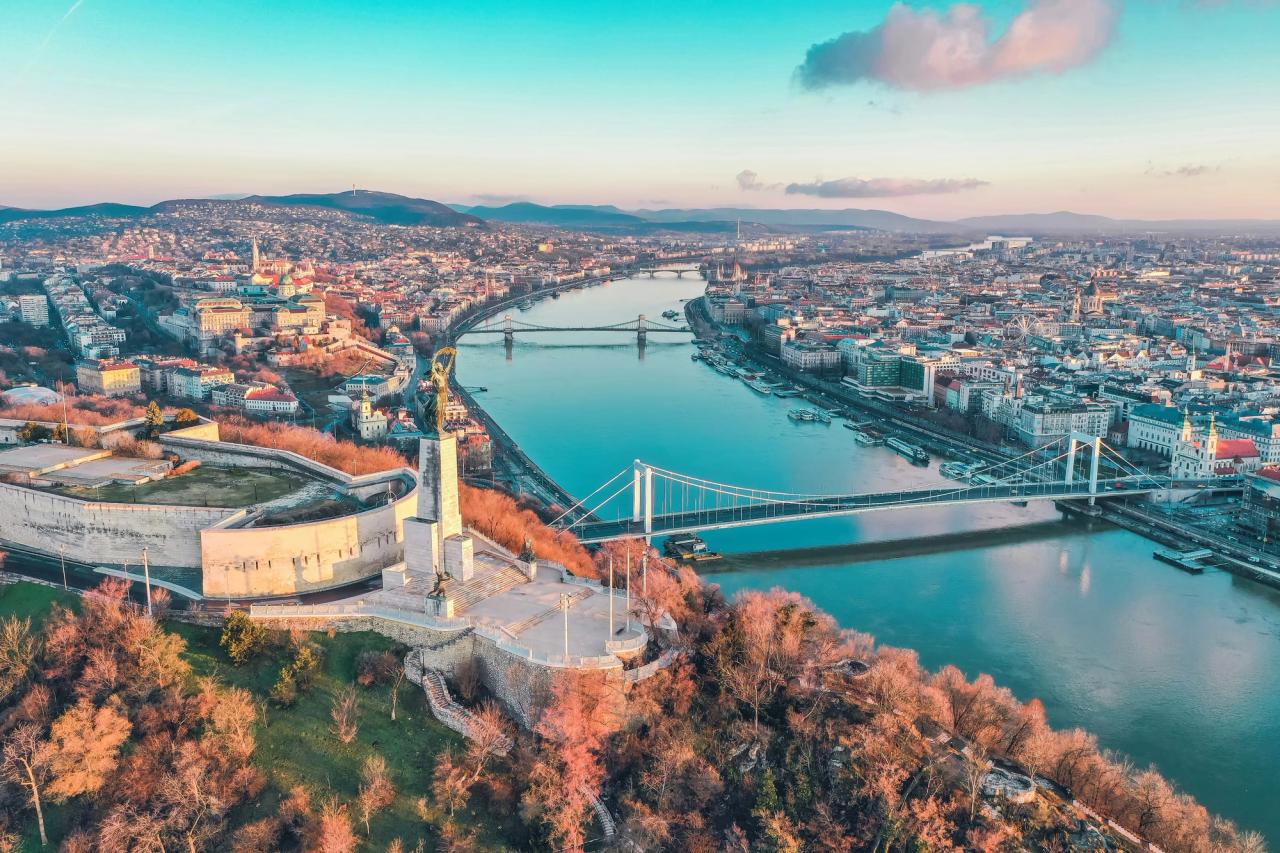
Budapest est l'une des capitales les plus fascinantes d'Europe, divisée par le Danube en deux parties : le côté Buda, vallonné et résidentiel, et le côté Pest, plat et animé. Réputée pour ses bains thermaux, ses légendaires ruin bars et son coût de la vie remarquablement abordable, Budapest attire les télétravailleurs, les étudiants et les professionnels en quête d'un art de vivre à l'européenne à moindre coût. Que vous soyez un jeune créatif attiré par la vie nocturne du District VII ou une famille en quête de collines verdoyantes à Buda, la ville a un quartier adapté à chaque étape de la vie.
Budapest s'est réinventée au cours des deux dernières décennies, passant d'une capitale post-communiste à un carrefour européen prospère. La grandeur architecturale de la ville — du Parlement néo-gothique aux Bains Gellért Art Nouveau — rivalise avec celle de villes deux fois plus chères. Ajoutez à cela un secteur technologique en plein essor, des transports en commun de classe mondiale et l'un des meilleurs quartiers de vie nocturne du continent, et l'on comprend pourquoi Budapest figure constamment parmi les premières destinations des expatriés qui s'installent en Europe centrale.
Budapest en un coup d'œil

- Population
- ~1,67 million (agglomération ~3,0 millions)
- Région
- Hongrie centrale (ville indépendante, entourée du comté de Pest)
- Réputée pour
- Bains thermaux, ruin bars, panorama sur le Danube
- Loyer moyen (1 chambre)
- 220 000–320 000 HUF/mois (centre-ville)
- Salaire moyen
- 450 000–550 000 HUF/mois net
- Communauté d'expatriés
- Grande et diversifiée ; importantes communautés allemande, britannique, américaine et asiatique
- Langue
- Hongrois ; anglais largement parlé dans les zones centrales
Pourquoi s'installer à Budapest
- Capitale abordable : loyer, restauration et transports coûtent 40 à 60 % moins cher qu'à Vienne ou Prague, pour une qualité de vie comparable.
- Culture des bains thermaux : plus d'une douzaine de bains thermaux historiques, dont Széchenyi, Gellért et Rudas, offrent une détente toute l'année et font partie intégrante de la vie sociale locale.
- Vie nocturne animée : les ruin bars du District VII (Szimpla Kert, Instant-Fogas) créent une scène nocturne unique en Europe — éclectique, sans prétention et toujours surprenante.
- Carrefour d'Europe centrale : l'aéroport Budapest Ferenc Liszt dessert plus de 150 destinations ; Vienne, Bratislava et Zagreb sont accessibles en quelques heures de train ou de bus.
- Paradis du télétravail : internet rapide, nombreux espaces de coworking et faibles coûts font de Budapest l'une des meilleures villes européennes pour les nomades numériques.
Trouver un logement à Budapest
Loyers moyens
| Quartier | 1 chambre (HUF/mois) | 3 chambres (HUF/mois) | Caractère |
|---|---|---|---|
| District V (Belváros) | 250 000–350 000 | 500 000–750 000 | Huppé, central, historique |
| District VII (Erzsébetváros) | 180 000–260 000 | 350 000–500 000 | Animé, vie nocturne, jeunes professionnels |
| District XIII (Angyalföld) | 160 000–230 000 | 300 000–450 000 | Familial, calme, moderne |
| District XI (Újbuda) | 170 000–250 000 | 320 000–480 000 | Verdoyant, résidentiel, bien desservi |
| District VIII (Józsefváros) | 150 000–220 000 | 280 000–420 000 | En gentrification, multiculturel, abordable |
| District IX (Ferencváros) | 165 000–240 000 | 310 000–460 000 | Tendance, riverain, nouveaux projets immobiliers |
Comment trouver un logement
- Ingatlan.com : le plus grand portail immobilier de Hongrie ; la plupart des propriétaires y publient leurs annonces en premier. Le meilleur point de départ pour toute recherche d'appartement.
- Groupes Facebook : « Budapest Apartments for Rent » et « Expats in Budapest Housing » publient des annonces quotidiennes, aussi bien d'agences que de particuliers.
- Albérlet.hu : plateforme dédiée à la location avec des filtres pour les logements meublés et acceptant les animaux de compagnie.
- Conseil local : la plupart des contrats sont d'un an minimum. Prévoyez 2 mois de caution plus le premier mois de loyer à l'avance. Un garant hongrois peut parfois permettre de réduire le montant de la caution.
Conseils pour les expatriés
- Visitez toujours en personne avant de signer ; les photos sur les sites d'annonces peuvent être trompeuses ou obsolètes.
- Vérifiez si les charges communes (közös költség) sont incluses dans le loyer affiché — elles ne le sont souvent pas.
- Retenez le terme « rezsi » — il désigne les charges et est souvent indiqué séparément du loyer.
- Les immeubles anciens (d'avant-guerre) ont du cachet, mais peuvent manquer d'ascenseur ou d'isolation moderne. Vérifiez le type de chauffage et le classement énergétique avant de vous engager.
- Les Districts VII et VIII offrent le meilleur rapport qualité-prix près du centre, mais peuvent être bruyants la nuit.
Guide des quartiers
- District V (Belváros-Lipótváros) : le cœur politique et commercial en bord de Danube. Appartements huppés, vues sur le Parlement et loyers élevés. Idéal pour les professionnels qui souhaitent tout faire à pied.
- District VI (Terézváros) : tendance et central, accueillant l'avenue Andrássy et l'Opéra. Prisé des jeunes professionnels et des expatriés. Loyers moyens à élevés, avec une vie de rue animée.
- District VII (Erzsébetváros) : le quartier festif de Budapest, riche en ruin bars, en street art et abritant la Grande Synagogue. Loyers abordables et énergie débordante — idéal pour les étudiants et les créatifs.
- District XI (Újbuda) : un quartier verdoyant et résidentiel côté Buda, près de la colline Gellért. Bonnes écoles, parcs et lignes de tramway. Familial avec des loyers modérés.
- District XIII (Angyalföld) : calme, moderne et de plus en plus prisé des familles. Nouveaux immeubles résidentiels, promenades en bord de rivière et transports en commun fiables. En plein essor.
- District VIII (Józsefváros) : en pleine gentrification, multiculturel et encore abordable. Accueille le Musée national hongrois et la Promenade Corvin. Un bon choix pour les expatriés soucieux de leur budget.
Coût de la vie à Budapest
Répartition du budget mensuel
| Catégorie | Fourchette budgétaire (HUF) |
|---|---|
| Loyer (1 chambre, centre) | 220 000–320 000 |
| Charges | 35,000–55,000 |
| Internet | 5,000–8,000 |
| Alimentation | 60,000–90,000 |
| Transport (abonnement mensuel) | ~10,500 (vérifiez les tarifs actuels BKK BudapestGO) |
| Restaurants (4x/mois) | 25,000–40,000 |
| Loisirs/Salle de sport | 12,000–20,000 |
| Total | 366,500–562,500 |
Coûts du quotidien
- Café (flat white) : HUF 900–1,500
- Déjeuner (restaurant décontracté) : HUF 2,500–4,000
- Abonnement mensuel de transport : ~HUF 10,500 (vérifiez les tarifs actuels BKK BudapestGO)
- Bière (bar, 0.5L) : HUF 800–1,500
- Billet de cinéma : HUF 2,000–2,800
- Miche de pain : HUF 500–800
- 1 litre de lait : HUF 350–450
- Abonnement mensuel salle de sport : HUF 10,000–20,000
Se déplacer à Budapest
- Transports en commun : BKK exploite 4 lignes de métro, un vaste réseau de tramways (notamment le légendaire tramway 2 longeant le Danube), de bus et de trolleybus. Un abonnement mensuel couvre tous les modes de transport. Consultez BKK BudapestGO pour connaître les tarifs actuels (les prix sont révisés chaque année). Le réseau fonctionne du petit matin jusqu'à environ 23 h 30, les bus de nuit (marqués « éjszakai ») remplaçant le métro et les tramways après minuit.
- Vélo : Le réseau de pistes cyclables est en pleine expansion. Le vélo en libre-service MOL Bubi est très populaire et coûte HUF 500/mois pour les courtes distances. Idéal du côté plat de Pest ; les collines de Buda sont plus difficiles à parcourir.
- Voiture : Peu recommandée pour les trajets quotidiens — le stationnement est cher et rare dans le centre. Les services d'autopartage comme GreenGo et MOL Limo sont courants et pratiques pour les déplacements occasionnels.
- Aéroport : L'aéroport international Budapest Ferenc Liszt (BUD) se trouve à 16 km du centre. Le bus 100E relie directement Deák tér pour HUF 2,200. Un taxi jusqu'au centre coûte environ HUF 8,000–10,000.
- Intercités : Des trains directs desservent Vienne (2 h 30), Bratislava (2 h 30), Zagreb et Bucarest depuis les gares Budapest Keleti et Nyugati. FlixBus propose des liaisons en autocar abordables à travers toute l'Europe centrale.
Santé à Budapest
- Hôpitaux/Cliniques : L'hôpital universitaire Semmelweis, le Szent János Hospital et de nombreuses cliniques privées (Medicina, Swiss Medical). Le système public couvre les soins de base, mais les délais d'attente peuvent être longs.
- Médecins anglophones : Largement disponibles dans les cliniques privées ; limités dans les hôpitaux publics. Le Rózsakert Medical Center et FirstMed sont très appréciés des expatriés. Les consultations privées coûtent HUF 15,000–30,000.
- Pharmacies : Très nombreuses. Reconnaissables à la croix verte. Beaucoup sont ouvertes tard le soir ou 24 h/24 dans le centre-ville.
- Numéro d'urgence : 112 (général), 104 (ambulance)
Recevez un plan de demenagement personnalise
Laissez votre e-mail et nous vous enverrons une checklist adaptee ainsi que trois devis de demenageurs verifies.
Culture et mode de vie
- Bains thermaux : Széchenyi, Gellért, Rudas et Király sont des incontournables. Les habitants considèrent les bains comme des lieux de vie sociale, et pas seulement comme des attractions touristiques. L'entrée coûte HUF 2,500–6,000 selon le bain et les prestations.
- Bars dans les ruines : Ce phénomène typique du VIIe arrondissement — des bars aménagés dans des bâtiments abandonnés avec une décoration éclectique. Szimpla Kert est le pionnier ; Instant-Fogas est le plus grand complexe.
- Bords du Danube : Les promenades en soirée le long des quais de Pest et de la colline du château de Buda sont légendaires. Gratuites et incomparables.
- Festivals : Sziget Festival (août), Budapest Wine Festival (septembre), marchés de Noël de Budapest (décembre), Budapest Spring Festival (mars/avril).
Gastronomie et restauration
- Essayez le gulyás (goulash), le lángos (pâte frite à la crème fraîche) et le kürtőskalács (gâteau cheminée).
- Le Grand Marché Couvert (Nagyvásárcsarnok) est l'endroit idéal pour les produits locaux et la street food.
- Repas économiques : Les menus de déjeuner à la menza (plats du jour) coûtent HUF 2,000–3,500.
- Cuisine gastronomique : Budapest compte plusieurs restaurants étoilés au guide Michelin, dont Costes et Stand.
Vie nocturne
- Les bars dans les ruines du VIIe arrondissement sont la principale attraction — Szimpla Kert, Instant-Fogas, Élesztő et Csendes ont chacun une ambiance unique.
- Musique live : Le A38 Ship (un navire ukrainien reconverti sur le Danube) accueille des artistes internationaux. Le Budapest Jazz Club et Muzikum sont idéaux pour les concerts intimistes.
- Clubs : Akvárium, Morrisons 2 et Lärm proposent musique électronique et danse. La plupart des clubs restent ouverts jusqu'à 4–5 h du matin le week-end.
Communauté d'expatriés
- InterNations Budapest : Des rencontres et événements de networking réguliers pour les professionnels.
- Groupe Facebook Budapest Expats : Plus de 50,000 membres ; la référence pour les conseils, le logement et les événements sociaux.
- Échanges linguistiques : Tandem Budapest et diverses soirées d'échange linguistique en bar ont lieu chaque semaine.
Travail à distance
- Espaces de coworking : Loffice, Kaptár, KUBIK et Impact Hub proposent des postes de travail à partir de HUF 30,000–60,000/mois. De nombreux cafés disposent d'une bonne connexion WiFi et sont accueillants pour les télétravailleurs.
- Internet : La vitesse moyenne du haut débit fixe dépasse 150 Mbps. La fibre optique est largement disponible.
- Fuseau horaire : CET (UTC+1), idéal pour travailler en chevauchant les horaires européens et ceux de la côte Est des États-Unis.
Faire ses achats à Budapest
- Alimentation : Spar, Aldi, Lidl et Penny Market pour les achats économiques. CBA et Match pour la proximité. Le Grand Marché Couvert pour les produits frais et les spécialités.
- Centres commerciaux : Westend City Center, Arena Mall et Árkád sont les plus grands centres commerciaux. Mammut et Allee sont populaires du côté de Buda.
- Marchés : Le marché aux puces d'Ecseri (le samedi matin) est idéal pour les antiquités et les curiosités.
Marché de l'emploi à Budapest
- Principaux secteurs : IT et technologie, centres de services partagés (SSC), automobile, finance, tourisme.
- Principaux employeurs : Audi, Mercedes-Benz, Nokia, Morgan Stanley, Deutsche Telekom (IT Services), GE.
- Salaires moyens par secteur :
| Secteur | Salaire net mensuel moyen (HUF) |
|---|---|
| IT / Logiciel | 500,000–900,000 |
| Finance / Banque | 450,000–750,000 |
| Services partagés (SSC) | 350,000–550,000 |
| Hôtellerie / Tourisme | 250,000–350,000 |
- Ressources pour la recherche d'emploi : Profession.hu, LinkedIn, Bluebird, Hays Hungary, No Fluff Jobs (pour la tech).
Éducation à Budapest
- Écoles internationales : Britannica International School, British International School of Budapest (BISB), American International School of Budapest (AISB). Les frais de scolarité varient de HUF 4,000,000 à HUF 8,000,000 par an.
- Universités : Corvinus University, Semmelweis University, Budapest University of Technology and Economics (BME), ELTE, Óbuda University. (Remarque : la CEU a délocalisé la majeure partie de ses activités à Vienne en 2019.)
- Écoles de langues : Berlitz, International House et des dizaines d'écoles de hongrois pour les expatriés.
Langue et intégration
- Le hongrois est l'une des langues les plus difficiles d'Europe, mais apprendre même quelques expressions de base sera très apprécié par les habitants.
- La plupart des administrations exigent le hongrois ou la présence d'un interprète. L'assistance en anglais se développe, mais n'est pas garantie.
- Des cours de hongrois gratuits et subventionnés sont disponibles auprès de la fondation MigHelp, basée à Budapest, et dans les collèges communautaires (nyelviskola).
Conseils pour vivre en hiver
- Les hivers à Budapest (décembre–février) affichent généralement des maximales de 0 °C à 4 °C en journée et des minimales de -3 °C à -1 °C la nuit. Des vagues de froid occasionnelles peuvent faire descendre les températures en dessous de -10 °C. Habillez-vous en couches et investissez dans un manteau d'hiver de qualité.
- Les frais de chauffage augmentent considérablement en hiver — prévoyez un budget supplémentaire de 10 000–20 000 HUF par mois pour les charges entre novembre et mars.
- Les bains thermaux sont particulièrement magiques en hiver — la vapeur s'élevant des bassins chauds dans l'air glacial est une expérience quintessentielle de Budapest.
Liste de contrôle pour s'installer à Budapest
- Obtenir un visa ou confirmer le droit de résidence EU/EEE
- Explorer les quartiers et présélectionner des appartements sur Ingatlan.com
- Obtenir un acte de mariage/naissance apostillé si nécessaire pour les démarches administratives
- Souscrire une assurance maladie internationale pour les premiers mois
- Déclarer votre adresse au Kormányablak local (guichet administratif)
- Faire une demande de carte TAJ (numéro de sécurité sociale)
- Ouvrir un compte bancaire hongrois (OTP, Erste ou K&H)
- Obtenir une carte SIM locale (Vodafone, Yettel, Telekom)
- S'inscrire pour obtenir un adószám (numéro fiscal) auprès de NAV
- S'inscrire à des cours de hongrois
- Explorer votre quartier à pied et repérer le marché, la pharmacie et la clinique les plus proches
- Rejoindre un groupe d'expatriés ou participer à un événement de rencontre
Sports et loisirs
- Course à pied et randonnée : Margitsziget (île Marguerite) dispose d'une piste de course en caoutchouc. Les collines de Buda offrent des sentiers de randonnée accessibles en transports en commun (chemin de fer à crémaillère + télésiège jusqu'à la colline János).
- Natation : au-delà des bains thermaux, Dagály et Palatinus sont des piscines en plein air très fréquentées en été. La Duna Arena accueille des compétitions de natation.
- Football : Ferencváros (Fradi) et MTK sont les principaux clubs. La Groupama Arena accueille des matchs dans une atmosphère animée.
- Fitness : des chaînes de salles de sport comme McFit, BioTech USA et Flex Gym proposent des abonnements à partir de 10 000 HUF/mois. Les parcs de fitness en plein air sont courants sur Margitsziget et dans les parcs de la ville.
- Sports d'hiver : pas de ski à Budapest, mais les collines de Buda sont idéales pour la randonnée hivernale. Les Tatras slovaques sont à environ 3 à 4 heures de route.
Conseils de sécurité pour les expatriés
- Gardez vos objets de valeur hors de vue dans les transports en commun et dans les zones touristiques fréquentées.
- Utilisez des taxis officiels (Főtaxi, Bolt) plutôt que des véhicules non identifiés à l'aéroport.
- Inscrivez-vous auprès de votre ambassade à votre arrivée pour bénéficier d'un soutien en cas d'urgence.
- Enregistrez le 112 (urgences générales) et le 104 (ambulance) dans votre téléphone.
Guides connexes
- [S'installer en Hongrie] — guide complet du pays
- [S'installer à Debrecen] — la deuxième ville de Hongrie
- [S'installer à Szeged] — la ville la plus ensoleillée de Hongrie