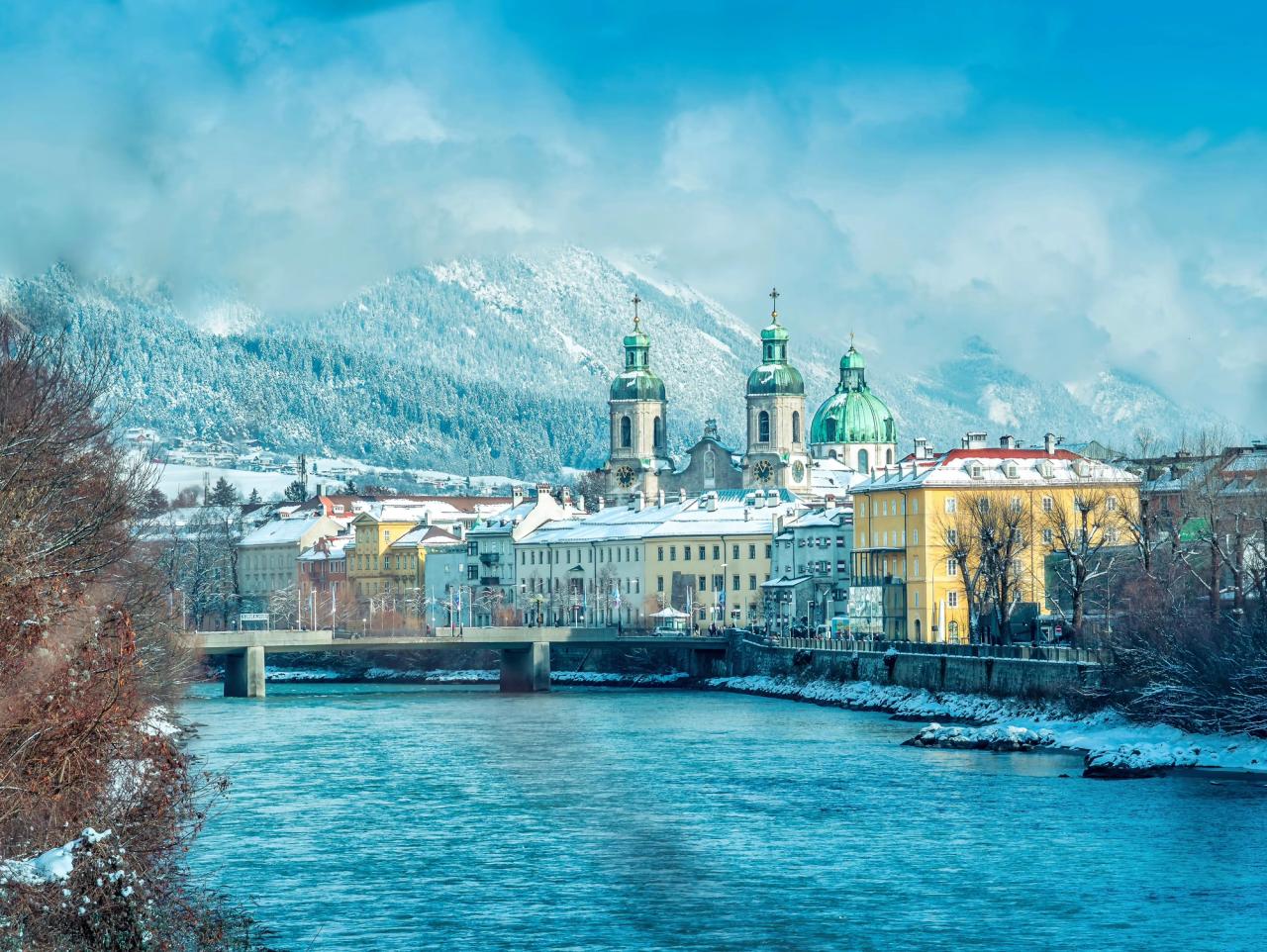
Nichée dans une étroite vallée où la rivière Inn rejoint la chaîne de montagnes du Nordkette, Innsbruck est la capitale du Tyrol (Tirol) et l'une des villes les plus spectaculaires d'Europe sur le plan géographique. Avec environ 130 000 habitants serrés entre des sommets qui s'élèvent au-dessus de 2 000 mètres, elle est à la fois une ville universitaire, un pôle de sports d'hiver et un centre administratif régional. Les expatriés s'y installent pour des postes de recherche alpine à l'Université d'Innsbruck, des fonctions dans le tourisme, des startups technologiques, et tout simplement parce qu'on peut rejoindre une piste de ski depuis le centre-ville en moins de trente minutes par téléphérique. Ce guide vous présente tout ce qu'il faut savoir avant de vous relocaliser.
Innsbruck en un coup d'œil
- Population
- ~132 000 (ville), ~250 000 (aire métropolitaine incluant les vallées tyroliennes environnantes)
- Région
- Tyrol (Tirol), ouest de l'Autriche
- Connu pour
- Paysages alpins, sports d'hiver, Université d'Innsbruck, accès au Nordkette depuis le centre-ville
- Loyer moyen (1 chambre)
- €900–€1 300 selon le quartier
- Salaire moyen
- ~€2 800–€3 300 net/mois
- Communauté d'expatriés
- Modérée — portée par des chercheurs universitaires, des professionnels du tourisme et des travailleurs saisonniers ; groupes internationaux actifs via MCI et l'Uni Innsbruck
Pourquoi s'installer à Innsbruck
- La montagne à portée de porte : le funiculaire Hungerburgbahn part du centre-ville et atteint le Nordkette en quelques minutes ; des domaines skiables comme le Patscherkofel et l'Axamer Lizum sont accessibles en bus public.
- Une ville compacte et agréable à vivre : la plupart des courses se font à pied ou à vélo ; les ponts de l'Innbrücke relient les rives nord et sud en dix minutes à pied.
- Un secteur universitaire et de recherche solide : l'Université d'Innsbruck (Leopold-Franzens-Universität) et le MCI Management Center Innsbruck attirent des chercheurs et des étudiants internationaux.
- Air pur et culture du plein air : le Tiroler Landesumweltanwaltschaft (médiateur environnemental du Tyrol) protège activement la qualité de l'air ; la randonnée, l'escalade et le ski dominent les week-ends.
- Des connexions au cœur de l'Europe : l'Innsbruck Hauptbahnhof propose des liaisons ferroviaires directes vers Munich (moins de 2 heures), Vienne (4 heures) et Zurich (3 h 30).
Visas et résidence
L'Autriche exige que la plupart des ressortissants non-EU/EEE obtiennent un permis de résidence avant de s'y installer. Les principales catégories pour les expatriés qui s'installent à Innsbruck sont :
- Rot-Weiss-Rot Karte (carte Rouge-Blanc-Rouge) : permis de travail à points pour les travailleurs qualifiés. Les employeurs d'Innsbruck dans la technologie, le tourisme et la recherche parrainent fréquemment cette carte. Il vous faut au moins 55 points selon vos qualifications, votre expérience, votre âge et vos compétences linguistiques. Le traitement prend 8 à 12 semaines via l'ambassade ou le consulat autrichien dans votre pays d'origine. Après 21 mois avec la carte RWR, vous pouvez demander la RWR Card plus, qui accorde des droits plus souples pour changer d'employeur.
- Aufenthaltsbewilligung (permis de résidence) : pour les étudiants inscrits à l'Université d'Innsbruck ou au MCI ; une preuve de ressources financières suffisantes (environ €1 000/mois) et une assurance maladie sont requises. Les étudiants hors EU doivent effectuer leur demande auprès du consulat autrichien compétent avant d'entrer en Autriche.
- D-Visum (visa national D) : pour les séjours de 91 jours à six mois ; couramment utilisé par les chercheurs et les travailleurs saisonniers du tourisme.
- Citoyens EU/EEE : ils doivent s'inscrire auprès du Meldeamt (bureau d'enregistrement) local dans les trois jours suivant leur arrivée. Vous recevrez un Meldezettel (formulaire d'enregistrement) confirmant votre adresse — ce document est indispensable pour tout, de l'ouverture d'un compte bancaire à l'inscription à la couverture santé.
Les demandes de permis de résidence sont traitées par la Bezirkshauptmannschaft Innsbruck-Land (autorité de district pour les zones environnantes) ou le Magistrat der Stadt Innsbruck (magistrat municipal pour les résidents dans les limites de la ville). Comptez des délais de traitement de 8 à 16 semaines pour les permis hors EU.
Trouver un logement à Innsbruck
Loyers moyens
| Quartier | 1 chambre | 3 chambres | Caractère |
|---|---|---|---|
| Altstadt (vieille ville) | €1 100–€1 400 | €1 800–€2 400 | Centre historique, offre limitée, essentiellement des appartements Alt-bau rénovés au-dessus des commerces |
| Saggen | €1 000–€1 300 | €1 700–€2 200 | Quartier résidentiel calme, proche du Tirol Klinikum, prisé des familles et du personnel médical |
| Pradl | €850–€1 100 | €1 400–€1 800 | Quartier résidentiel dense, bonnes liaisons en bus, forte présence étudiante près des installations universitaires |
| Hötting | €950–€1 250 | €1 600–€2 100 | Flanc de colline au nord de l'Inn, vues panoramiques, anciennes fermes mélangées à des constructions modernes |
| Wilten | €800–€1 050 | €1 300–€1 700 | Au sud du Hauptbahnhof, plus abordable, site du tremplin de ski du Bergisel |
| Reichenau | €750–€1 000 | €1 200–€1 600 | Quartier est, plus verdoyant et plus calme, prisé des familles, bon accès au tramway IVB |
Comment trouver un logement
- Willhaben.at : la principale plateforme immobilière d'Autriche ; filtrez par Innsbruck et les villages tyroliens environnants. La plupart des propriétaires publient exclusivement ici.
- Housing.at : géré par des associations de logement municipales et à but non lucratif (Gemeindebauten) ; loyers plafonnés selon les revenus, mais longues listes d'attente.
- University of Innsbruck Studentenwerk : gère les résidences étudiantes ; certains logements sont disponibles pour les chercheurs et le personnel international.
- Agents immobiliers locaux (Immobilienmakler) : Re/Max Tirol et real|esty Innsbruck s'occupent des locations meublées et non meublées. Depuis juin 2023, le Bestellerprinzip autrichien s'applique : c'est celui qui mandate l'agent qui paie les honoraires. Si le propriétaire engage l'agent, c'est le propriétaire qui paie — pas vous. Vous ne payez la Maklerprovision que si vous engagez vous-même un agent pour trouver un appartement.
- Groupes Facebook : « Wohnung Innsbruck » et « Innsbruck Expats Housing » proposent des sous-locations et des chambres en WG (Wohngemeinschaft, colocation), très répandues chez les étudiants et les jeunes actifs.
Conseils pour les expatriés
- La géographie en vallée d'Innsbruck limite sévèrement les terrains constructibles, ce qui rend le marché locatif plus tendu qu'à Graz ou Linz. Commencez vos recherches au moins six semaines avant votre date de déménagement.
- Les propriétaires autrichiens exigent généralement une Kaution (caution) de deux à trois mois de loyer froid (loyer net hors charges), trois mois étant le maximum légal en vertu du § 15 MRG. La caution doit être conservée sur un compte séquestre distinct.
- Un Mietvertrag (contrat de location) en Autriche est généralement à durée indéterminée (unbefristet) pour les appartements non meublés ; les locations meublées à court terme affichent une majoration de 20 à 40 %.
- Votre Meldezettel est requis avant de signer la plupart des contrats de bail. Prévoyez de vous inscrire au Magistrat dans les trois jours suivant votre emménagement.
- Les frais de chauffage pendant les hivers innsbruckiens sont significatifs — demandez toujours si le loyer indiqué inclut les Betriebskosten (charges de fonctionnement de l'immeuble) ou si celles-ci sont facturées séparément.
Guide des quartiers
- Altstadt (vieille ville) : idéale pour les célibataires et les couples qui souhaitent tout faire à pied. Le Goldenes Dachl (toit doré) est le monument emblématique au cœur du quartier. Les loyers sont les plus élevés de la ville ; le stationnement est extrêmement limité et coûteux. La vie nocturne se concentre le long de la Seilergasse et de la Maria-Theresien-Straße en bord de rivière.
- Saggen : apprécié des médecins, des familles et des professionnels travaillant au Tirol Klinikum ou à proximité. Larges rues bordées d'arbres, mélange de villas de la Belle Époque et d'immeubles d'après-guerre. À courte distance à pied de l'Innbrücke et de l'Altstadt.
- Pradl : le quartier le plus densément peuplé ; grandes cités d'après-guerre et constructions récentes. Il accueille le stade de football Tivoli Neu et le complexe sportif Olympiaworld. Bonne liaison en tramway (ligne 3) vers le Hauptbahnhof. Loyers dans la moyenne.
- Hötting : s'étend sur le flanc de colline au nord de la rivière Inn. D'anciennes fermes tyroliennes (Einhöfe) côtoient de luxueux penthouses modernes avec vue sur les montagnes. Le sentier de randonnée Höttinger Alm part pratiquement de la limite du quartier, ce qui le rend populaire auprès des amateurs de plein air. La voiture est fortement recommandée ici — les rues en montée sont raides et les conditions hivernales rendent le vélo peu pratique.
- Wilten : ancré par la basilique de Wilten et le tremplin de ski du Bergisel conçu par Zaha Hadid. Plus abordable que Saggen ou l'Altstadt, avec un mélange d'étudiants et de résidents de longue date. Le Hauptbahnhof se trouve à sa limite est, ce qui en fait un lieu idéal pour les navetteurs qui se rendent régulièrement à Munich ou Vienne. Le cimetière Südfriedhof et le parc adjacent offrent des espaces verts.
- Reichenau : le quartier le plus à l'est, bordé par la rivière Inn au nord et la montagne Patscherkofel au sud. Verdoyant et familial, avec de bonnes écoles et le tramway IVB ligne 5 reliant directement le centre-ville. Les loyers sont les plus bas dans les limites de la ville, et les appartements y sont généralement plus récents et plus spacieux que dans les quartiers centraux plus anciens.
- Igls (en périphérie de la ville) : un quartier au charme villageois sur les pentes du Patscherkofel au sud de la ville, techniquement rattaché à Innsbruck mais à l'atmosphère résolument rurale. Prisé des familles aisées et des retraités en quête de calme et de beaux panoramas. La piscine en plein air Igler Mühlbachl est ouverte en été. La ligne de bus J relie le centre-ville en 20 minutes.
Coût de la vie à Innsbruck
Répartition du budget mensuel
| Catégorie | Fourchette budgétaire |
|---|---|
| Loyer (1 chambre, centre) | €1 000–€1 300 |
| Charges (chauffage inclus) | €200–€350 |
| Internet | €30–€45 |
| Courses alimentaires | €280–€380 |
| Transports (abonnement mensuel IVB) | €52–€59 |
| Repas au restaurant (4x/mois) | €120–€200 |
| Loisirs/Salle de sport | €50–€100 |
| Ticket modérateur assurance maladie | €20–€50 |
| Total | €1 750–€2 500 |
Dépenses du quotidien
- Café (Melange dans un café de la Maria-Theresien-Straße) : €3,20–€4,00
- Déjeuner (informel, par ex. un Tiroler Gröstl dans un Wirtshaus) : €10–€14
- Abonnement mensuel de transport (IVB Semesterticket pour étudiants) : €52 ; tarif adulte standard : €59
- Bière (un demi-litre de Tiroler Bier local dans un bar) : €4,00–€5,50
- Billet de cinéma (Cinematograph ou Metropolkin) : €10–€13
- Forfait journée de ski (Patscherkofel, accessible en bus de ville) : €42–€55
Santé à Innsbruck
- Tirol Klinikum (Universitätsklinik Innsbruck) : le principal complexe hospitalier, situé à Saggen. C'est l'un des plus grands hôpitaux universitaires d'Autriche et il prend en charge tout, des urgences traumatologiques à la médecine alpine spécialisée. Adresse : Anichstraße 35.
- Médecins anglophones : disponibles via le bureau des patients internationaux du Tirol Klinikum et plusieurs cabinets privés dans les quartiers Altstadt et Saggen. L'ÖGK (Österreichische Gesundheitskasse, la caisse d'assurance maladie publique) propose un annuaire de médecins consultable en ligne.
- Pharmacies (Apotheken) : présentes dans presque chaque grande rue ; la Hauptapotheke sur la Maria-Theresien-Straße assure une rotation de permanence nocturne. En Autriche, les pharmaciens peuvent délivrer certains médicaments qui nécessiteraient une ordonnance ailleurs.
- Numéros d'urgence : 144 pour l'ambulance ; 112 pour les urgences générales européennes ; 141 pour le service de médecin de garde (Ärztefunkdienst).
- Inscription à l'assurance maladie : une fois embauché, votre employeur vous inscrit auprès de l'ÖGK. Les expatriés indépendants s'inscrivent directement au bureau de la Gebietskrankenkasse Tirol. Votre e-card (carte de santé électronique) vous parvient par courrier et est utilisée à chaque visite chez le médecin.
Recevez un plan de demenagement personnalise
Laissez votre e-mail et nous vous enverrons une checklist adaptee ainsi que trois devis de demenageurs verifies.
Banque et finances
Ouvrir un compte bancaire à Innsbruck nécessite votre Meldezettel, votre passeport et souvent une preuve d'emploi ou d'inscription universitaire.
- Raiffeisen Landesbank Tirol : la banque régionale dominante avec des agences dans chaque quartier ; propose des comptes en anglais pour les nouveaux arrivants.
- Erste Bank : dispose d'une agence sur la Museumstraße près de l'Altstadt ; bonne application de banque en ligne.
- Bank Austria (UniCredit) : agence à la Meinhardstraße à Pradl ; assistance en anglais disponible.
- Steuer-ID (numéro d'identification fiscale) : délivré par le Finanzamt Innsbruck lors de votre inscription à des fins fiscales. Votre employeur ou votre université peut vous aider dans la démarche. Ce numéro est distinct de votre Sozialversicherungsnummer (numéro de sécurité sociale), que vous recevez lors de votre inscription à l'assurance maladie.
Se déplacer à Innsbruck
- Transports en commun : les Innsbrucker Verkehrsbetriebe (IVB) exploitent des tramways (Strassenbahn) et des bus dans toute la ville. Les lignes 1, 2, 3 et 5 sont les lignes principales. La IVB Monatskarte (abonnement mensuel) coûte €59 ; un abonnement annuel est d'environ €530. Pour les déplacements régionaux, la VVT Wochenkarte (carte hebdomadaire) et le KlimaTicket VVT couvrent l'IVB ainsi que les trains et bus régionaux vers les vallées environnantes.
- Hungerburgbahn et Nordkette : le funiculaire depuis le centre-ville (station Congress) jusqu'à Hungerberg, puis les télécabines vers le sommet du Nordkette, sont exploités par les Innsbrucker Nordkettenbahnen. Ces transports sont couverts par des billets ski/randonnée séparés, et non par l'abonnement IVB standard.
- Vélo : Innsbruck est compacte et favorable au vélo, avec des pistes dédiées le long de la rivière Inn (Innradweg). Stadtwerke Innsbruck exploite un système de vélos en libre-service avec des stations au Hauptbahnhof, sur le campus universitaire et dans l'Altstadt. Le vélo en hiver est possible mais nécessite des pneus cloutés sur les rues secondaires verglacées. Les vélos électriques sont de plus en plus populaires pour négocier les côtes à Hötting et Igls.
- En voiture : une voiture n'est pas indispensable dans les limites de la ville, mais elle est utile pour atteindre les villages des vallées tyroliennes. Le stationnement dans l'Altstadt est rare et coûte €2–€3 par heure dans les parkings municipaux (Tiefgarage Altstadt, Citygarage). Les autoroutes A12 et A13 relient Innsbruck à l'Allemagne (au nord) et à l'Italie (au sud via le col du Brenner). Notez que les autoroutes autrichiennes nécessitent une Vignette (vignette de péage) — achetez-en une dans une station-service ou en ligne avant de prendre l'A12.
- Aéroport : l'aéroport d'Innsbruck (INN) à Hötting propose des vols vers Vienne (Austrian Airlines), Francfort (Lufthansa), Amsterdam (KLM), et des routes saisonnières exploitées par easyJet et Transavia. Les horaires de vols sont limités en hiver en raison des conditions météo alpines. De nombreux expatriés utilisent l'aéroport de Munich (MUC) pour les vols long-courriers, accessible en train en moins de 2 h 30 via le Bayerische Oberlandbahn ou l'ÖBB Railjet.
- Train intercités : l'Innsbruck Hauptbahnhof est un arrêt sur le principal corridor ferroviaire est-ouest. Les trains ÖBB Railjet desservent Vienne (4 heures), Munich (1 heure 50 minutes) et Zurich (3 heures 30 minutes). La ligne ferroviaire du Brenner relie le sud à Bolzano et Vérone.
Éducation à Innsbruck
- Écoles internationales : l'International School Innsbruck (ISI), située dans la partie est de la ville, propose des programmes IB en anglais du primaire jusqu'au diplôme. Le Lyzeum Innsbruck propose des filières bilingues.
- Universités : l'Université d'Innsbruck (Leopold-Franzens-Universität) est la plus grande, avec des programmes solides en recherche alpine, physique, économie et droit. Le MCI Management Center Innsbruck propose des licences et des masters en sciences appliquées dans les domaines du commerce, de la technologie et des sciences sociales, avec de nombreux programmes enseignés en anglais.
- Cours de langue : Deutsch.in Innsbruck et la Volkshochschule Innsbruck (VHS) proposent des cours d'allemand intensifs de niveau A1 à C1, avec des options en soirée et le week-end pour les professionnels en activité. Le Sprachenzentrum de l'université offre des cours aux étudiants inscrits et au personnel, notamment des ateliers d'allemand académique et de dialecte Tirolerisch. Les cours particuliers coûtent €30–€50 de l'heure et peuvent être trouvés via Nachhilfe.at ou les tableaux d'affichage universitaires.
Le marché de l'emploi à Innsbruck
- Principaux secteurs : tourisme et hôtellerie, administration publique (gouvernement du Land du Tyrol), santé (Tirol Klinikum), éducation et recherche (Université d'Innsbruck, MCI), construction, et un écosystème tech/startup en plein essor ancré à l'Innovationszentrum Tirol (IZT).
- Principaux employeurs : Tirol Klinikum, Université d'Innsbruck, Tiroler Landesregierung (gouvernement du Land du Tyrol), Swarovski (dont le siège est à Wattens, tout près), IVB, et de nombreux groupes hôteliers dont l'Innsbruck Tourismus exploitant les infrastructures de ski.
- Salaires moyens par secteur :
| Secteur | Salaire mensuel brut |
|---|---|
| Tourisme/Hôtellerie | €2 200–€2 800 |
| Santé (infirmier/médecin) | €3 000–€5 500 |
| Informatique/Tech | €3 200–€4 800 |
| Université/Recherche | €3 000–€4 500 |
| Administration publique | €2 800–€4 200 |
- Ressources pour la recherche d'emploi : le bureau AMS (Arbeitsmarktservice) Tirol sur l'Ing.-Etzel-Straße pour les demandeurs d'emploi inscrits ; la section emploi de Willhaben.at ; le portail carrières de l'Université d'Innsbruck ; les services carrières du MCI ; LinkedIn est de plus en plus utilisé par les entreprises tech d'Innsbruck ; et les groupes Facebook « Jobs in Innsbruck » et « Expats in Tirol » publient des offres d'hôtellerie, de cours particuliers et de postes saisonniers.
- Travail saisonnier : l'économie touristique d'Innsbruck génère un afflux de postes saisonniers chaque hiver (novembre–mars) et chaque été (juin–septembre). Les moniteurs de ski, le personnel hôtelier, les guides touristiques et les employés de restauration sont très demandés. La maîtrise de l'allemand améliore considérablement vos chances, bien que certains hôtels internationaux recrutent des anglophones pour les postes d'accueil.
Culture et mode de vie
- Identité alpine : Innsbruck a accueilli les Jeux olympiques d'hiver en 1964 et en 1976, et les infrastructures olympiques font toujours partie du quotidien — le tremplin de ski du Bergisel, le complexe sportif Olympiaworld à Pradl et l'Olympia Express au domaine skiable d'Axamer Lizum sont tous encore utilisés activement.
- Le dialecte tyrolien : les habitants parlent un dialecte austro-bavarois (le Tirolerisch) qui diffère sensiblement de l'allemand standard. Des mots comme « Pfiati » (au revoir), « Grüassdi » (bonjour) et « Pfiats eich » (à bientôt) sont des salutations du quotidien. La plupart des habitants d'Innsbruck passent à l'allemand standard ou à l'anglais quand ils s'adressent à des étrangers, mais comprendre les bases du Tirolerisch aide énormément à s'intégrer.
- Institutions culturelles : le Tiroler Landesmuseum (Ferdinandeum) sur la Museumstraße abrite des collections d'art et d'histoire culturelle tyrolienne. Le château d'Ambras, perché au-dessus de la ville, renferme une armurerie Renaissance et une galerie de portraits. Le musée du Goldenes Dachl documente l'héritage de l'empereur Maximilien Ier. Le Tiroler Landestheater propose des opéras, des pièces de théâtre et des ballets tout au long de la saison, de septembre à juin.
- Marchés de Noël : le Christkindlmarkt dans l'Altstadt sous le Nordkette est l'un des plus envoûtants d'Autriche, de mi-novembre jusqu'en décembre. Les stands proposent du Glühwein, des Kiachln (beignets fourrés à la confiture d'airelles) et des ornements tyroliens en bois sculptés à la main.
- La vie sportive au-delà du ski : l'Innsbruck Alpine Trailrun Festival attire des athlètes internationaux chaque juin. Le marathon de la ville suit un parcours le long de la rivière Inn et dans les contreforts du Nordkette. Des salles d'escalade comme le Kletterzentrum Innsbruck sur l'Olympiastraße accueillent la communauté d'escalade tout au long de l'année.
Gastronomie et restauration
- Les spécialités locales comprennent les Tiroler Knödel (quenelles fourrées au speck), le Gröstl (poêlée de pommes de terre et de viande), le Kaiserschmarrn (pancake sucré émietté avec compote de prunes) et les Speckknödel (quenelles au lard servies en bouillon ou avec une salade). Les fromageries de la Markthalle près de la gare proposent du Tiroler Bergkäse, du Graukäse et des produits frais des vallées tyroliennes environnantes.
- Les restaurants se concentrent le long de la Maria-Theresien-Straße, du Rennweg en bord de rivière et des ruelles de la Seilergasse dans l'Altstadt. Les Wirtshäuser (tavernes) traditionnels comme le Gasthaus Anich et le Stiftskeller servent une généreuse cuisine tyrolienne à €10–€18 le plat principal. Pour les petits budgets, la Mensa universitaire de l'Université d'Innsbruck subventionne les repas des étudiants et du personnel à environ €4–€7 le plat.
- La convention de pourboire autrichienne : arrondissez l'addition ou ajoutez 5 à 10 % ; dites « stimmt so » (gardez la monnaie) pour les petites sommes. Partager l'addition est courant entre amis, mais pas toujours attendu — une personne paie souvent pour toute la table et les autres lui remboursent leur part.
- La culture du café suit la tradition autrichienne : commandez un Melange (similaire à un cappuccino) ou un Verlängerter (espresso allongé) et attardez-vous à votre table. Des cafés comme le Café Central Innsbruck et le Café Katharina servent des pâtisseries, notamment la Sachertorte et le Apfelstrudel, tout au long de l'après-midi.
Communauté d'expatriés
- Groupes d'expatriés : « Expats in Innsbruck » et « International Community Innsbruck » sur Facebook et Meetup organisent régulièrement des événements, des randonnées et des Stammtisch (rencontres informelles régulières dans un bar).
- Organisations internationales : AIESEC Innsbruck et le Bureau des relations internationales de l'université coordonnent des activités de mentorat et d'intégration pour les nouveaux arrivants.
- Échanges linguistiques : des rencontres Tandem sont organisées chaque mois via le Sprachenzentrum et la VHS Innsbruck, mettant en contact des apprenants d'allemand avec des habitants qui étudient l'anglais, l'espagnol ou d'autres langues.
Liste de contrôle pour s'installer à Innsbruck
- Confirmez que votre visa ou permis de résidence est approuvé (Rot-Weiss-Rot Karte, Aufenthaltsbewilligung ou D-Visum selon votre situation)
- Réservez un hébergement temporaire pour vos deux premières semaines (hôtel, Pension ou Airbnb dans l'Altstadt ou à Wilten près du Hauptbahnhof)
- Rassemblez les documents apostillés : acte de naissance, acte de mariage (le cas échéant), diplômes universitaires — tous traduits en allemand par un traducteur assermenté (vereidigter Übersetzer)
- Souscrivez une assurance maladie autrichienne prenant effet à votre date d'arrivée (l'employeur s'en charge généralement pour les salariés)
- Téléchargez l'application IVB et l'application ÖBB Scotty pour la planification des transports locaux et nationaux
- Expédiez vos affaires tôt — le dédouanement via le Zollamt Innsbruck peut prendre 1 à 3 semaines ; utilisez l'exemption Umzugsgut (effets personnels) pour l'importation en franchise de douane des biens personnels usagés possédés depuis six mois ou plus
- Enregistrez votre adresse au Magistrat der Stadt Innsbruck (Stadthaus, Maria-Theresien-Straße 18) pour obtenir votre Meldezettel — faites-le dans les trois jours suivant votre emménagement à votre adresse définitive
- Ouvrez un compte bancaire à la Raiffeisen Landesbank Tirol ou à l'Erste Bank avec votre Meldezettel et votre passeport
- Inscrivez-vous au Finanzamt Innsbruck pour recevoir votre Steuer-ID (numéro d'identification fiscale)
- Activez votre e-card en confirmant votre inscription à l'assurance maladie ÖGK via votre employeur ou au bureau de la Gebietskrankenkasse Tirol
- Achetez un abonnement mensuel IVB ou chargez un ticket hebdomadaire sur l'application IVB
- Échangez votre permis de conduire étranger à la Bezirkshauptmannschaft Innsbruck ou au Magistrat (les permis EU/EEE sont échangés sans examen ; la plupart des permis hors EU nécessitent un examen théorique et pratique en allemand)
- Inscrivez-vous à un cours d'allemand à la Volkshochschule Innsbruck ou au Sprachenzentrum de l'université
- Inscrivez vos enfants à la Volksschule (école primaire) locale ou postulez à l'International School Innsbruck pour un enseignement en anglais
- Souscrivez les services publics s'ils ne sont pas inclus dans le loyer : électricité via Tiwag (Tiroler Wasserkraft), internet via A1 ou Magenta (VDSL ou fibre selon le quartier)
- Demandez la Familienbeihilfe (allocation familiale) au Finanzamt si vous avez des enfants — l'Autriche verse des mensualités par enfant indépendamment de la nationalité pour les résidents légaux
Avantages et inconvénients de vivre à Innsbruck
Avantages
- Accès direct au ski, à la randonnée et à l'escalade de niveau mondial sans quitter la ville
- Air pur, faible pollution et classements régulièrement élevés dans les enquêtes de qualité de vie
- Suffisamment petite pour la traverser à pied en 30 minutes, mais dotée d'une infrastructure urbaine complète
- Excellentes liaisons ferroviaires vers Munich, Vienne, Zurich et le nord de l'Italie
- Fort sentiment d'identité tyrolienne locale avec une attitude accueillante envers les nouveaux arrivants qualifiés venus de l'étranger
Inconvénients
- Les loyers figurent parmi les plus élevés hors Vienne en raison du manque de terrains constructibles dans la vallée de l'Inn
- Les inversions hivernales piègent l'air froid dans la vallée, entraînant des périodes grises et froides de novembre à février tandis que les sommets environnants profitent du soleil
- Le marché de l'emploi est plus étroit et plus spécialisé qu'à Vienne ou Graz ; le tourisme domine et les salaires dans l'hôtellerie sont plus bas
- L'allemand (et souvent le dialecte Tirolerisch) est indispensable au quotidien ; l'anglais seul ne suffit pas en dehors du milieu universitaire
- Passer l'hiver sans voiture est gérable, mais l'accès aux villages tyroliens environnants sans véhicule reste limité
Guides associés
- [S'installer en Autriche] — guide national complet couvrant l'administration fédérale, le système fiscal et la santé nationale
- [S'installer à Vienne] — la capitale et la plus grande ville d'Autriche, avec le marché de l'emploi le plus large et les meilleures options d'écoles internationales
- [S'installer à Salzbourg] — une autre ville alpine autrichienne, à environ deux heures à l'est d'Innsbruck en train, avec une identité culturelle propre