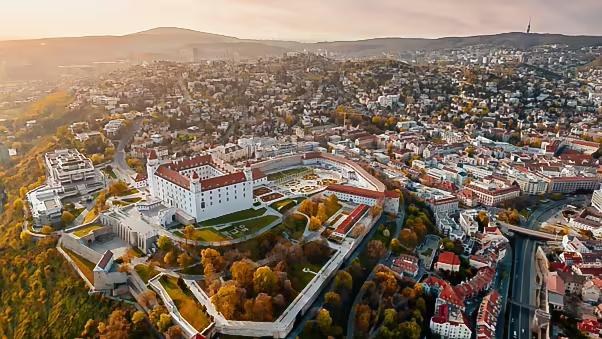
Bratislava, the capital of Slovakia, sits on the Danube River at the crossroads of Central Europe — just 60 km from Vienna, with Hungary to the south and the Czech Republic to the northwest. It is one of the smallest EU capitals, but punches above its weight with a growing IT and shared-services sector, a compact walkable Old Town (Staré Mesto), and vineyards within the city limits. Bratislava Castle overlooks the Danube from a hill above the Old Town, and the UFO Bridge (Most SNP) — with its saucer-shaped observation deck — has become the city's architectural signature.
For expats who want Western European career opportunities at lower living costs — with weekend trips to Vienna, Budapest, and Prague all within a few hours — Bratislava is a practical and increasingly popular choice. The city is home to around 430,000 people but functions like a larger metro thanks to its international corporate base and the daily flow of commuters, students, and tourists passing between Slovakia and Austria.
Bratislava at a Glance
- Population
- ~430,000 (city); ~600,000 (metro area)
- Region
- Bratislavský kraj (Bratislava Region), southwestern Slovakia
- Known For
- Danube riverfront, Bratislava Castle, proximity to Vienna
- Average Rent (1BR)
- €500–€800
- Average Salary
- ~€1,700/month (net)
- Expat Community
- Growing — concentrated in IT, finance, and shared services
Why Move to Bratislava
- Proximity to Vienna: At roughly 60 km, Bratislava is one of the closest capital cities to another capital in Europe. Many expats live in Bratislava and commute to Vienna, or take advantage of the twin-city dynamic for weekend trips and airport access.
- Affordable living costs: Rent, groceries, and dining out cost significantly less than in Vienna or Prague, even as salaries in the IT and corporate sectors approach Western European levels.
- Growing job market: IBM, Dell, Amazon, AT&T, and dozens of shared-services centers operate in and around Bratislava, creating steady demand for English-speaking professionals.
- Compact and green: The city is small enough to cross by bike in under an hour, with the Small Carpathians (Malé Karpaty) vineyards and the Danube floodplain forests within easy reach.
Things to Consider
- Language barrier outside corporate circles: Government offices, older service workers, and many landlords operate entirely in Slovak. Bureaucratic processes can be slow and opaque without a Slovak speaker to help.
- Housing quality varies: While new developments are modern and well-built, older panelák apartments (common in Petržalka and Karlova Ves) can suffer from poor insulation, inconsistent heating, and outdated wiring.
- Limited long-haul flights: M. R. Štefánik Airport (BTS) handles only short-haul European routes. For intercontinental travel, you will almost always connect through Vienna, Prague, or Frankfurt.
- Rising costs: Bratislava remains cheaper than Vienna or Prague, but rents have climbed steadily as international companies expand. The gap is narrowing each year, particularly in Staré Mesto and newly developed riverside areas.
Visas and Residency for Slovakia
EU/EEA and Swiss citizens can live and work in Slovakia freely but must register their address with the local Obvodný úrad (District Office) within 30 days of arrival. Non-EU nationals need a residence permit before relocating. The most common routes are:
- Employee card (Zamestnanecká karta): Tied to a specific employer and job. Your employer initiates the process at the local Foreign Police (Cudzinecká polícia). Processing takes 60–90 days.
- Business residence permit: For freelancers and entrepreneurs. Requires proof of a registered trade license (živnosť), a clean criminal record, and documented financial means.
- Student residence permit: For enrolled students at recognized institutions such as Comenius University or the Slovak University of Technology (STU).
- Family reunification: For spouses and dependent family members of legal residents.
After five years of continuous legal residence (or immediately for family members of Slovak/EU citizens), you can apply for Trvalý pobyt (Permanent Residence), which grants broader rights including full access to the public healthcare system and the ability to change jobs without notifying the Foreign Police.
Finding Housing in Bratislava
Average Rents
| Neighborhood | 1-Bedroom | 3-Bedroom | Character |
|---|---|---|---|
| Staré Mesto (Old Town) | €650–€900 | €1,100–€1,600 | Historic center, walkable, touristy, priciest |
| Petržalka | €400–€550 | €600–€900 | Large panelák estate across the Danube, affordable, densely built |
| Ružinov | €500–€700 | €800–€1,200 | Residential, family-friendly, near airport and shopping |
| Nové Mesto | €450–€650 | €700–€1,100 | Mix of residential and commercial, near main train station |
| Karlova Ves | €400–€600 | €650–€950 | Student-heavy area near STU campus, good value |
| Rača | €400–€550 | €600–€850 | Suburban feel, vineyards, quiet, Small Carpathians foothills |
How to Find Housing
- Reality.sk and Nehnutelnosti.sk: The two dominant Slovak property portals. Most listings are in Slovak but translate easily with browser tools. Both agents and landlords post here.
- Facebook groups: "Byty Bratislava" and "Bratislava Expats Housing" are active. Direct-from-owner listings are common and can save you the one-month agent fee.
- Real estate agencies: RE/MAX, Engel & Völkers, and Century 21 all have Bratislava offices. Agencies typically charge the tenant one month's rent as commission.
- Word of mouth: In a city this size, many apartments change hands through personal networks. Colleagues already working at your company can be the fastest route to a good flat.
Tips for Expats
- Landlords will ask for ID (passport), proof of income or an employment contract, and sometimes a Slovak guarantor. If you lack local credit history, offering 2–3 months' rent as deposit helps.
- Most leases run for 12 months with automatic renewal. Check whether utilities are included (všetky poplatky) or billed separately.
- The housing market tightens in September when university students arrive. Start searching in July or August.
- Petržalka offers the best value per square meter, but some panelák buildings have poor insulation and limited parking. Visit in person before committing.
Neighborhoods Guide
- Staré Mesto (Old Town): For singles and couples who want to walk everywhere. Cobblestone streets, the Schöne Naci statue on Rybárska brána, Eurovea waterfront, Bratislava Castle, and the Danube promenade. Rents are the highest in the city, and parking is extremely limited.
- Petržalka: The largest residential district in Central Europe, a dense cluster of socialist-era panelák buildings across the UFO Bridge (Most SNP). Affordable and well-connected by bus to the center in 15–20 minutes, but the concrete environment is not for everyone.
- Ružinov: A solid choice for families. Flat streets, large parks, shopping at Avion Shopping Park and Bory Mall, and close to M. R. Štefánik Airport (BTS). Good tram and bus connections to the center in 15–20 minutes.
- Nové Mesto: Wraps around the main railway station (Bratislava hlavná stanica) and includes the Nivy shopping center. A practical base for commuters who travel frequently by train. Mix of older apartment blocks and newer developments.
- Karlova Ves: Dominated by the STU campus and student housing, but the southern part along the Danube has quiet residential streets and good access to the Karlova Ves railway stop. Good value for those willing to live slightly outside the center.
- Rača: The wine-growing quarter. Vineyards on the Small Carpathians slopes produce some of Slovakia's best white wines, particularly Rizling vlašský. Residential, green, and affordable — ideal for families or anyone who prefers a quieter pace. Tram to the center takes about 25 minutes.
Cost of Living in Bratislava
Monthly Budget Breakdown
| Category | Budget Range |
|---|---|
| Rent (1BR, center) | €600–€800 |
| Utilities (electricity, heating, water, waste) | €150–€220 |
| Internet + mobile plan | €20–€35 |
| Groceries | €200–€300 |
| Transport (monthly MHD pass) | €29 |
| Dining out (4x/month) | €60–€100 |
| Leisure/Gym | €30–€60 |
| Total | €1,089–€1,544 |
Day-to-Day Costs
- Coffee (espresso): €1.80–€2.50
- Lunch (denné menu / daily menu): €5.50–€8.50
- Monthly transport pass (MHD): €29
- Beer (0.5L, pub): €2.00–€3.00
- Cinema ticket: €7–€9
- Gym membership: €25–€50
Getting Around Bratislava
- Public transport: MHD Bratislava (Mestská hromadná doprava) operates trams, trolleybuses, and buses across the city. A monthly pass costs €29 and covers all zones within Bratislava. The network is extensive and reliable, though trams do not yet reach Petržalka (bus and trolleybus serve it instead). Buy tickets via the IDS BK mobile app or at machines at stops.
- Cycling: The Danube cycle path (EuroVelo 6) runs through Bratislava and connects to Vienna in under two hours by bike. The city has growing bike-lane infrastructure, though it is not as developed as in Austrian cities. Nextbike operates a public bike-sharing system.
- Driving: Car ownership is not essential. Parking in Staré Mesto is expensive and scarce — most zones are metered residential (modré parkovacie zóny). If you import a car from outside the EU, you must register it through the colný úrad (Customs Office) and pay the deväťdvadsať (19% VAT) on newly purchased vehicles.
- Airport: M. R. Štefánik Airport (BTS) is 9 km from the center and handles short-haul flights across Europe via Ryanair, Wizz Air, and Air Explore. For long-haul connections, most expats fly from Vienna International (VIE), reachable by bus in about 1 hour (FlixBus or RegioJet) or by train.
- Intercity: Bratislava hlavná stanica (main railway station) connects to Vienna (1 hour), Budapest (2.5 hours), Prague (4 hours), and Brno (2 hours). The Mlynské Nivy bus station provides long-distance coach services. The Twin City Liner catamaran connects Bratislava and Vienna by Danube in about 75 minutes.
Healthcare in Bratislava
- Public health insurance: Once you have a residence permit, you must register with a public health insurer. Všeobecná zdravotná poisťovňa (VšZP — General Health Insurance) is the largest state-owned insurer and covers most services. Your employer typically registers you during onboarding. Contributions are deducted from salary (4% employee, 10% employer). Other public insurers include Union poisťovňa and Dôvera, but VšZP has the broadest network of contracted providers.
- Hospitals and clinics: Major public hospitals include Nemocnica Ružinov and Nemocnica Staré Mesto. Univerzitná nemocnica Bratislava (University Hospital) on Kramáre handles specialist and emergency care. For private care, ProCare clinics and the Canadian Medical center offer faster appointments and English-speaking staff at higher out-of-pocket cost.
- English-speaking doctors: Available but not universal. The Canadian Medical Care Center and Poliklinika ProCare have English-speaking GPs and specialists. Ask in expat Facebook groups for recommendations — the community shares doctor lists regularly.
- Pharmacies (lekárne): Found on nearly every main street. The pharmacy on Štúrova ulica near the Old Town is open 24 hours. Many common medications that require a prescription in Western countries are available over the counter in Slovakia, but always check. Bring your EHIC card if you are an EU citizen for immediate coverage.
- Emergency number: 112 (general emergency), 155 (ambulance directly), 158 (police).
Planning your move?
Tell us about your move to compare quotes from international moving companies.
Banking
Opening a bank account is straightforward with a passport, proof of address, and residence permit (or employment contract). Major banks include:
- Slovenská sporiteľňa (part of Erste Group): Largest network of branches and ATMs. Good for everyday banking.
- Tatra Banka (part of Raiffeisen): Modern app, English interface, popular with young professionals.
- VÚB Banka (part of Intesa Sanpaolo): Solid full-service option.
- ČSOB: Another mainstream choice with business banking services.
For tax purposes, you will need a DIČ (Daňové identifikačné číslo — Tax Identification Number), assigned by the Finančná správa (Tax Authority) when you register. Self-employed people also receive an IČO (Identifikačné číslo organizácie — company ID) when they register a trade license (živnosť). Keep receipts for every výdavok (tax-deductible expense) if you are self-employed — Slovakia allows flat-rate expense deductions, but itemized deductions require full documentation verified by a notár (notary) in some cases.
Education in Bratislava
- International schools: Cambridge International School Bratislava (in Ružinov), QSI Bratislava (English-language, in Staré Mesto), and the International School of Bratislava (IB curriculum) are the main options. Tuition ranges from €5,000 to €18,000 per year depending on age group.
- Universities: Comenius University (Univerzita Komenského) is Slovakia's largest and most prestigious university, with faculties spread across the city. Slovak University of Technology (STU) has its main campus in Karlova Ves and is strong in engineering and IT. Bratislava International School of Liberal Arts (BISLA) offers English-language undergraduate programs.
- Language schools: International House Bratislava and Studia Academica offer Slovak courses for foreigners. Many expats pick up enough conversational Slovak in 6–12 months to handle daily errands, though English is widely spoken in the corporate sector.
Culture and Lifestyle
- Old Town and riverfront: Staré Mesto's Hlavné námestie (Main Square), Hviezdoslavovo námestie, and the Eurovea waterfront complex are the social heart of the city. In summer, the Danube promenade fills with outdoor cafés and pop-up bars.
- Wine culture: Bratislava is one of the few European capitals with vineyards within city limits. Rača and the Small Carpathians produce Rizling vlašský, Veltlínske zelené, and Frankovka modrá. Wine bars in the Old Town pour local bottles from €3–€5 a glass.
- History and day trips: Devín Castle, at the confluence of the Danube and Morava rivers (reachable by city bus 29), dates to the 9th century and offers panoramic views. The Danubiana Meulensteen Art Museum, on a peninsula in the Danube near Čunovo, exhibits contemporary European art. Schöne Naci, a bronze statue on the Rybárska brána, is the city's most beloved monument — a gentleman who tips his hat to passersby.
- Sports and outdoor life: The Small Carpathians offer hiking and mountain biking trails that start at the edge of the city. The Danube cycle path connects all the way to Vienna. In winter, ski resorts such as Pezinská Baba (30 minutes by car) are within easy reach.
- Arts and events: The Slovak National Theatre (Slovenské národné divadlo) stages opera, ballet, and drama in a modern building on the Danube waterfront. Bratislava Music Festival (BHS) runs each autumn. The city also hosts a lively Christmas market on Hlavné námestie from late November through December, serving mulled wine (varené víno) and lokše (potato pancakes).
- Weekend escapes: Vienna is 1 hour by train. Budapest is 2.5 hours. The wine towns of Modra and Pezinok, in the Small Carpathians wine region, are 20–30 minutes by car. The Morava River floodplain near Devín offers quiet cycling and birdwatching.
Food and Dining
- Slovak staples include bryndzové halušky (potato dumplings with sheep cheese and bacon), kapustnica (sauerkraut soup with sausage), and trdelník (chimney cake). The Old Town has dozens of Slovak restaurants; try Modrá Hviezda on Židovská ulica for traditional fare.
- For international dining, the Eurovea food court, Nivy shopping center food hall, and the streets around Ventúrska and Michalská offer everything from Thai to Lebanese.
- Budget option: the denné menu (daily lunch menu), available at most restaurants on weekdays for €5–€8, typically includes soup, a main course, and sometimes a drink.
Expat Community
- Expat groups on Facebook such as "Expats in Bratislava" and "Bratislava Internationals" are very active for housing, social events, and practical advice.
- The International Women's Club of Bratislava organizes monthly meetups and charity events.
- Language exchange meetups happen weekly at pubs like Mockingjay Café in Staré Mesto. Slovak-English tandems are easy to arrange through university bulletin boards and Facebook.
Job Market in Bratislava
- Main industries: IT and software development, shared services and BPO (business process outsourcing), finance and accounting, automotive (Volkswagen has a large plant in Bratislava), and logistics.
- Major employers: IBM (shared services), Dell (IT), Amazon (logistics and development), AT&T (shared services), T-Systems, Lenovo, Accenture, and Volkswagen Slovakia.
- Average salaries by sector:
| Sector | Monthly Gross |
|---|---|
| IT / Software | €2,800–€4,500 |
| Finance / Accounting | €2,000–€3,500 |
| Shared Services (entry) | €1,400–€2,000 |
| Engineering / Automotive | €1,800–€3,200 |
| Teaching (international schools) | €1,500–€2,500 |
- Job search resources: Profesia.sk is the dominant Slovak job portal. LinkedIn is widely used by multinational employers targeting English-speaking candidates. "Expats in Bratislava" and similar Facebook groups also post openings regularly.
Moving Checklist for Bratislava
- Secure a job offer or university enrollment (required for most residence permits)
- Apply for the appropriate visa or residence permit at the Slovak embassy in your country
- Gather documents: passport, birth certificate, marriage certificate (if applicable) — have them apostilled and translated into Slovak by a sworn translator
- Arrange health insurance coverage for your first weeks (travel insurance or EHIC card for EU citizens)
- Research neighborhoods and set up apartment viewings for your first week (contact agents via Reality.sk or Nehnutelnosti.sk)
- If importing belongings, prepare a detailed itemized inventory for the colný úrad (Customs Office); items owned and used for 6+ months qualify for duty-free import
- Book temporary accommodation for your first 2–4 weeks (Airbnb in Staré Mesto or Ružinov)
- If moving with children, research international school admissions — places fill up by spring for September starts
- Notify your home country's tax authority of your relocation if required
- Register your address at the Obvodný úrad (District Office) — bring your lease agreement, passport, and residence permit
- Visit the Cudzinecká polícia (Foreign Police) to confirm your residence registration
- Open a bank account (Slovenská sporiteľňa or Tatra Banka recommended for expats)
- Get a Slovak SIM card: Orange, Slovak Telekom, or O2 — all offer prepaid plans from €10/month
- Buy an MHD monthly transport pass (€29) via the IDS BK app or at a ticket office
- Register with VšZP (or your employer's designated health insurer) — your HR department usually handles this
- Arrange pet registration at a local vet if you brought animals — microchipping and EU pet passport required
- Set up a my electricity/gas account online with ZSE or SPP to avoid estimated bills
- Obtain your DIČ (Tax Identification Number) from the Finančná správa if not handled by your employer
- If self-employed, register your trade license (živnosť) to receive your IČO (company ID); some documents may require a notár (notary) to verify
- Find a local GP (všeobecný lekár) — ask in expat groups for English-speaking recommendations
- Set up utilities if not included in your rent (electricity via ZSE, gas via SPP, internet via Orange or Slovak Telekom)
- Explore your neighborhood — find your nearest grocery stores (Billa, Lidl, Tesco, Kaufland)
- Join the "Expats in Bratislava" Facebook group for social events, secondhand furniture, and local tips
- Enroll in a Slovak language course if you plan to stay long-term — International House Bratislava offers evening classes
- If you imported a vehicle, complete registration and technical inspection (STK) within 30 days
- Apply for Trvalý pobyt (Permanent Residence) if you already qualify — it simplifies future bureaucracy significantly
No — English is widely spoken in the corporate sector, international restaurants, and among younger Slovaks. However, government offices (Obvodný úrad, Cudzinecká polícia), older landlords, and service workers often speak only Slovak. Learning basic phrases will make daily life much smoother and is appreciated by locals.
Bratislava is about 60 km from Vienna. The train takes roughly 1 hour, buses via FlixBus and RegioJet take 1–1.5 hours, and the Twin City Liner catamaran covers the Danube route in about 75 minutes. Some expats do commute daily, though the cost and time add up over the year. Living in Bratislava and working remotely for Vienna-based companies is an increasingly common alternative.
Petržalka has a reputation as a concrete jungle — it is the largest panelák housing estate in Central Europe, with dozens of identical socialist-era towers. The reality is more nuanced: apartments are spacious and cheap, transport links to the center are good (15–20 minutes by bus), and the area has improved with new parks and retail. It is not picturesque, but it is practical and safe.
Once registered with VšZP (or another public insurer), you have access to public hospitals and doctors. Care is generally competent but facilities can feel dated compared to Western Europe. Wait times for non-urgent specialists can be long. Many expats use a mix of public insurance for emergencies and private clinics (ProCare, Canadian Medical) for faster routine care.
Yes. Slovakia follows EU pet travel rules. Dogs, cats, and ferrets need a microchip, a valid rabies vaccination, and an EU pet passport (or veterinary health certificate for non-EU entries). From certain non-EU countries, a rabies antibody titer test is also required. The process takes several weeks, so start early.
Bratislava is generally very safe. Violent crime is rare. Petty theft (pickpocketing) can occur in the Old Town and on trams during peak hours, as in any city with tourists. The area around the main train station can feel uncomfortable at night, but common-sense precautions are sufficient. Most residents feel safe walking alone after dark in residential areas.
Slovakia has a progressive income tax: 19% on income up to €49,790 and 25% above that threshold. Social security and health insurance contributions add roughly 13.4% on the employee side. Self-employed individuals can deduct either a flat 60% of income as a výdavok (expense) or itemize actual costs. The standard VAT rate is deväťdvadsať (19%), with a reduced 10% rate on basics like food and books. If you are a tax resident (living in Slovakia for 183+ days per year), you are taxed on worldwide income, though double-taxation treaties with most Western countries prevent double payment.
EU and EEA licenses are valid in Slovakia indefinitely. Non-EU licenses can be used for up to 6 months from the date you establish residency. After that, you must exchange it for a Slovak license — the process involves a medical check and, depending on your country of origin, may require a written test and driving test. Citizens of countries with reciprocal agreements (including the US, Canada, and Australia) typically get a simpler exchange process.
Related Guides
- Moving to Slovakia — comprehensive country guide
- Moving to Vienna — the city just 60 km away
- Moving to Prague — Czech capital, 4 hours by train
- Moving to Budapest — Hungarian capital, 2.5 hours by train
- Moving to Košice — Slovakia's second city, eastern Slovakia