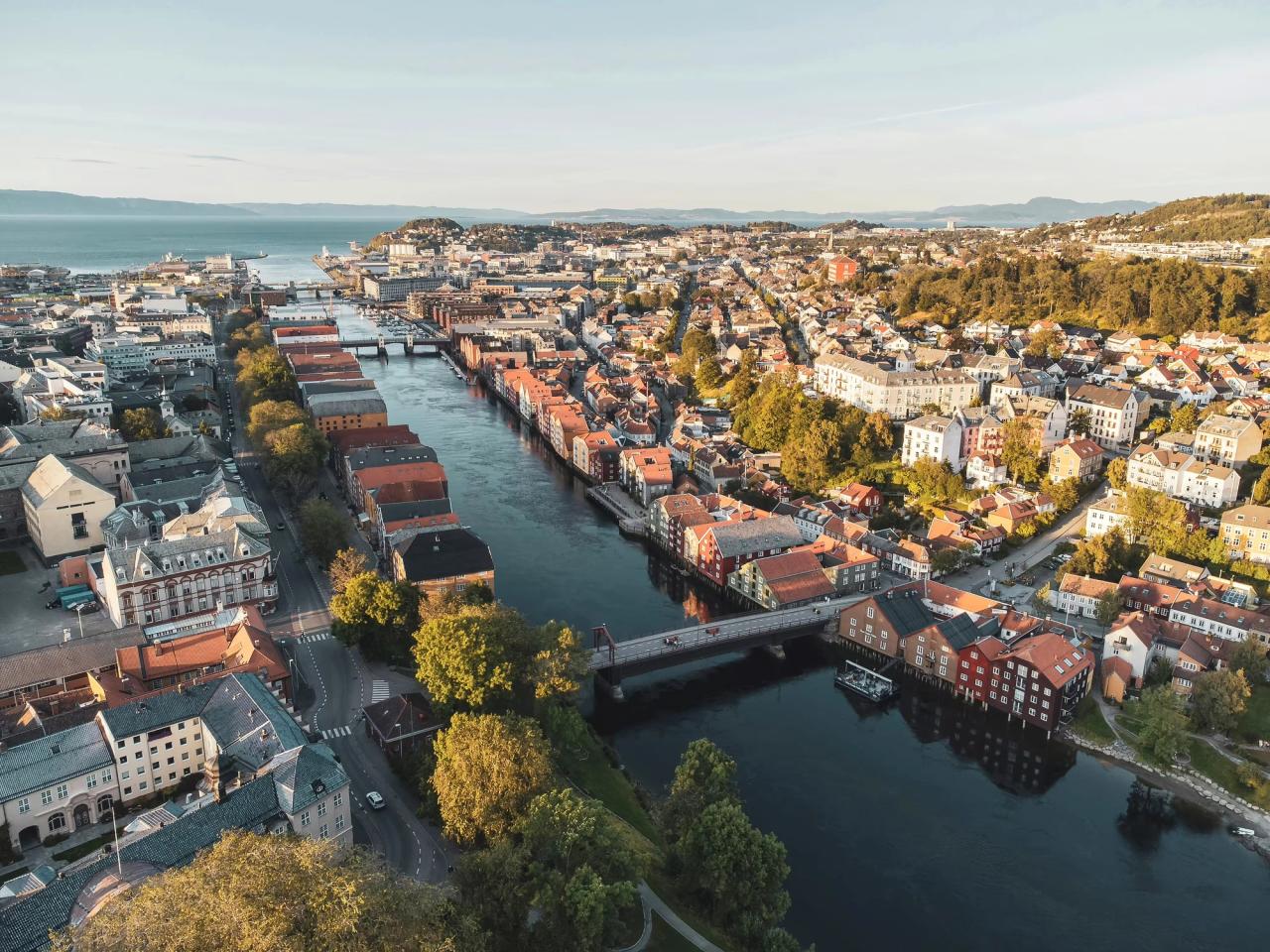

Trondheim is Norway's third-largest city and its undisputed technology and education capital. Home to NTNU — the Norwegian University of Science and Technology — and the stunning Nidaros Cathedral, Trondheim blends medieval heritage with cutting-edge research and innovation. The city's student energy, manageable size, and access to nature make it a favourite among academics, engineers, and families seeking a quieter Norwegian lifestyle.
Trondheim at a Glance
- Population
- ~215,000 (metro area ~280,000)
- Region
- Central Norway (Trøndelag)
- Known For
- NTNU, Nidaros Cathedral, tech and research hub
- Average Rent (1BR)
- NOK 9,500–13,000/month (city centre)
- Average Salary
- NOK 33,000–39,000/month net
- Expat Community
- Medium — dominated by students, researchers, and tech workers
Why Move to Trondheim
- Tech and research hub: NTNU drives a strong startup ecosystem and attracts thousands of international researchers.
- Affordable living: Lower rents and cost of living than Oslo and Bergen while maintaining competitive salaries.
- Nidaros Cathedral: The largest medieval building in Scandinavia and Norway's national sanctuary.
- Nature access: Fjords, forests, and ski trails are minutes from the city centre.
- Student atmosphere: With over 40,000 students, the city has a youthful, vibrant energy.
Finding Housing in Trondheim
Average Rents
| Neighborhood | 1-Bedroom (NOK/month) | 3-Bedroom (NOK/month) | Character |
|---|---|---|---|
| Midtbyen (Centre) | 11,000–14,000 | 20,000–27,000 | Central, historic, near Cathedral |
| Bakklandet | 10,000–13,000 | 18,000–24,000 | Charming wooden houses, cafes, riverside |
| Moholt | 8,000–10,500 | 14,000–18,000 | Student-focused, near NTNU campus |
| Byåsen | 9,000–12,000 | 16,000–22,000 | Family-friendly, elevated, nature access |
| Lade | 9,500–12,500 | 17,000–23,000 | Coastal, modern apartments, shopping |
| Ila | 8,500–11,000 | 15,000–20,000 | Quiet, residential, good value |
How to Find Housing
- Finn.no: The go-to platform for rental and purchase listings across Trondheim.
- Hybel.no: Popular for shared accommodation and student housing.
- SIT (Studentsamskipnaden i Trondheim): Student housing for NTNU — apply immediately upon admission.
- Facebook groups: "Trondheim Bolig" and student housing groups post regularly.
Tips for Expats
- Competition spikes in August before the university semester — start searching months ahead.
- Student housing through SIT is cheaper but has long waitlists.
- A fødselsnummer is usually required to sign a lease — arrange temporary housing first.
- Check whether utilities are included — many listings show cold rent (kald husleie) only.
- Most apartments are unfurnished — budget for furniture or find furnished (møblert) listings at higher rent.
- Parking spaces (p-plass) in Trondheim can cost NOK 1,000–2,000/month if not included with the apartment.
Neighborhoods Guide
- Midtbyen: The historic core. Walkable, lively, and close to everything. High rent for Trondheim.
- Bakklandet: Iconic neighbourhood with colourful wooden warehouses along the river. Cafes, galleries, and charm. Mid rent.
- Moholt: Student heartland near NTNU campus. Affordable apartment blocks and grocery stores. Low rent.
- Byåsen: Elevated residential area popular with families. Larger homes and quick access to Bymarka forest. Mid rent.
- Lade: Coastal district east of the centre with shopping centres and newer developments. Mid rent.
- Ila: Quiet, residential area west of the centre with a mix of old and new housing. Low-to-mid rent.
- Ranheim: Eastern suburb with newer housing, schools, and coastal access. Family-friendly. Low-to-mid rent.
Cost of Living in Trondheim
Monthly Budget Breakdown
| Category | Budget Range (NOK) |
|---|---|
| Rent (1BR, centre) | 9,500–13,000 |
| Utilities | 1,300–2,000 |
| Internet | 450–650 |
| Groceries | 3,500–4,800 |
| Transport (monthly pass) | 700–800 |
| Dining out (4x/month) | 1,800–3,200 |
| Leisure/Gym | 400–650 |
| Total | 17,550–25,100 |
Day-to-Day Costs
- Coffee: NOK 45–55
- Lunch (casual): NOK 130–170
- Monthly transport pass: NOK 700–800
- Beer (bar): NOK 80–105
- Cinema ticket: NOK 130–155
- Loaf of bread: NOK 30–42
- 1 litre of milk: NOK 18–22
- Monthly gym membership: NOK 350–550
- Takeaway pizza: NOK 170–230
- Bottle of wine (Vinmonopolet): NOK 150–250
- Monthly mobile plan: NOK 250–400
Getting Around Trondheim
- Public transport: AtB operates buses, the Metrobuss BRT (replacing the former Gråkallbanen tramline), and ferries. Monthly pass costs around NOK 700–800.
- Cycling: Flat city centre with good bike infrastructure. Trondheim has the world's only bicycle lift (Sykkelheisen Trampe).
- Driving: Manageable traffic, but parking in the centre is limited and tolled.
- Airport: Trondheim Værnes (TRD), 35 km east. Airport express bus takes 30–40 minutes.
- Intercity: Train connections to Oslo (~6.5 hours) and Bodø. Bus links to coastal towns. The Dovrebanen is one of Norway's most scenic railways.
Healthcare in Trondheim
- Hospitals/Clinics: St. Olavs Hospital is the main hospital for central Norway, affiliated with NTNU's medical faculty.
- English-speaking doctors: Widely available, especially at university-affiliated clinics.
- Pharmacies: Apotek 1, Boots, and Vitusapotek.
- Emergency number: 113 (ambulance), 110 (fire), 112 (police).
- GP registration: Register your fastlege at Helsenorge.no.
Get a personalised relocation plan
Drop your email and we'll send a tailored checklist plus three quotes from vetted movers.
Visas and Residency
- Work Permit for Skilled Workers (faglært): Requires a job offer and relevant qualifications. Norway is not an EU member — there is no EU Blue Card scheme. Apply through UDI (udi.no).
- Student Residence Permit: For those admitted to NTNU or other Norwegian institutions.
- Family Immigration Permit: For close relatives of Norwegian residents.
- Researcher Residence Permit: For those with a hosting agreement with NTNU or SINTEF.
EU/EEA citizens can live and work freely but must register within 3 months.
Visa information: https://www.udi.no/en/want-to-apply
Utilities and Internet
- Electricity: Providers include TrønderEnergi, Fjordkraft, and Tibber. Average NOK 700–1,400/month. Winters are cold, so heating costs rise from November to March.
- Internet: Telenor, Telia, and Altibox offer fiber connections in most areas. Expect NOK 450–650/month for 100–500 Mbps.
- Water and waste: Typically included in municipal fees or building costs.
- Heating: Electric radiators are standard. Check energy ratings when viewing apartments — older buildings can be expensive to heat.
Culture & Lifestyle
- Student atmosphere: With over 40,000 students, pubs, live music, and cultural events are constant.
- Nidaros Cathedral: Norway's national sanctuary — the architecture is breathtaking.
- Bakklandet charm: Old warehouses, riverside cafes, and cobbled streets — one of Scandinavia's most photogenic areas.
- Winter sports: Cross-country skiing in Bymarka and Oppdal ski resort are popular (November–April).
- Rockheim: Norway's national museum of popular music near the harbour.
Food & Dining
- Local specialties: klippfisk (dried cod), sodd (meat soup), locally brewed craft beer.
- Best dining areas: Midtbyen, Bakklandet, and Solsiden (converted shipyard with restaurants).
- Budget options: Bakeries and student-friendly cafes near NTNU from NOK 100–140.
Expat Community
- NTNU International House: Dedicated support for international students and researchers.
- Trondheim International School community: Active social network for expat families.
- Meetup and Facebook groups: Language exchanges, hiking groups, and social gatherings.
- Sports clubs: Football, handball, and climbing clubs welcome international members.
Job Market in Trondheim
- Main industries: Technology and IT, research and education, healthcare, oil and gas (subsea), aquaculture, defence.
- Major employers: NTNU, SINTEF, Equinor, Kongsberg Maritime, DNV, Nammo.
- Average salaries by sector (monthly gross):
| Sector | Average (NOK) |
|---|---|
| IT / Tech | 55,000–80,000 |
| Research | 50,000–70,000 |
| Engineering | 52,000–72,000 |
| Healthcare | 42,000–58,000 |
| Education | 43,000–55,000 |
| Public Sector | 40,000–52,000 |
- Job search resources: Finn.no/jobb, Nav.no, LinkedIn, NTNU career services, TEKNA job board.
Education in Trondheim
- International schools: Trondheim International School (ThIS), offering bilingual education for ages 5–16.
- Universities: NTNU — Norway's largest university with world-class engineering, technology, and science programs (42,000+ students).
- Language schools: Folkeuniversitetet, NTNU Norwegian courses (often free for enrolled students).
Banking and Registration
Open a bank account with: passport, fødselsnummer or D-number, proof of address, and proof of employment or study. Register at Skatteetaten for your fødselsnummer — it is essential for banking, healthcare, and tax. The process typically takes 2–4 weeks.
Moving Checklist for Trondheim
- Confirm residence permit or EU/EEA registration.
- Apply for student housing through SIT immediately upon receiving your offer.
- Arrange temporary accommodation for the first weeks.
- Research the Norwegian winter — pack warm clothing and waterproof layers.
- Register at Skatteetaten for fødselsnummer or D-number.
- Open a bank account (DNB, Nordea, or Sparebanken Midt-Norge).
- Buy an AtB monthly transport pass.
- Find permanent housing via Finn.no or Hybel.no.
- Register with a GP (fastlege) at Helsenorge.no.
- Get a Norwegian phone number.
Moving Your Belongings to Trondheim
Shipping costs vary by volume and origin. Typical market rates:
| Move Type | Time | Cost (USD) |
|---|---|---|
| 20 ft container (FCL) | 2–6 weeks | $1,500–4,200 |
| 40 ft container (FCL) | 2–6 weeks | $2,500–5,200 |
| Air freight (~1 m³) | 3–5 days | $1,800+ |
Norway is not in the EU — import duty 0–10% + 25% VAT on CIF value applies. Used household goods owned 6+ months may qualify for duty-free import if you lived abroad 12+ months.
Bringing a Car to Trondheim
Importing a vehicle requires customs declaration, 25% VAT, and registration tax (engangsavgift). Imported cars must pass technical inspection. EU/EEA driving licences are valid without exchange. Non-EU licences must be exchanged within 12 months.
Bringing Pets to Trondheim
Pets must be microchipped, vaccinated against rabies, and have an EU health certificate or Pet Passport. Non-EU pets need a veterinary certificate issued within 10 days. Certain dog breeds are banned in Norway. Pets from outside EU/EEA enter through designated points and may be checked by Mattilsynet.
Tax Obligations in Trondheim
Tax residents (183+ days/year) are taxed on worldwide income. Progressive rates: approximately 22%–45%. Social contributions around 8% of income. Double tax treaties with 90+ countries.
Norwegian Language and Integration
- Is Norwegian necessary? You can get by with English at NTNU and in daily life, but learning Norwegian is recommended for full integration and broader job options.
- Free courses: Trondheim Kommune offers free Norwegian classes for registered residents. NTNU provides Norwegian courses for international students and staff.
- Online resources: Duolingo (Norwegian Bokmål), NTNU's free online Norwegian course, and Memrise.
- Language levels: B1–B2 is expected by most employers within 1–2 years. Citizenship requires A2 oral and written.
- Trønder dialect: Trondheim's local dialect (Trøndersk) differs from standard Bokmål but is fully understandable once you know the basics.
Related Guides
- Moving to Norway — comprehensive country guide
- Moving to Oslo — capital city guide
- Moving to Bergen — gateway to the fjords
- Moving to Stavanger — Norway's oil capital
- Moving to Tromsø — life above the Arctic Circle
- Moving to Drammen — affordable Oslo commuter city