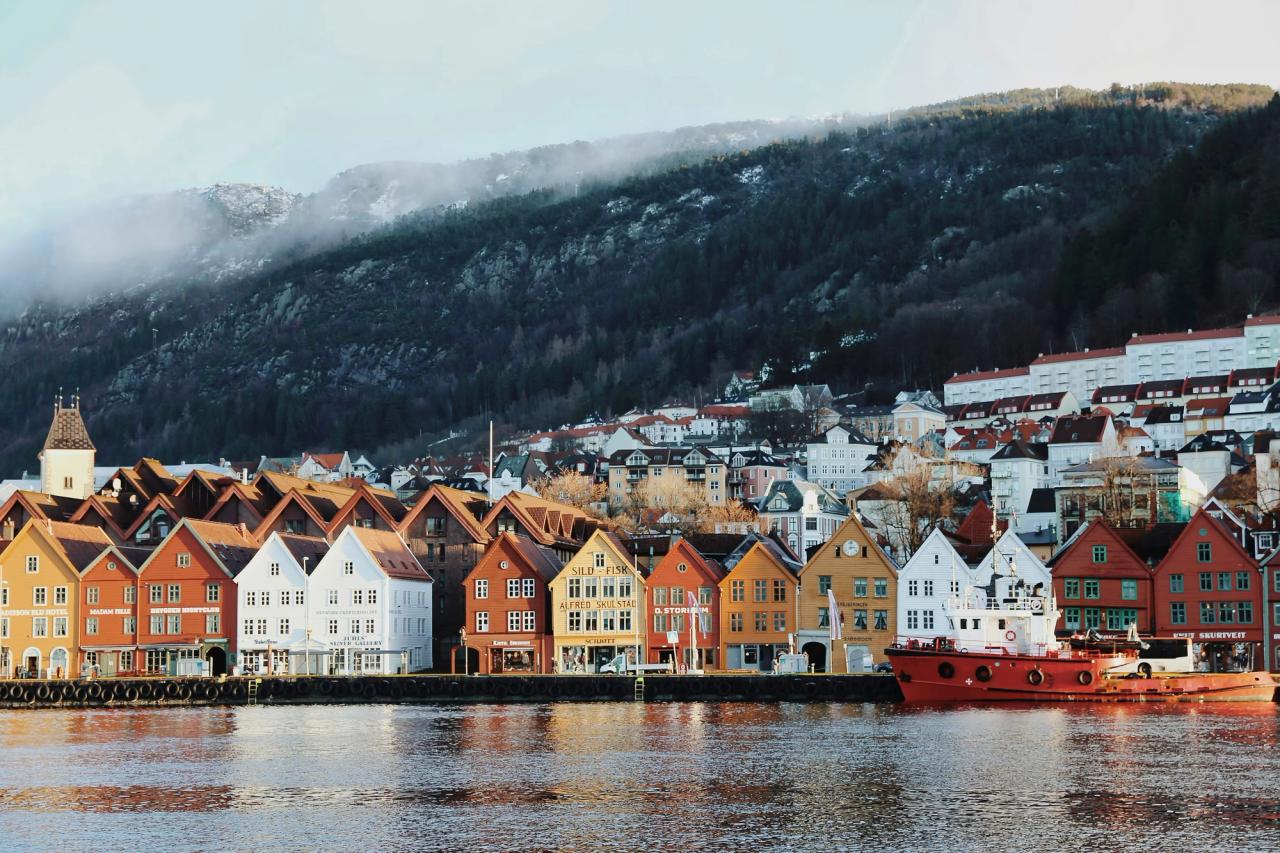

Bergen is Norway's second-largest city, known as the "Gateway to the Fjords" for its position between seven mountains and deep coastal inlets. With its iconic Bryggen wharf, a lively cultural scene, and more rainfall than almost anywhere in Europe, Bergen has a distinct identity that sets it apart from Oslo. If you love seafood, dramatic scenery, and a tight-knit community feel, Bergen is a compelling choice for your Norwegian move.
Bergen at a Glance
- Population
- ~295,000 (metro area ~470,000)
- Region
- Western Norway (Vestland)
- Known For
- Bryggen wharf, fjords, rain, Hanseatic heritage
- Average Rent (1BR)
- NOK 11,000–15,000/month (city centre)
- Average Salary
- NOK 48,000–65,000/month gross
- Expat Community
- Medium — energy sector, university, maritime
Why Move to Bergen
- Gateway to fjords: Sognefjord, Hardangerfjord, and Nærøyfjord are all within a few hours.
- Cultural capital: Home to the Bergen International Festival, KODE art museums, and a thriving music scene.
- Compact and walkable: Most of central Bergen is easily explored on foot.
- Strong job market: Offshore energy, maritime, aquaculture, and a growing tech sector.
- Distinct identity: Bergen has its own dialect, traditions, and fierce local pride — it feels different from the rest of Norway.
Finding Housing in Bergen
Average Rents
| Neighborhood | 1-Bedroom (NOK/month) | 3-Bedroom (NOK/month) | Character |
|---|---|---|---|
| Sentrum (Centre) | 13,000–16,000 | 23,000–30,000 | Historic, lively, near Bryggen |
| Sandviken | 11,000–14,000 | 20,000–26,000 | Residential, fjord views, quiet |
| Fantoft | 8,500–11,000 | 15,000–20,000 | Student-friendly, affordable, near Bybanen |
| Åsane | 9,500–12,000 | 17,000–22,000 | Suburban, shopping centres, families |
| Nesttun | 10,000–13,000 | 18,000–24,000 | Family-friendly, tram-connected |
| Landås | 9,500–12,500 | 17,000–22,500 | Elevated, parks, schools |
How to Find Housing
- Finn.no: The primary platform for all rental and purchase listings in Bergen.
- Hybel.no: Useful for shared flats and smaller units.
- Sammen: Student housing organization for those enrolled at the University of Bergen or HVL.
- Local Facebook groups: Active Bergen housing groups post daily.
Tips for Expats
- Expect 2–3 months' deposit plus first month's rent — standard across Norway.
- Bergen gets 2,250 mm of rain per year. Check for dampness and mould when viewing apartments.
- Priority waitlists exist for popular areas — start searching early, especially before the university semester in August.
- A fødselsnummer or D-number is needed for most lease agreements.
- Most apartments in Norway are unfurnished — budget for furniture or look for furnished (møblert) options at a premium.
- Garages and storage units (bod) often cost extra — ask before signing.
Neighborhoods Guide
- Bryggen / Sentrum: The heart of Bergen. UNESCO-listed wooden wharves, restaurants, and nightlife. Touristy but charming. High rent.
- Sandviken: Quiet residential area north of the centre with fjord views. Popular with families and professionals. Mid rent.
- Fantoft: Large student population, affordable housing blocks, and direct Bybanen connection. Low rent.
- Nordnes: Peninsula with colourful wooden houses and harbour views. Walkable to the centre. Mid-to-high rent.
- Laksevåg: Across the harbour, more affordable, with growing development and bus links to the centre. Low-to-mid rent.
- Landås: Elevated residential area with parks and schools. Good value for families. Mid rent.
- Ytre Sandviken: Northern extension of Sandviken with newer developments and harbour access. Mid rent.
Cost of Living in Bergen
Monthly Budget Breakdown
| Category | Budget Range (NOK) |
|---|---|
| Rent (1BR, centre) | 11,000–15,000 |
| Utilities | 1,400–2,200 |
| Internet | 500–700 |
| Groceries | 3,500–5,000 |
| Transport (monthly pass) | 750–850 |
| Dining out (4x/month) | 2,000–3,500 |
| Leisure/Gym | 400–700 |
| Total | 19,550–27,950 |
Day-to-Day Costs
- Coffee: NOK 45–60
- Lunch (casual): NOK 140–180
- Monthly transport pass: NOK 750–850
- Beer (bar): NOK 85–110
- Cinema ticket: NOK 130–160
- Loaf of bread: NOK 30–45
- 1 litre of milk: NOK 18–23
- Monthly gym membership: NOK 350–600
- Takeaway pizza: NOK 180–250
- Bottle of wine (Vinmonopolet): NOK 150–250
- Monthly mobile plan: NOK 250–400
Getting Around Bergen
- Public transport: Skyss operates buses and the Bybanen light rail. Monthly pass costs around NOK 750–850.
- Cycling: Hilly terrain makes cycling challenging, but bike lanes exist in flatter areas. Bysykkel city bikes available seasonally.
- Driving: Narrow streets and limited parking in the centre. Toll rings (bomring) apply daily charges.
- Airport: Bergen Flesland (BGO), 18 km south. Bybanen connects the airport to the city centre in about 45 minutes.
- Intercity: Direct trains to Oslo (~7 hours). Express boats to coastal towns. Hurtigruten coastal ferry departs daily.
Healthcare in Bergen
- Hospitals/Clinics: Haukeland University Hospital is the main hospital in western Norway. Several private clinics also operate.
- English-speaking doctors: Readily available — most medical professionals speak English.
- Pharmacies: Apotek 1 and Vitusapotek found throughout the city.
- Emergency number: 113 (ambulance), 110 (fire), 112 (police).
- GP registration: Choose your fastlege through Helsenorge.no.
Planning your move?
Tell us about your move to compare quotes from international moving companies.
Visas and Residency
- Work Visa (skilled worker): Requires a job offer and relevant qualifications.
- Skilled Worker Permit (non-EU/EEA): Norway is not an EU member and does not issue EU Blue Cards. Non-EU/EEA skilled workers apply through UDI's Skilled Worker permit — requires a job offer and relevant qualifications.
- Student Visa: For those admitted to UiB, NHH, or HVL.
- Family Immigration Permit: For close relatives of Norwegian residents.
- Self-employed / Startup Visa: For entrepreneurs with viable business plans.
EU/EEA citizens can live and work in Norway without a visa but must register within 3 months.
Visa information: https://www.udi.no/en/want-to-apply
Utilities and Internet
- Electricity: Choose from multiple providers (Fjordkraft, Tibber, Norgesenergi). Average NOK 800–1,500/month depending on usage and season. Electricity is cheaper in summer.
- Internet: Providers include Telenor, Telia, and Altibox. Fiber connections widely available. Expect NOK 500–700/month for 100–500 Mbps.
- Water and waste: Usually included in municipal fees or building costs. Separate water bills are uncommon for apartments.
- Heating: Most apartments use electric radiators. Older buildings may have higher heating costs.
Culture & Lifestyle
- Rainy identity: Bergen embraces its rain — locals say "there is no bad weather, only bad clothing."
- Music scene: Bergen has produced international artists like Kygo and the indie duo Kings of Convenience. Live music venues run year-round.
- Fjord adventures: Weekend trips to Hardangerfjord, Voss, and Sognefjord are easy and popular.
- Bergen International Festival: Held every May/June, featuring classical music, opera, theatre, and dance.
- Bergen Philharmonic Orchestra: One of the world's oldest, performing regularly at Grieghallen.
Food & Dining
- Bergen is Norway's seafood capital — fresh cod, salmon, crab, and shrimp from the harbour fish market (Fisketorget).
- Best dining areas: Bryggen, Engen, and the KODE museum quarter.
- Budget options: Bakeries and casual eateries around Torgallmenningen offer meals from NOK 100–140.
Expat Community
- Bergen International Hub: Networking and social events for international professionals.
- University of Bergen international office: Support for foreign students and researchers.
- Meetup groups: Language exchanges, hiking groups, and social meetups.
- Sports and outdoor clubs: Running groups, climbing clubs, and ski associations welcome internationals.
Job Market in Bergen
- Main industries: Oil and gas, maritime and shipping, aquaculture, tourism, higher education, finance.
- Major employers: Equinor, DNV, Bergen Group, Grieg Group, University of Bergen, HVL.
- Average salaries by sector (monthly gross):
| Sector | Average (NOK) |
|---|---|
| Oil & Gas | 65,000–95,000 |
| Maritime | 50,000–75,000 |
| IT / Tech | 52,000–78,000 |
| Healthcare | 42,000–60,000 |
| Education | 43,000–55,000 |
| Hospitality | 33,000–42,000 |
- Job search resources: Finn.no/jobb, Nav.no, LinkedIn, Bergens Tidende job listings.
Education in Bergen
- International schools: Bergen International School (BIS), offering bilingual education for ages 6–16.
- Universities: University of Bergen (UiB), Norwegian School of Economics (NHH), Western Norway University of Applied Sciences (HVL).
- Language schools: Folkeuniversitetet Bergen, Bergen Kommune Norwegian classes.
Banking and Registration
To open a bank account you need: passport, fødselsnummer or D-number, proof of address, and sometimes proof of employment. Register at Skatteetaten with your passport, residence permit, and address to receive your fødselsnummer — essential for banking, healthcare, and tax.
Moving Checklist for Bergen
- Confirm your residence permit status or EU/EEA registration.
- Arrange short-term accommodation for the first few weeks.
- Pack quality rain gear — non-negotiable in Bergen.
- Research school places if moving with children.
- Register at Skatteetaten for your fødselsnummer or D-number.
- Open a bank account at DNB, Danske Bank, or Sparebanken Vest.
- Purchase a Skyss monthly transport pass.
- Secure permanent housing via Finn.no or Hybel.no.
- Register with a GP (fastlege) at Helsenorge.no.
- Get a Norwegian SIM card (Telia, Telenor, or ice).
Yes. Bergen receives approximately 2,250 mm of rain annually — over 200 rainy days per year. Locals adapt quickly, and you will need a proper rain jacket (not an umbrella, which the coastal wind destroys). The upside: the surrounding landscape is spectacularly green and lush.
Bergen is smaller, more affordable, and has a stronger sense of local identity. Rent is roughly 15–20% cheaper than Oslo. The job market is more focused on energy and maritime sectors. The cultural scene is rich but more compact. If you prefer a big city, Oslo wins; for character and proximity to fjords, Bergen is hard to beat.
It depends on the industry. Oil and gas, maritime, and international companies often operate in English. However, learning Norwegian significantly improves your job prospects and social integration.
A casual lunch costs NOK 140–180. A mid-range dinner for two with drinks runs NOK 1,000–1,500. Fast food or kebab meals are around NOK 100–130. Bergen is cheaper than Oslo for dining but still expensive by European standards.
Yes. The Bybanen light rail is efficient and connects the airport to the city centre. Bus coverage is good across the city. Delays can occur in heavy rain or snow, but the system is generally punctual. A monthly pass costs NOK 750–850.
Hike one of the seven surrounding mountains — Fløyen and Ulriken are the most popular, with cable car and funicular access. Visit Bryggen and the fish market, explore KODE art museums, take a fjord cruise, or catch a live concert. The Hardangerfjord and Sognefjord regions are perfect for day trips.
Yes. Bergen has excellent public schools, safe neighbourhoods, and abundant outdoor activities. The international school (BIS) provides an alternative for English-speaking families. The city is compact enough that children can walk or cycle to school.
Moving Your Belongings to Bergen
Shipping costs vary by volume and origin. Typical market rates:
| Move Type | Time | Cost (USD) |
|---|---|---|
| 20 ft container (FCL) | 2–6 weeks | $1,450–4,100 |
| 40 ft container (FCL) | 2–6 weeks | $2,450–5,100 |
| Air freight (~1 m³) | 3–5 days | $1,750+ |
Norway is not in the EU — import duty 0–10% + 25% VAT on CIF value applies. Used household goods owned for 6+ months may qualify for duty-free import if you lived abroad for 12+ months.
Bringing a Car to Bergen
Importing a vehicle requires customs declaration, 25% VAT, and registration tax (engangsavgift). Imported cars must pass technical inspection. EU/EEA driving licences are valid without exchange. Non-EU licences must be exchanged within 12 months — some countries allow exchange without testing; others require exams.
Bringing Pets to Bergen
Pets must be microchipped, vaccinated against rabies, and have an EU health certificate or Pet Passport. Pets from non-EU countries need a veterinary certificate issued within 10 days. Certain dog breeds are banned in Norway. Pets from outside the EU/EEA enter through designated points and may be checked by Mattilsynet.
Tax Obligations in Bergen
Tax residents (183+ days/year) are taxed on worldwide income. Income tax is progressive: approximately 22%–45%. Social contributions around 8% of income. Double tax treaties with 90+ countries prevent double taxation.
Norwegian Language and Integration
- Is Norwegian necessary? You can survive with English, but learning Norwegian is essential for long-term integration and many jobs. Bergen's distinct dialect (Bergensk) means locals use a slightly different version of Norwegian — but standard Bokmål is universally understood.
- Free courses: Bergen Kommune offers free Norwegian classes for registered residents. Folkeuniversitetet Bergen offers paid courses.
- Online resources: Duolingo (Norwegian Bokmål), NTNU's free Norwegian course, and Memrise.
- Language levels: Most employers expect B1–B2 level Norwegian within 1–2 years. Citizenship requires A2 oral and written Norwegian.
- Tips for Bergen: Locals are proud of their dialect. Learning a few Bergen-specific phrases endears you to the community.
Related Guides
- Moving to Norway — comprehensive country guide
- Moving to Oslo — capital city guide
- Moving to Trondheim — tech and university hub
- Moving to Stavanger — Norway's oil capital
- Moving to Tromsø — life above the Arctic Circle
- Moving to Drammen — affordable Oslo commuter city