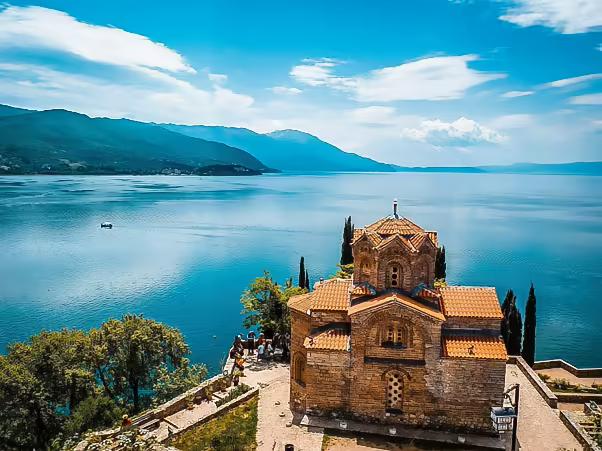
Ohrid sits on the shores of one of Europe's oldest and deepest lakes, a UNESCO World Heritage site that has drawn travellers for centuries. Known for its medieval churches, Ottoman-era Old Town, and a pace of life that feels far removed from big-city stress, Ohrid attracts remote workers, retirees, and creatives looking for beauty and affordability in equal measure. The town blends lakeside relaxation with a layer of history visible on nearly every corner — from Byzantine frescoes to the imposing ramparts of Samuel's Fortress. If you want a European lifestyle at Balkan prices, Ohrid deserves a serious look.
Ohrid at a Glance
- Population
- ~38,800
- Region
- Southwestern North Macedonia, Ohrid Municipality
- Known For
- Lake Ohrid (UNESCO), ancient churches, Samuel's Fortress
- Average Rent (1BR)
- €180–€250 per month
- Average Salary
- €600–€700 net per month
- Expat Community
- Small but growing — digital nomads, retirees, and seasonal workers
- Currency
- Macedonian Denar (MKD); €1 ≈ 61.5 MKD
- Climate
- Mediterranean-influenced; warm summers (28–33°C), mild winters (2–8°C)
Why Move to Ohrid
- Lake Ohrid lifestyle: Swimming, kayaking, and sunset walks along one of the world's oldest lakes are part of daily life, not just weekend plans. The lake's clarity and clean shores rival any Mediterranean setting, without the crowds or price tag.
- Extremely affordable: Ohrid ranks among the cheapest cities in Europe for rent, dining, and everyday expenses — a single person can live well on under €600 per month. Retirees and remote workers find their budgets stretch further here than almost anywhere else on the continent.
- UNESCO heritage everywhere: Over 365 medieval churches, Byzantine frescoes, and Samuel's Fortress give the town an open-air museum quality that never gets old. You can stumble across 1,000-year-old ruins just walking to the shops.
- Safe and walkable: Low crime, compact streets, and a relaxed atmosphere make it easy to settle in without a car. Neighbours greet each other, doors stay unlocked in some areas, and the pace is unhurried.
- Summer energy: From June to September, Ohrid transforms into a lively destination with festivals, open-air concerts, lakeside bars, and a vibrant social scene that balances the off-season calm. The Ancient Theatre, beach bars, and the promenade come alive.
- Gateway to the Balkans: Ohrid's location in southwestern North Macedonia puts it within easy reach of Albania, Greece, and Kosovo — weekend trips across borders are simple and inexpensive.
Finding Housing in Ohrid
Average Rents
| Neighborhood | 1-Bedroom | 3-Bedroom | Character |
|---|---|---|---|
| Old Town (Varosh) | €200–€280 | €350–€500 | Historic stone houses, narrow lanes, lake views |
| City Centre | €180–€250 | €300–€450 | Modern apartments, cafés, shops, walkable |
| Lakeside (Kaneo–Sveti Jovan) | €220–€320 | €400–€550 | Scenic waterfront, quieter, touristy in summer |
| Labunishta | €150–€200 | €250–€380 | Budget-friendly, residential, local atmosphere |
| St. Stefan | €160–€220 | €280–€400 | Suburban feel, family-friendly, green spaces |
| Trpejca (nearby village) | €170–€260 | €300–€450 | Lakeside village, ultra-quiet, scenic |
How to Find Housing
- Pazar3.mk: The largest local classifieds site; most Ohrid rentals are listed here. Search "Охрид" for the best results.
- Facebook groups: "Ohrid Apartments for Rent" and "Ohrid Expat Community" have regular postings from landlords who speak English.
- Local agencies: Small real estate offices in the city centre can help, especially if you don't speak Macedonian. Fees are typically one month's rent.
- Walk-in approach: Many landlords advertise with handwritten signs on buildings — exploring the area in person often yields the best deals and lower prices than online listings. Ask at local cafés and shops; word of mouth is powerful in a town this size.
- Seasonal vs. year-round: Be clear about whether you want a year-round lease. Some properties are only available October–May, as landlords switch to short-term tourist rentals in summer. Confirm availability for all 12 months before signing.
Tips for Expats
- Negotiate rent — listed prices are rarely final, especially outside peak tourist season (October–May). Landlords prefer stable long-term tenants and will often reduce the price for a 12-month lease.
- Inspect heating systems before signing; some older buildings rely on electric heaters that spike winter bills significantly. Ask to see a recent electricity bill to gauge typical winter costs.
- Ask whether utilities are included — most rentals charge electricity, water, and internet separately. Budget an extra €50–€80 per month. Water is cheap; electricity is the main variable cost depending on heating.
- Get a written contract even for short stays. Informal agreements are common but leave you unprotected if disputes arise. A contract also helps with residence permit applications.
- Tourist-season pricing affects long-term rentals too. Lock in your lease before June if possible to avoid seasonal markups. Some landlords prefer short-term tourist lets in summer, so finding year-round housing is easier in the off-season.
- Bring documentation copies: Have notarised copies of your passport, proof of income, and any certificates ready. Landlords and authorities may request them at various stages.
Neighborhoods Guide
- Old Town (Varosh): Best for history lovers and those who want to live among centuries-old architecture. Cobbled streets wind past stone churches and Ottoman houses. Slightly pricier, but the atmosphere is unmatched.
- City Centre: The most practical area — close to shops, restaurants, banks, and bus connections. Apartments tend to be newer and better insulated. Good all-rounder for newcomers.
- Lakeside (Kaneo–Sveti Jovan): Stunning clifftop views over the lake, home to the iconic Sveti Jovan at Kaneo church. Quiet off-season but busy in summer. Ideal for remote workers and retirees who value scenery.
- Labunishta: Budget-friendly residential area east of the centre. Less touristy, more local, and good for long-term stays on a tight budget. Limited dining options but well-connected by bus.
- St. Stefan: A quieter suburb with family homes and gardens. Slightly removed from the bustle but well-connected by local buses. Popular with families and retirees seeking space and greenery.
- Trpejca: A tiny fishing village on the lake, about 15 km south of Ohrid. Houses cling to the hillside above a pebble beach. Perfect if you want complete isolation and postcard views, though amenities are minimal.
Cost of Living in Ohrid
Monthly Budget Breakdown
| Category | Budget Range |
|---|---|
| Rent (1BR, centre) | €180–€250 |
| Utilities | €50–€80 |
| Internet | €12–€18 |
| Groceries | €120–€160 |
| Transport | €15–€25 |
| Dining out (4x/month) | €40–€60 |
| Leisure/Gym | €20–€35 |
| Total | €437–€628 |
Day-to-Day Costs
- Coffee: €0.70–€1.20
- Lunch (casual, local grill): €3–€5
- Monthly transport pass: €21–€22
- Beer (bar): €1.50–€2.50
- Cinema ticket: €3–€4
- Loaf of bread: €0.40–€0.60
- 1 litre of milk: €0.90–€1.10
- Meal at mid-range restaurant: €6–€10
All prices use the Macedonian Denar (MKD) — the local currency. As of 2026, €1 ≈ 61.5 MKD. ATMs are widely available throughout the city centre, and most shops and restaurants accept debit cards, though cash is still preferred at markets, bakeries, and smaller establishments. International bank transfers work but can be slow — many expats use Wise or Revolut for better rates.
Visa & Residency in Ohrid
- Short stays: Citizens of the EU, US, UK, Canada, Australia, and many other countries can enter North Macedonia visa-free for up to 90 days within a 180-day period.
- Temporary residence: To stay longer, you must apply for a temporary residence permit through the Ministry of Internal Affairs. Common grounds include employment, study, family reunification, or property ownership. You will need a valid passport, proof of accommodation, health insurance, and financial means.
- Permanent residence: After five years of continuous legal residence, you may apply for permanent residency. The process requires proof of stable income, clean criminal record, and basic Macedonian language knowledge.
- Work permits: Non-EU nationals need a work permit in addition to a residence permit. Employers typically sponsor the application. Freelancers and remote workers often use the self-employment route, though the process can be bureaucratic.
- Useful contacts: Ministry of Foreign Affairs – Visa Procedures and Ministry of Internal Affairs – Residence Permits.
Getting Around Ohrid
- Walking: The city centre, Old Town, and lakeside are compact and best explored on foot. You can walk from one end to the other in 30–40 minutes. Most daily errands don't require transport at all.
- Public transport: A small network of minibuses covers the main routes within the city and to nearby villages. Fares are very cheap (~€0.40 per ride), but schedules are loose and infrequent. Don't rely on it for time-sensitive trips.
- Taxis: Affordable and plentiful. A ride within the city typically costs €1.50–€3. Agree on the price before getting in, as meters are not always used. Call-ahead taxis are more reliable than hailing on the street.
- Cycling: Flat lakeside roads make cycling pleasant, especially the path along the shore. Bike rental is available in tourist areas for €3–€5 per day. Outside the main road, some streets are steep and cobbled.
- Driving: Roads are generally fine, though narrow and congested in Old Town during summer. Parking is easy outside peak season and mostly free. A car is useful for exploring villages around the lake and for day trips to St. Naum or the Galicica National Park. Fuel costs are moderate (~€1.40–€1.60 per litre).
- Airport: Ohrid St. Paul the Apostle Airport handles seasonal charter flights and occasional connections to European hubs. Capacity is limited, so most expats fly via Skopje International Airport (~3 hours by car or bus).
- Intercity: Regular bus services connect Ohrid to Skopje (~3 hours, €7–€9), Bitola (~1 hour, €3–€4), and Tirana, Albania (~3.5 hours). There is no train station in Ohrid — the nearest rail link is in Bitola. Buses are the primary mode of intercity travel.
Healthcare in Ohrid
- Hospitals/Clinics: Ohrid General Hospital provides basic and emergency care, but facilities are modest by Western European standards. For specialist treatment, imaging, or elective procedures, many residents travel to Bitola or Skopje, which have larger private and public hospitals. Private clinics in Ohrid offer faster service for routine consultations at affordable prices (€10–€25 per visit).
- English-speaking doctors: Limited availability in Ohrid. Private clinics in the city centre may have staff who speak some English, but it is not guaranteed. Learning basic Macedonian medical vocabulary is strongly recommended. For complex medical needs, Acibadem Sistina and Remedika in Skopje are well-regarded private hospitals with English-speaking staff.
- Pharmacies: Several pharmacies operate in the city centre during standard hours (typically 8:00–20:00). A rotation system ensures at least one pharmacy stays open 24 hours. Common medications are inexpensive and often available without a prescription. Branded Western medications may need to be ordered from Skopje.
- Dental care: Private dental clinics in Ohrid are affordable and generally competent. A routine checkup and cleaning costs €10–€20; fillings run €15–€30. Many expats and tourists use Ohrid for dental tourism due to the price advantage.
- Emergency number: 112 (general emergency) or 194 (ambulance). Response times are reasonable in the city but may be slower in outlying villages.
- Health insurance: Public health insurance is mandatory for long-term residents and covers GP visits, hospital stays, and subsidised medications. Private health insurance from international providers is recommended for the first months and for anyone who wants access to better facilities in Skopje or abroad.
Get a personalised relocation plan
Drop your email and we'll send a tailored checklist plus three quotes from vetted movers.
Culture & Lifestyle
- UNESCO dual heritage: Lake Ohrid and its shoreline are a joint UNESCO World Heritage Site for both natural and cultural significance — one of only around 30 places worldwide to hold dual status. The lake itself is one of the oldest and deepest in Europe, estimated at over 1.3 million years old, with depths reaching 288 metres. Its unique endemic species — including the Ohrid trout and several types of freshwater snail — are found nowhere else on Earth.
- Ancient churches: The town has over 365 historical churches, one for every day of the year. Highlights include the Cathedral of St. Sophia (11th century), Sveti Jovan at Kaneo perched on a cliff above the lake, and the Church of St. Clement and Panteleimon with its reconstructed early Christian mosaics. Many are still active places of worship, not just museums.
- Samuel's Fortress: The imposing medieval fortress dominating Ohrid's skyline was the capital stronghold of the First Bulgarian Empire under Tsar Samuel (late 10th century). Its massive walls and towers offer panoramic views of the lake and surrounding mountains — one of the best free viewpoints in the Balkans. The fortress is open daily and entry costs around €1.
- Ohrid Summer Festival: Running from mid-July to late August, this internationally recognised festival brings classical music, theatre, and dance performances to historic venues including the Ancient Theatre and church courtyards. Performances range from Macedonian folk to world-class orchestral concerts. Tickets are affordable, and many outdoor events are free.
- Ancient Theatre of Ohrid: Discovered in 1985, this Hellenistic-era theatre dating to around 200 BC is one of the few ancient theatres in the world with a sea view. It seats approximately 5,000 and is still used for performances during the summer festival.
- Ottoman bazaar and architecture: The Old Town preserves Ottoman-era houses, mosques, and the traditional bazaar quarter. Narrow stone lanes, wooden balconies, and courtyard gardens give the area a timeless feel that contrasts sharply with modern European cities.
Food & Dining
- Try Ohrid trout (Ohridska pastrmka) — a local delicacy found only in Lake Ohrid, often grilled whole or baked with herbs. It is a protected species, so supply is limited and seasonal. Expect to pay €6–€10 for a whole trout at a lakeside restaurant.
- The Old Town and lakeside promenade are lined with restaurants serving Macedonian staples like tavče gravče (baked beans), ajvar (roasted pepper spread), grilled meats, and Shopska salad. Portions are generous and prices remain low even at the best spots.
- Budget meals start at €2–€3 at local grills (rostiljnica) and bakeries. A lakeside dinner with wine runs €8–€12 per person. Fresh produce from the daily market is excellent and cheap — expect to pay €1–€2 for a bag of seasonal fruit.
- Turkish-style coffee is a daily ritual. Most cafés serve it for under €1. The café culture is central to Ohrid's social life — people sit for hours, especially along the lakefront.
- Wine from the Tikveš region (North Macedonia's main wine area) is widely available and very affordable at €2–€5 per bottle in shops. Local rakija (fruit brandy) is homemade by many households and offered as a welcome drink. North Macedonia's wine scene is underrated — don't skip it.
- Vegetarian options exist but are limited. The national cuisine is meat-heavy. Shopska salad, grilled vegetables, and bean-based dishes are the best bets. Larger restaurants in tourist areas are more accommodating.
Day Trips & Surroundings
- St. Naum Monastery: Located 30 km south on the Albanian border, this 10th-century monastery sits beside crystal-clear springs that feed Lake Ohrid. Boat tours from Ohrid's harbour run daily in summer (€10–€15 return). A must-visit for the springs, peacocks, and Byzantine architecture.
- Galicica National Park: The mountain range between Lake Ohrid and Lake Prespa offers hiking trails with panoramic views of both lakes. Trails range from easy 2-hour walks to full-day summit hikes. Free entry; bring water and sturdy shoes.
- Bay of Bones: A reconstructed prehistoric pile-dwelling settlement on the southern shore, about 15 km from Ohrid. Entry is ~€2. Combines well with a visit to St. Naum.
- Bitola: North Macedonia's second city is an hour away by bus. Worth a day trip for its Shirok Sokak pedestrian boulevard, Ottoman bazaar, and the ancient ruins of Heraclea Lyncestis with Roman mosaics.
- Lake Prespa: The neighbouring lake, higher and wilder than Ohrid, is home to Pelister National Park, the Golem Grad island with ancient ruins, and quiet villages with almost no tourists.
Expat Community
- A small but active expat community includes retirees from Western Europe (particularly the Netherlands, Germany, and the UK) and a growing number of digital nomads drawn by the low cost of living and scenic setting.
- Facebook groups like "Expats in Ohrid" and "Digital Nomads North Macedonia" are the best places to connect, ask questions, and find housing leads.
- Language exchange meetups happen informally in cafés, especially during the tourist season. In the off-season, the social scene is quieter but locals are generally welcoming and curious about newcomers.
- Ohrid lacks the coworking spaces found in larger cities, but several cafés offer reliable Wi-Fi and a work-friendly atmosphere. The lakeside café strip is a popular spot for remote workers during warmer months.
Job Market in Ohrid
- Main industries: Tourism and hospitality (dominant, highly seasonal), education, retail, small-scale agriculture and fisheries, and a budding remote-work ecosystem.
- Major employers: Hotels, restaurants, tour operators, Ohrid municipality, the University of Information Science and Technology (UIST), and seasonal tourism businesses.
- Average salaries by sector:
| Sector | Monthly Net (EUR) |
|---|---|
| Tourism / Hospitality | €400–€600 |
| Education | €450–€650 |
| Retail | €350–€500 |
| IT / Remote work | €800–€2,000+ |
- Job search resources: Pazar3.mk and Vrabotuvanje.com.mk are the main local job boards. LinkedIn is used for professional roles, especially at international-facing companies. Most expats in Ohrid work remotely for employers or clients outside North Macedonia — local employment options are seasonal and limited.
Education in Ohrid
- International schools: There are no full international schools in Ohrid. The nearest options are in Skopje, including NOVA International Schools and QSI Skopje, which follow IB or American curricula. Families with school-age children often commute or relocate to Skopje for this reason. Some families use online schooling as an alternative while living in Ohrid.
- Local schools: Ohrid has several public primary and secondary schools teaching in Macedonian. The quality of education is adequate, though instruction is entirely in Macedonian and the curriculum differs from Western systems. Enrollment for foreign children is possible with residency documentation.
- Universities: The University of Information Science and Technology (UIST) offers English-language programs in IT, computer science, and related fields, drawing a small international student body. It is one of few Macedonian universities with English as the primary language of instruction.
- Preschool and childcare: Public kindergartens exist but have long waitlists. Private nurseries and babysitters are affordable (€100–€200 per month) and more readily available.
- Language schools: Private tutors for Macedonian and English are available locally, typically charging €5–€10 per hour. Some community centres and cafés host informal language exchange sessions during the tourist season. Online tutoring is a practical alternative in the quieter months.
Moving Checklist for Ohrid
- Confirm passport validity (6+ months recommended)
- Research visa and residence requirements via MFA North Macedonia
- Arrange health insurance that covers North Macedonia
- Book temporary accommodation for the first 1–2 weeks (Booking.com or Airbnb have good options)
- Notify your bank of the move; bring cash in euros for the first few days — easily exchanged at local offices
- Download offline maps of Ohrid and the surrounding area
- Check whether your driving licence needs an International Driving Permit (IDP) for North Macedonia
- Register your address with the local police station (required by law within 72 hours for foreigners not staying in a hotel)
- Get a local SIM card from T-Mobile, A1, or LycaMobile — available at shops and kiosks for under €5
- Open a bank account at NLB Banka, Stopanska Banka, or Halkbank with your passport and proof of address
- Walk the Old Town, lakeside promenade, and city centre to orient yourself
- Visit the daily fresh produce market near the centre for affordable groceries
- Locate the nearest pharmacy, hospital, and police station to your accommodation
- Try local restaurants and grills to find your regular spots before committing to cooking
- Find long-term housing using Pazar3, Facebook groups, or a local agent
- Obtain a Tax Identification Number (TIN / ЕМБГ) from the Public Revenue Office
- Set up utilities (electricity via EVN, water, and internet via A1 or Telekabel) at your new address
- Register with a local GP or private clinic for ongoing healthcare
- Connect with the expat community through Facebook groups and local cafés
- Explore Galicica National Park and St. Naum Monastery for weekend trips
- Learn the Cyrillic alphabet basics — it helps immensely with reading street signs, menus, and bus routes
Related Guides
- Moving to North Macedonia — comprehensive country guide
- Moving to Skopje — capital city guide
- Moving to Bitola — nearby city guide
- Moving to Tetovo — university city guide
- Moving to Kumanovo — northern city guide