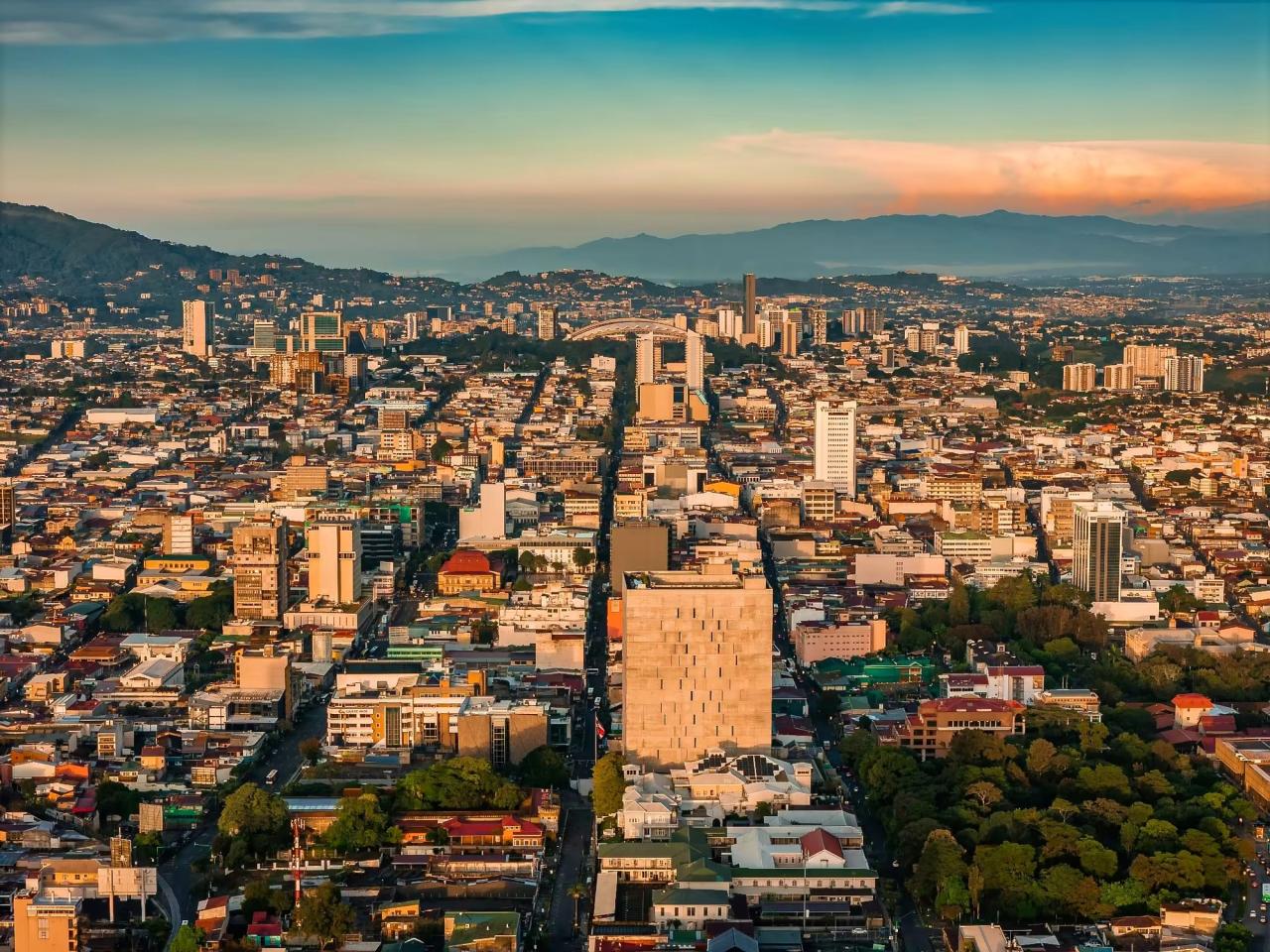

San José is the capital and largest city of Costa Rica, sitting in the Central Valley at roughly 1,030 meters (3,380 ft) above sea level. That elevation gifts the city a pleasant spring-like climate year-round, with daytime temperatures hovering between 18°C and 25°C — a welcome contrast to the steamy lowlands. The San José metropolitan area — known as the Greater Metropolitan Area (GAM), which includes San José proper along with Escazú, Santa Ana, Heredia, Alajuela, and Cartago — is home to over 2.1 million people and functions as the country's economic, political, and cultural hub.
It is also the nucleus of Costa Rica's booming tech sector, sometimes called the "Silicon Valley of Central America," with offices for Intel, HP, IBM, Amazon, and Oracle clustered in the western suburbs. Yet for all its modern corporate footprint, San José retains a distinctly Latin American rhythm: bustling markets, impromptu street festivals, and a pervasive culture of Pura Vida — the national credo of laid-back contentment. This guide is for professionals, remote workers, retirees, and families considering a move to San José.
San José at a Glance

- Population
- ~352,000 (city); ~2.16 million (GAM)
- Region
- Central Valley, San José Province
- Known For
- Spring-like climate year-round, "Silicon Valley of Central America," Teatro Nacional
- Average Rent (1BR)
- ₡350,000–₡750,000 (CRC)
- Average Salary
- ₡700,000–₡1,000,000/month net
- Expat Community
- Large and diverse — North American retirees, European digital nomads, Latin American professionals, corporate transferees in Escazú and Santa Ana
Why Move to San José
- Year-round spring climate: At ~1,030 m elevation in the Central Valley, San José avoids the oppressive tropical heat of the coasts — most days are 18–25°C with low humidity during the dry season (December–April).
- Tech and career hub: International tech companies including Intel, HP, IBM, Amazon, and Oracle maintain significant operations in the western GAM, creating a steady pipeline of bilingual professional jobs.
- Gateway to two oceans: Both the Pacific and Caribbean coasts are only 2–3 hours away by car, and the city sits surrounded by volcanoes — Poás, Irazú, and Turrialba — offering weekend excursions few capital cities can match.
- High-quality, affordable healthcare: Costa Rica's public health system, the Caja Costarricense de Seguro Social (CCSS), provides universal coverage to all legal residents, while private hospitals like Clinica Biblica and Hospital CIMA offer world-class care at a fraction of US prices.
- Stable democracy: Costa Rica abolished its army in 1948 and has been the most politically stable country in Central America for decades — a significant draw for families and investors.
- Strong environmental credentials: Costa Rica generates over 98% of its electricity from renewable sources (hydroelectric, geothermal, wind, and solar), and San José benefits from some of the cleanest urban air in the developing world. The country aims for carbon neutrality, and the city's bus fleet is gradually transitioning to electric vehicles.
Finding Housing in San José
Average Rents
| Neighborhood | 1-Bedroom | 3-Bedroom | Character |
|---|---|---|---|
| Escazú | ₡550,000–₡900,000 | ₡1,000,000–₡2,000,000 | Upscale expat hub with gated communities, multinational offices, and modern shopping centers |
| Santa Ana | ₡500,000–₡800,000 | ₡900,000–₡1,700,000 | Quieter suburban feel, newer condo developments, strong international community |
| Rohrmoser / Pavas | ₡400,000–₡700,000 | ₡800,000–₡1,400,000 | Diplomatic district near embassies, mid-range apartments, good security |
| Barrio Escalante | ₡450,000–₡750,000 | ₡850,000–₡1,500,000 | Trendy foodie neighborhood with craft breweries, cafes, and walkable streets |
| San José Centro | ₡250,000–₡450,000 | ₡500,000–₡900,000 | Gritty but authentic urban core near Mercado Central, Teatro Nacional, and government offices |
| San Pedro / Los Yoses | ₡350,000–₡600,000 | ₡700,000–₡1,300,000 | University-adjacent, youthful energy, cafes and bars near UCR campus |
| Curridabat | ₡320,000–₡550,000 | ₡650,000–₡1,100,000 | Fast-developing eastern suburb with modern condos and shopping centers |
| Heredia | ₡280,000–₡500,000 | ₡550,000–₡1,000,000 | University town feel, cooler climate, lower costs, 30 min to downtown by bus |
How to Find Housing
- Encuentra24.com: The most widely used real estate platform in Costa Rica — filter by neighborhood, price in colones, and furnished vs. unfurnished. Listings from both landlords and agents.
- Craigslist Costa Rica (costarica.craigslist.org): Popular with English-speaking expats, especially for short-term rentals and shared housing in Escazú and Santa Ana.
- Facebook Groups: "Costa Rica Real Estate — Expats" and "Alquileres San José" are active communities where landlords post directly, often without agent commissions.
- Local realtors: Remax and Coldwell Banker have well-established offices in Escazú and Santa Ana, useful if you want an agent to handle Spanish-language negotiations.
Tips for Expats
- Landlords in San José typically ask for a fiador (guarantor) — a Costa Rican citizen or company that co-signs your lease. If you don't have one, expect to pay 2–3 months' deposit instead of the standard 1 month.
- Always confirm whether rent is listed in CRC (Costa Rican colones) or USD — some upscale Escazú and Santa Ana listings are quoted in dollars.
- Short-term furnished rentals through Airbnb or local platforms are a smart first step while you learn the neighborhoods and commute routes.
- Gated communities (condominios) in Escazú and Santa Ana almost always include 24-hour security, which is worth the premium if safety is a priority.
- Rents in the Greater Metropolitan Area have risen steadily since 2022; negotiate the listed price — especially for leases of 12 months or longer.
- Electricity in San José is managed by CNFL (Compañía Nacional de Fuerza y Eléctrica) for most of the GAM and is relatively inexpensive compared to Europe or the US — roughly ₡15,000–₡25,000/month for a one-bedroom apartment with moderate air conditioning use. Water is billed by AyA (Acueductos y Alcantarillados) and is among the cheapest utilities.
- Leases in Costa Rica are typically governed by the Ley General de Arrendamientos Urbanos (General Urban Leases Law). Standard leases run 3 years for residential properties, though 1-year agreements are common for expats. Read the contract carefully — some landlords include automatic renewal clauses that commit you to an additional year unless you provide written notice 90 days before expiration.
Neighborhoods Guide
- Escazú: The most popular neighborhood for expats and corporate transferees. Multiplaza Escazú mall, Avenida Escazú lifestyle center, Hospital CIMA, and numerous international restaurants are all within a small radius. Rents are the highest in the GAM, but security, English-language services, and convenience are unmatched. Best for professionals and families who want a comfortable, Western-style setup.
- Santa Ana: West of Escazú, Santa Ana offers a quieter suburban pace with newer condominium developments, greener surroundings, and slightly lower rents. It attracts families and remote workers who want space without feeling disconnected from the city. The Momentum shopping center and Forum office park anchor the local expat scene.
- Barrio Escalante: San José's gourmet district, packed with craft breweries, specialty coffee shops, wine bars, and farm-to-table restaurants. Walkable, culturally vibrant, and popular with young professionals and digital nomads. Rent sits in the mid-to-upper range. The neighborhood hosts the annual Transitarte arts festival.
- Barrio Amón and Barrio Otoya: Two of San José's oldest residential neighborhoods, lined with colonial mansions and Art Deco buildings now converted into boutique hotels, galleries, and cafes. Atmospheric and central — walking distance to Teatro Nacional and Plaza de la Cultura — but street crime after dark is a concern. Best for singles and couples who want urban authenticity and don't mind taking taxis at night.
- Rohrmoser / Pavas: The diplomatic quarter, home to many embassies and international organizations. Tree-lined streets, mid-rise apartment buildings, and reliable security. Rents are moderate for the quality of life. Pavas is also where you'll find the Tobías Bolaños domestic airport for flights within Costa Rica. Good for professionals who want a quiet, secure base.
- Heredia (city): Technically a separate city 10 km northwest of downtown San José, Heredia hosts the Universidad Nacional (UNA) and has a cooler, slightly rainier microclimate. Rents are noticeably lower, and the town has a relaxed, student-friendly atmosphere. The commute to San José by bus takes 30–60 minutes depending on traffic.
- San Pedro / Los Yoses: Adjacent to downtown on the eastern side, San Pedro is home to the Universidad de Costa Rica (UCR) campus and has a youthful, bookish energy — cafes, used bookstores, and late-night bars line the streets near the university. Los Yoses, just south, is an established residential neighborhood with older homes, quiet streets, and several small parks. Together they offer a middle ground between urban grit and suburban sprawl. Rents fall in the mid-range.
- Curridabat: East of San José along the main highway to Cartago, Curridabat has become one of the fastest-developing areas in the GAM. Modern condominium towers, shopping centers (Momentum Pinares, Plaza del Sol), and improved infrastructure attract middle-class families and professionals. Rents are moderate, and the commute to downtown is 20–40 minutes.
Cost of Living in San José
Monthly Budget Breakdown
| Category | Budget Range (CRC) |
|---|---|
| Rent (1BR, central area) | ₡350,000–₡750,000 |
| Utilities (electricity, water, gas) | ₡40,000–₡80,000 |
| Internet (fiber or cable) | ₡18,000–₡35,000 |
| Groceries | ₡180,000–₡300,000 |
| Transport (buses + occasional taxi) | ₡25,000–₡50,000 |
| Dining out (4x/month) | ₡40,000–₡80,000 |
| Leisure / Gym | ₡35,000–₡80,000 |
| CCSS health contribution (if employed) | ~5.5% of salary |
| Total (single person) | ₡690,000–₡1,375,000 |
Day-to-Day Costs
- Coffee at a local soda (small traditional eatery): ₡800–₡1,500
- Casado (typical lunch plate with rice, beans, plantain, salad, and a protein) at a soda: ₡2,500–₡4,000
- Gallo pinto (traditional rice-and-beans breakfast) with eggs: ₡2,000–₡3,500
- Monthly bus pass: ₡25,000–₡35,000
- Imperial or Pilsen beer at a bar: ₡1,500–₡3,000
- Cinema ticket (Multiplaza or CCM): ₡3,500–₡5,500
- Uber ride across the GAM (e.g., Escazú to downtown): ₡4,000–₡8,000
- Gym membership (mid-range, e.g., Sporta or ESEFN): ₡25,000–₡55,000/month
- Laundry service (per kg, lavandería): ₡800–₡1,500
- Mobile data plan (Kölbi 4G, 2 GB): ₡5,000–₡8,000/month
Getting Around San José
- Public transport: Buses are the dominant mode of public transport in San José — there is no metro system. The commuter train is limited to a single line connecting the western suburbs (Belén, Heredia) with downtown and the eastern neighborhood of San Pedro during peak hours. A typical bus fare within the GAM costs ₡250–₡700 depending on distance. Routes are extensive but confusing for newcomers; the COSEVI (Consejo de Seguridad Vial) website and the "Moovit" app help with route planning. Buses are color-coded by route — for example, the Heredia–San José buses are red, while Escazú routes are blue and white. There is no central bus station; terminals are scattered across downtown by destination, which adds to the initial confusion.
- Rideshare: Uber, Didi, and inDrive all operate in San José and are heavily used by expats. Fares are reasonable — a cross-city ride typically runs ₡3,000–₡10,000 — and they avoid the need to negotiate with taxis. Uber is technically in a legal gray area with the taxi unions; you may be asked to sit in the front seat when arriving at SJO airport to avoid confrontation with licensed taxi drivers.
- Taxis: Red official taxis (with the yellow triangle on the door and "taxi" light on the roof) use meters (marías). Always insist the driver turns on the meter — the fare from SJO to downtown San José should be roughly ₡15,000–₡25,000. Unofficial "pirata" taxis operate everywhere; avoid them for safety reasons.
- Driving: Car ownership is optional in the GAM thanks to buses and rideshare apps, but many expats in Escazú and Santa Ana own vehicles. Traffic in San José is notoriously congested, especially during the rainy season (May–November) when flash flooding can close underpasses. Parking downtown is scarce; most malls and condos offer private spots. All vehicles must pass the revisión técnica (mandatory vehicle inspection) annually. San José uses a restricción vehicular system: one weekday per week, your car cannot circulate within the downtown core during peak hours based on your license plate's last digit.
- Cycling: San José is not a bike-friendly city — dedicated bike lanes are limited to a few stretches of Avenida Central and La Sabana park. The combination of aggressive traffic, narrow roads, and tropical downpours makes cycling a niche option rather than a practical commute method. The occasional Ciclovía events on Sundays close certain streets to cars.
- Airport: Juan Santamaría International Airport (SJO) is located in Alajuela, approximately 20 minutes west of downtown San José by car (longer in rush hour). SJO is the busiest airport in Central America, with direct flights to Miami, New York, Los Angeles, Madrid, Frankfurt, Mexico City, Bogotá, Lima, Panama City, and Toronto, among others. A public bus (Tuasa, Route 2) runs between SJO and downtown San José every 10 minutes for roughly ₡700. Tobías Bolaños Airport in Pavas handles domestic and charter flights, including services to Quepos, Tamarindo, and Tortuguero.
- Intercity travel: Long-distance buses connect San José to Liberia, Puntarenas (Pacific), Limón (Caribbean), and the Panama border. The main bus terminals are scattered across downtown — Terminal 7-10 for Caribbean routes, Terminal Coca-Cola for western routes, and Terminal Atlántico Norte for northern destinations. The commuter train is slowly expanding but remains limited. For weekend trips to the coast, most expats drive or book private shuttle services through companies like Interbus or Easy Ride.
Healthcare in San José
- Public system (CCSS): All legal residents must enroll in the Caja Costarricense de Seguro Social (CCSS), Costa Rica's public health system. Enrollment is mandatory for residency and provides access to general practitioners, specialists, hospital care, and most medications at no additional point-of-service cost. The main public hospital in San José is Hospital San Juan de Dios (founded 1845). Wait times for non-emergency specialist appointments can be weeks or months.
- Private hospitals: Clinica Biblica (downtown, bilingual staff) and Hospital CIMA (Escazú, affiliated with Baylor College of Medicine) are the two primary private hospitals used by expats. Consultations with a specialist cost roughly ₡60,000–₡120,000 out of pocket. Many expats carry private insurance through INS (Instituto Nacional de Seguros) or international providers for faster access.
- English-speaking doctors: Widely available at Clinica Biblica, Hospital CIMA, and in the Escazú/Santa Ana corridor. Many Costa Rican physicians trained in the US or Cuba and speak fluent English. | Pharmacies: Farmacia Fischel, Farmacia Sucre, and Farmacity are everywhere in the GAM. Many medications that require prescriptions elsewhere are sold over the counter in Costa Rica, though regulations have tightened since 2023.
- Emergency number: 911 (nationwide). For CCSS medical emergencies, Hospital San Juan de Dios (Avenida 2, Calle 0) operates a 24-hour emergency room. Hospital México (La Uruca) is the other major public ER. At private hospitals, Clinica Biblica's emergency line and Hospital CIMA's emergency department both accept walk-ins and carry shorter wait times.
Get a personalised relocation plan
Drop your email and we'll send a tailored checklist plus three quotes from vetted movers.
Culture and Lifestyle
- Pura Vida: Costa Rica's signature philosophy translates literally as "pure life" but functions as a greeting, farewell, and general expression of contentment. In San José it means a noticeably more laid-back approach to scheduling, customer service, and social commitments than North Americans or Europeans may be used to.
- Arts and architecture: The Teatro Nacional (National Theater), an ornate 1897 neoclassical landmark on Avenida 2, hosts the National Symphony Orchestra and touring international performers. The Pre-Columbian Gold Museum beneath Plaza de la Cultura holds one of the finest collections of indigenous goldwork in the Americas. The Jade Museum and the Museo Nacional (National Museum, housed in the old Bellavista Fortress with its preserved bullet holes from the 1948 civil war) are all within walking distance downtown.
- Markets: The Mercado Central (Central Market), operating since 1880, is a labyrinth of stalls selling fresh produce, herbs, meats, traditional medicines, and cheap sodas. It's chaotic, fragrant, and the best place in the city to experience everyday San José life.
- Rainy season rhythm: From May to November, afternoons bring heavy tropical downpours that can last 1–3 hours. Locals plan outdoor activities for mornings. The dry season (December–April) is sunny, dusty, and peak tourism time.
- Earthquake country: San José sits in a seismically active zone. Minor tremors are common; most buildings constructed after the 1990s follow strict seismic codes. Know your building's evacuation route and keep an emergency kit.
- Weekend escapes: The Central Valley location makes San José an ideal base for weekend trips. Volcán Poás (active crater, 90 minutes by car), Volcán Irazú (highest volcano in Costa Rica, also 90 minutes), and the rainforest and hot springs of La Paz Waterfall Gardens are all reachable on a day trip. Beach towns on the Pacific (Jacó, Herradura, Dominical) are 2–3 hours away, while the Caribbean coast (Puerto Viejo, Cahuita) is roughly 4 hours via Route 32 through Braulio Carrillo National Park.
- Sports and outdoors: Soccer (fútbol) is a national obsession — the national team (La Sele) plays at Estadio Nacional in La Sabana, and match days shut down the city. La Sabana Metropolitan Park, the largest urban park in the GAM at 72 hectares, is where San José residents jog, play soccer, picnic, and walk dogs. Running and cycling clubs meet there on weekend mornings.
Food and Dining
- Local staples include gallo pinto (rice and black beans seasoned with Salsa Lizano, served at breakfast), casado (a lunch plate combining rice, beans, plantain, salad, and a choice of meat or fish), and ceviche (particularly on the Pacific-influenced menus).
- Sodas — small, family-run restaurants often no bigger than a counter and a few plastic chairs — serve the most authentic and affordable Costa Rican food. The best cluster around Mercado Central and in Barrio Mexico.
- Barrio Escalante is the city's gourmet corridor, home to restaurants like Alquimia, Silvestre, and Franc and to craft breweries including Costa Rica's Craft Brewing Co. and Treintaycinco.
- Avenida Central, the main pedestrian boulevard downtown, is lined with quick-service restaurants, ice cream shops, and coffee chains. Café Britt, though tourist-oriented, offers a genuine taste of Costa Rican specialty coffee culture.
- For imported groceries and specialty items, AutoMercado (locations in Escazú, Santa Ana, and Rohrmoser) stocks US and European brands that regular supermarkets like Mas x Menos or Walmart do not.
- Fresh fruits and vegetables are abundant and affordable at weekly ferias (farmers' markets) held in every GAM municipality on Friday, Saturday, or Sunday. The Escazú feria (Saturday mornings) and the Zapote feria are favorites among expats for organic produce and imported cheese.
- Salsa Lizano is the ubiquitous Costa Rican condiment — a slightly sweet, mildly tangy vegetable sauce found on every restaurant table and in every household. Expect to develop an addiction to it on your gallo pinto within weeks of arriving.
Expat Community
- The InterNations San José community hosts regular events, primarily attracting corporate transferees and entrepreneurs in the Escazú/Santa Ana corridor.
- Facebook groups "Expats in Costa Rica" (200,000+ members) and "San José Expats" are the most active online communities for housing questions, visa advice, and social meetups.
- The Costa Rican–American Chamber of Commerce (AMCHAM) and the British-Costa Rican Chamber of Commerce organize networking events popular with English-speaking professionals.
- Language exchange meetups (intercambios) happen weekly at bars and cafes in Barrio Escalante and San Pedro — search Meetup.com or Facebook Events for "intercambio inglés español San José."
- Universidad de Costa Rica (UCR) in San Pedro draws international students and researchers, adding an academic flavor to the local expat mix.
- Volunteering is a strong entry point into the community. Organizations like ASVO (Asociación de Voluntarios para el Servicio en las Áreas Protegidas), Habitat for Humanity Costa Rica, and local animal shelters welcome foreign volunteers and provide immediate social connections.
- Religious communities are also gathering points — the International Baptist Church in Escazú and the English-speaking Catholic Mass at the Cathedral in downtown San José both serve the expat community.
Job Market in San José
- Main industries: Technology and shared services (BPO), tourism, pharmaceuticals, medical devices, finance, agriculture and food processing, government and diplomacy.
- Major employers: Intel (campus in Heredia), HP (shared services center), IBM, Amazon Web Services, Oracle, Boston Scientific, Baxter, Pfizer, Procter & Gamble, Walmart Centroamérica, Banco Nacional, Banco de Costa Rica.
- Bilingual advantage: English-Spanish bilingual professionals command a significant salary premium in San José — often 30–50% more than Spanish-only peers in equivalent roles. Most multinational companies conduct internal business in English, but dealing with local vendors, government offices, and staff requires Spanish.
- Average salaries by sector:
| Sector | Monthly Net (CRC) |
|---|---|
| Software development / IT | ₡900,000–₡2,500,000 |
| BPO / Customer service (bilingual) | ₡600,000–₡1,200,000 |
| Marketing / Communications | ₡650,000–₡1,400,000 |
| Teaching (international schools) | ₡800,000–₡1,600,000 |
| Tourism / Hospitality | ₡450,000–₡900,000 |
| Pharmaceutical / MedTech | ₡800,000–₡1,800,000 |
| Government / Public sector | ₡500,000–₡1,100,000 |
- Job search resources: LinkedIn is the primary professional network in Costa Rica. CompuTrabajo.co.cr and Encuentra24.com/jobs are the main local job boards. Many tech and bilingual roles are posted on Glassdoor and Indeed under "Costa Rica" location filters. For English-teaching positions, Dave's ESL Cafe and local international school websites are starting points.
- Remote workers: Costa Rica introduced a digital nomad visa in 2022 allowing remote workers to stay for up to one year (renewable) without local income tax, provided they earn at least US$3,000/month from foreign sources. San José's coworking scene has expanded to match, with WeWork (Escazú), Impact Hub (San José), and Selina (multiple locations) offering flexible desks and strong internet connectivity.
- Work culture: Costa Rican work culture blends Latin American warmth with increasing corporate formality in the multinational sector. Punctuality is appreciated but not universally practiced — the concept of "la hora tica" (Tico time) means meetings often start 10–15 minutes late. Business casual is standard in most offices, though tech companies tend toward the casual end. Building personal relationships matters; a coffee meeting (café) to discuss business is culturally important and should not be rushed.
Education in San José
- International schools: Country Day School (Escazú, US curriculum, Pre-K through 12), Lincoln School (Barva, near Heredia, International Baccalaureate), Blue Valley School (Escazú, bilingual IB program), British School of Costa Rica (Rohrmoser, British/IB curriculum), International Christian School (Santa Ana). Tuition ranges from ₡4,000,000 to ₡10,000,000 per year depending on grade level and school.
- Universities: Universidad de Costa Rica (UCR) in San Pedro is the country's top-ranked public university and the largest research institution in Central America. Universidad Nacional (UNA) in Heredia is the second public university, strong in education and environmental sciences. Instituto Tecnológico de Costa Rica (ITCR/TEC) in Cartago focuses on engineering and technology. Private options include Universidad Latina (ULatina) and Universidad Autónoma de Centro América (UACA).
- Language schools: Instituto Británico (British Institute) and Centro Cultural Costarricense Norteamericano offer structured Spanish courses for foreigners. Conversa Language School in Santa Ana runs intensive immersion programs popular with arriving expats. Universal de Idiomas in Barrio Amón and Intercultura in Heredia are additional options with group and private classes ranging from ₡80,000–₡200,000 per week.
- Public schools: Costa Rican public education is free and generally decent by regional standards, but classes are conducted entirely in Spanish and follow the national MEP (Ministerio de Educación Pública) curriculum. Most expat families with school-age children opt for private or international schools unless the children are already fluent in Spanish and the family plans a long-term stay.
Moving Checklist for San José
Before Arriving
- [ ] Confirm your residency category (Pensionado, Rentista, Investor, Work, Student, or Family Link) and gather required documents: birth certificate, police record, marriage certificate if applicable — all apostilled and translated by an official Costa Rican translator
- [ ] Open a Costa Rican bank account (Banco Nacional or Banco de Costa Rica accept foreign passports with a minimum deposit; full accounts require residency)
- [ ] Research and book temporary accommodation for your first 2–4 weeks in Escazú, Santa Ana, or Rohrmoser — areas with reliable Airbnb inventory and English-speaking hosts
- [ ] Ship belongings through a customs-registered mover; prepare a notarized inventory in Spanish of all items, noting serial numbers for electronics
- [ ] Check pet import requirements: microchip, rabies vaccination (at least 30 days old), and a veterinary health certificate issued within 10 days of travel endorsed by Costa Rican consulate
- [ ] Purchase private health insurance for your first months if you will not have immediate CCSS coverage
- [ ] Notify your home-country bank and tax authority of your relocation; understand Costa Rica's 183-day tax residency rule
- [ ] Download offline Spanish dictionary and translation app; have key documents photocopied and stored digitally
- [ ] Arrange international shipping for pets if applicable — Costa Rica requires an import permit from SENASA (Servicio Nacional de Salud Animal) processed at least 2 weeks before travel
- [ ] Request international driving permit (IDP) from your home country — valid for the first 90 days while you settle in
First Week
- [ ] Register with the Dirección General de Migración y Extranjería (Costa Rican Immigration) to begin or continue your residency application — the main office is in La Uruca, western San José
- [ ] Obtain a local SIM card (Kölbi by ICE is the state provider with best coverage; Claro and Movistar are alternatives) — you'll need a passport to purchase
- [ ] Open or convert your bank account at Banco Nacional, Banco de Costa Rica, or Banco Popular; request online banking access
- [ ] Begin apartment hunting in person — walk neighborhoods, visit buildings, and talk to building managers (encargados) who often know of unlisted units
- [ ] Register with the CCSS at your nearest EBAIS (Equipo Básico de Atención Integral en Salud — local public health clinic) to start your health coverage
- [ ] Keep all residency application receipts and appointment confirmations — Costa Rican immigration is paper-based and losing a receipt can mean restarting the process
- [ ] Locate your nearest EBAIS clinic (each neighborhood has one) and register your household — you'll need your passport, proof of address, and residency application receipt
- [ ] Get a Costa Rican mobile number (required for everything from banking to Uber to government 2-factor authentication) — ICE Kolbi kiosks at SJO airport sell prepaid SIMs for roughly ₡2,500
First Month
- [ ] Sign a lease and set up utilities: electricity (CNFL or ICE), water (AyA), internet (Kölbi, Cable Tica, or Tigo)
- [ ] Apply for your DIMEX (Documento de Identidad Migratorio para Extranjeros — the national ID card for foreign residents) at the immigration office once your residency is approved
- [ ] Register with the Dirección General de Tributación (Tax Authority) to obtain your NIT (Número de Identificación Tributaria — tax identification number) if you will earn income in Costa Rica
- [ ] If you imported a vehicle, complete registration with the Registro Nacional and schedule your revisión técnica (vehicle inspection)
- [ ] Exchange your foreign driver's license at the COSEVI office in La Uruca — bring your passport, DIMEX or residency receipt, and a medical certificate from a Costa Rican doctor
- [ ] Enroll children in school and submit apostilled academic records for grade-level placement
- [ ] Join expat groups on Facebook and attend an InterNations or AMCHAM event to build your local network
- [ ] Set up recurring colón transfers or a currency exchange strategy (Wise, Remitly, or bank-to-bank) if your income arrives in a foreign currency
- [ ] If applying for Rentista or Pensionado residency, set up the required bank deposit or pension verification with a Costa Rican bank and obtain letters from the Tributación Directa (Directorate General of Taxation) confirming compliance
- [ ] Install the "Edificios_seguros" or similar earthquake alert app on your phone; confirm your building's evacuation routes and assembly points
Related Guides
- Moving to Costa Rica — comprehensive country guide with visa types, tax system, and national healthcare overview
- Moving to Escazú — deep-dive into San José's most popular expat suburb (coming soon)
- Moving to Santa Ana — family-friendly suburb guide (coming soon)
- Moving to Heredia — university city with lower rents and cooler climate (coming soon)
- Moving to Tamarindo — Pacific coast beach town for the surf-and-remote-work lifestyle (coming soon)