Groupage or full container: what you are actually buying
Groupage — also sold as a shared container — consolidates your goods with other customers' shipments into one container, and you pay only for the space your belongings occupy rather than for the whole box. The pricing basis is not always identical, though: household groupage is billed by volume in cubic metres, while ocean LCL tariffs are charged per cubic metre or per 1,000 kg, whichever is greater.
A full container is the opposite trade. You book the whole box and pay one rate per container whether you fill it or not, and it is normally loaded and sealed at origin and not opened again until it reaches destination. Sealed through versus handled at both ends: most of what follows is a consequence of that single difference.
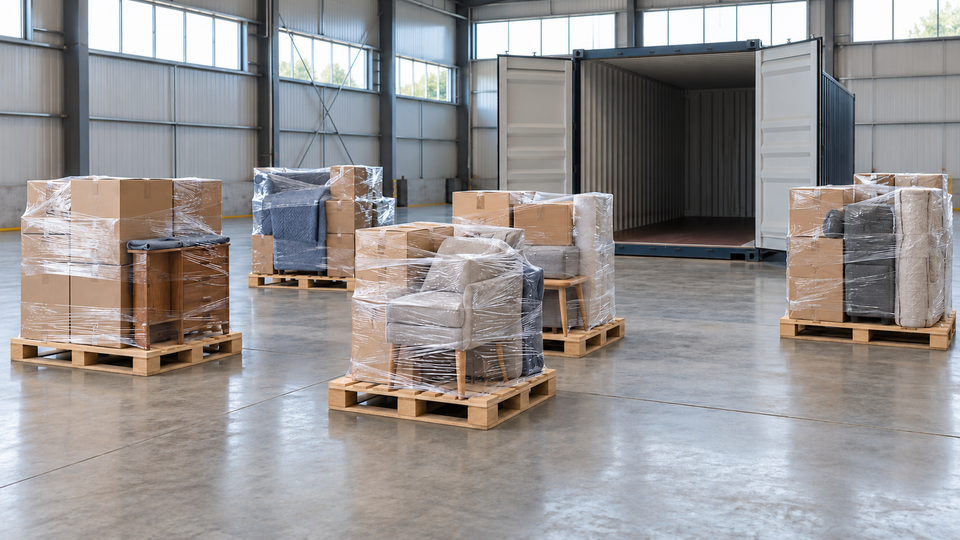
The break-even is a division, not a magic number
The crossover between the two is not a published figure. It is a division: the all-in rate for a 20-foot container divided by the all-in LCL cost per cubic metre. At the illustrative rates used in that guide — $1,800 all-in for a 20-foot container and $130 per cubic metre all-in for LCL — the two cost the same at 1,800 ÷ 130 = 13.85, or about 13.8 cubic metres, and above that volume the container is cheaper. The same source concedes that the 13–15 CBM range usually quoted in the trade has no primary source and shifts with route and market. Treat the arithmetic as the method and the numbers as an example you replace with your own quotes.
The crossover also moves with the lane. It rises on lanes where container rates spike and can fall below 10 CBM where backhaul capacity is cheap. Because the container rate is flat, every cubic metre past the crossover costs nothing extra — up to the container's practical capacity: a 20-foot container has a nominal 33.2 m³ and in practice takes roughly 25–28 CBM of boxes depending on box sizes. The volume at which a container fills is therefore a different number from the volume at which it becomes cheaper. For a shipment that fits inside the container, only the second one affects your invoice; once you approach that practical capacity, fill volume matters again, because it decides whether you need a larger container or a second one.
The comparison usually fails at the quoting stage rather than in the arithmetic. The commonest error is setting an LCL quote that shows only ocean freight against an all-in container quote, which makes the LCL side look far cheaper than it is. An ocean-only per-cubic-metre rate can look like a fraction of the final all-in cost once both freight-station charges, documentation and the delivery-order fee are added; the guide publishes example figures to make that point and describes them as examples, not market rates.
how much an international move costs overall
The charges that decide the comparison sit at the destination
Destination charges are costs incurred after your shipment has arrived, and they apply in most countries regardless of which shipping company you use. A mover's own breakdown lists customs inspection fees, port document fees, port handling charges and warehouse handling charges among them, and notes that they vary with each country's laws and customs rules and with the shipment's size, weight, contents and purpose.
On the container side, a full quote is built from three groups: origin charges, ocean freight, and destination charges. The destination group itself contains destination terminal handling (the port charge for handling the container, including lifting it off the vessel), import handling and release, and delivery haulage or drayage. Commonly outside a base container quote sit import duties and taxes (paid by the importer of record), cargo insurance, demurrage and detention, storage beyond the free period, and import customs clearance where it is quoted as a separate service.
Two of those are conditional by design, and they are exactly the lines that bite when your flat is not ready or your paperwork is late. Demurrage and detention apply only if the container sits at the port or is held beyond its free time, and storage beyond the standard free period at either end is billed separately when it occurs.
Groupage adds an extra pair of hands at each end. LCL cargo is consolidated at an origin container freight station and deconsolidated at a destination one, each billing per cubic metre on top of the ocean freight, plus a delivery-order fee, and the guide warns that destination freight-station handling, the delivery-order fee and storage after free time are frequently left out of the origin quote. Two quotes for the same shipment can differ in both scope and presentation: one forwarder gives an all-in figure while another itemises every charge; one includes destination handling while another leaves it out — so match the scope before comparing the totals.
| Charge | Where it arises | How quotes handle it |
|---|---|---|
| Destination terminal handling (lifting the container off the vessel) | Container, destination port | Included or left out depending on the forwarder |
| Import handling and release | Container, destination | Part of the destination group — check the scope |
| Delivery haulage or drayage | Container, port to your door | Included only if door delivery is quoted |
| Destination freight-station deconsolidation and delivery-order fee | Groupage, destination | Frequently missing from the origin quote |
| Import duties and taxes | Customs, importer of record | Commonly outside the base quote |
| Cargo insurance | Separate policy | Commonly outside the base quote |
| Demurrage and detention | Container held past free time | Charged only if free time is exceeded |
| Storage beyond the free period | Either end | Billed separately when it occurs |
| Import customs clearance | Destination | Sometimes quoted as a separate service |
Disqualifier one: a date you cannot move
A shared container does not sail when your goods are ready; it sails when the container is full, and that consolidation is why transit times run longer. Crown quotes its groupage at approximately 12 weeks door to door depending on origin and destination, and says directly that if transit time is critical you should consider the direct shipping options instead.
The wait is not evenly spread. Windmill publishes its own departure rhythm: several times a month, often twice, to popular destinations such as the United States, South Africa and Thailand; monthly to most others; once every two months to the quietest. Route availability narrows it further. Crown's groupage runs on four corridors only — Hong Kong to the UK and on-forwarding within the EU, to Australia, to New Zealand, and to the United States and Canada — while Britannia says it serves most major destinations but most regularly Australia, New Zealand, Canada and South Africa.
A groupage quote on a thin lane therefore bundles two waits — until the container fills, and until the next one leaves — on top of the sailing itself.
Disqualifier two: value, fragility and what the policy really covers
Extra handling is real but unmeasured. LCL cargo is unloaded and reloaded at a freight station at both ends, where a container is loaded once and sealed, and it shares space with other shippers' goods that can leak, crush or need fumigation. No published statistics measure the extra damage that follows.
What the policy actually says matters far more than the phrase 'all risks'. The two wordings below are named examples, not the market — check your own certificate against each exclusion line. Seven Seas' Basic tier does not protect against damage to, or partial loss of, the contents of your receptacles. Its Premier tier covers all risks under the Institute Cargo Clauses (A), War and Strikes clauses, but still excludes expense caused by delay, expense caused by confiscation or detention by customs or other authorities, and damage to furniture unless packed professionally in an outer container.
Crown's transit protection has its own edges. The standard policy does not cover loss or damage caused by a change in atmospheric conditions during transit that might lead to mould or mildew. Where a damaged item is part of a pair or set, only the damaged item is covered, not the depreciated value of the set. Electronic or mechanical derangement is not covered without visible damage to the item or its container. Declared value is set against a minimum guideline of US$10 per pound or US$2,475 per cubic metre, and anything not declared is not covered.
how moving insurance exclusions work in practice
Disqualifier three: clearance, documents and liability
Document requirements are not where the two modes diverge, at least in the one official rule in front of us. For US-bound effects claimed free of duty that do not accompany you on arrival, or are forwarded in bond, a declaration of the importer on CBP Form 3299, or its electronic equivalent, is required to support the claim, although an oral declaration may be accepted in lieu for a resident's effects that are free of duty under subheadings 9804.00.10 or 9804.00.45. That is one destination's rule, not a global checklist — verify your own.
What differs is what happens around clearance. One mover states that a dedicated container simplifies the clearance process and helps avoid delays that can sometimes occur when multiple shipments are consolidated. The mechanism described in independent freight guides is that a customs examination of one shipper's cargo can hold up release for the whole container. No official rule confirming that was found for this article, so treat it as forwarder-reported practice rather than a statutory certainty — and ask your mover how they have seen it play out on your route.
Liability is the other thing people assume they know. Maersk's LCL terms state that the volume agreement does not set out the parties' liability for loss or damage, and that carriage is governed by the transport document instead. The limits you actually live with therefore sit in the bill of lading, not in the booking terms, and that is where to read them.
customs rules for household goods
The worksheet: five steps before you sign
Measure first. Walk the flat room by room and total your volume in cubic metres — furniture and boxes, not floor area. Both quotes are only as good as that number, so measure twice before you send it to anyone.
Get both modes quoted to the same scope: same collection address, same delivery address, both ends included, exclusions listed in writing. If one figure is all-in and the other is not, you are comparing two different jobs rather than two prices.
Run the division yourself: all-in 20-foot container rate ÷ all-in groupage cost per cubic metre = break-even volume. Compare the result with your measured volume.
Apply the three disqualifiers in order: a date you cannot move, high-value or fragile goods whose damage would swallow the saving, and a destination where you expect slow or complicated clearance.
It is also worth naming the obvious: the mode a company recommends is a commercial recommendation as well as a technical one. The departure rhythm quoted above comes from a forwarder that sells groupage and calls itself the founder of groupage; other movers here sell both modes and publish conditions for both; and the break-even method comes from a commercial freight guide, not a neutral authority. None of that is dishonest — but ask every company quoting you what the other mode would cost on the same inventory, and read the answer as a quote, not as advice.
best international moving companies
Groupage vs full container: quick answers
Common Questions and Answers
Is groupage the same as LCL?
One mover says they are the same thing, both being part-load shared shipments. The billing basis can still differ: household groupage is priced by volume in cubic metres, while ocean LCL is charged per cubic metre or per 1,000 kg, whichever is greater. Ask which basis appears on your quote.
At how many cubic metres does a container become cheaper?
There is no published threshold. It is a division: all-in 20-foot container rate ÷ all-in groupage cost per cubic metre. At illustrative rates of $1,800 and $130 the answer is about 13.8 CBM, but the 13–15 CBM range often quoted in the trade has no primary source. Run the division on your own two all-in quotes.
Can another shipper's cargo delay my delivery?
A mover says consolidated shipments can attract clearance delays that a dedicated container helps avoid, and freight guides describe an examination of one consignment holding up release for the whole container. No official rule confirming it was found, so treat it as reported practice and ask about your specific route.