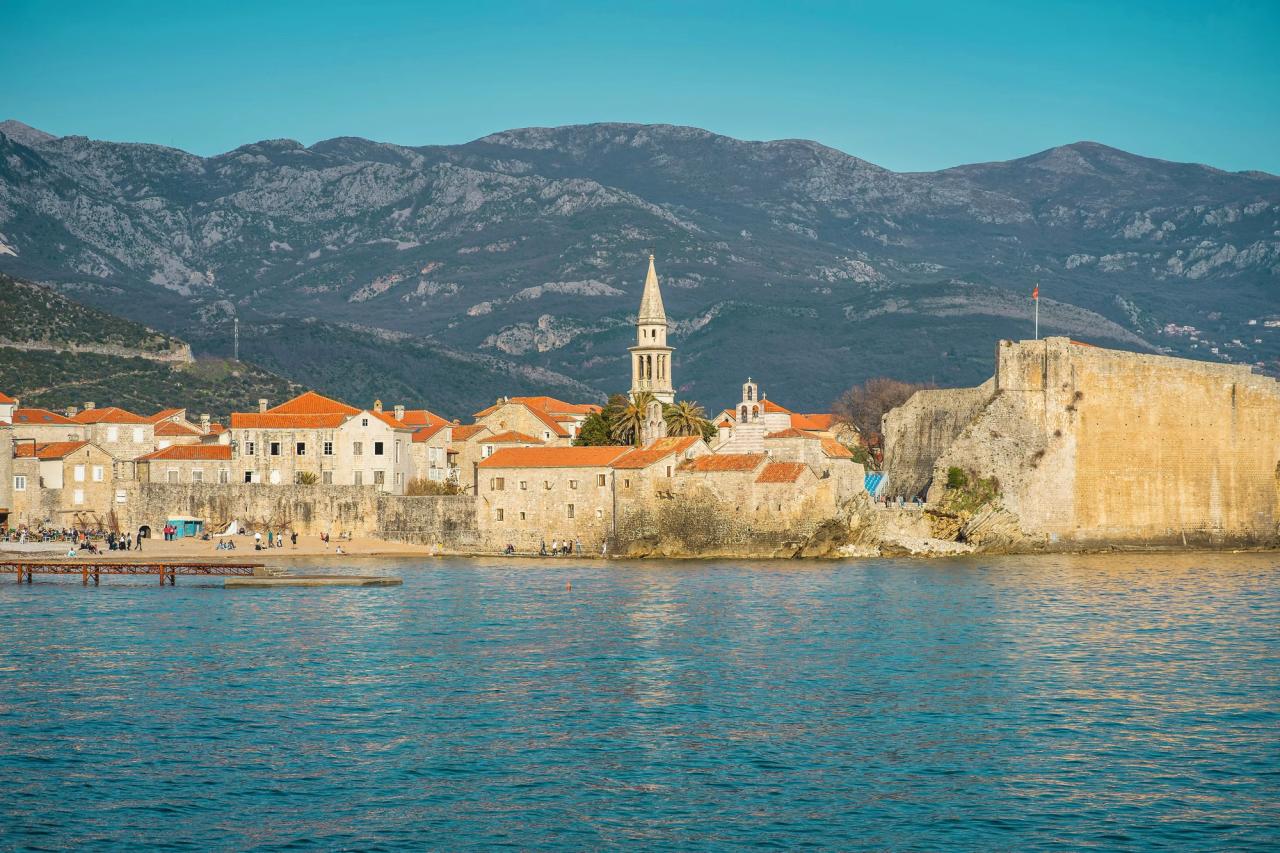

Budva est la capitale incontestée de la fête au Monténégro — une petite ville de l'Adriatique où les remparts médiévaux de la Vieille Ville côtoient une vie nocturne trépidante, des plages turquoise et une économie portée par le tourisme. Si vous êtes télétravailleur, entrepreneur ou retraité à la recherche d'un cadre côtier animé et que vous acceptez de payer un peu plus cher qu'ailleurs au Monténégro, Budva mérite sérieusement votre attention. La ville s'anime en été et s'apaise en hiver, offrant aux expatriés un mode de vie à deux saisons que beaucoup apprécient.
Située sur une presqu'île étroite encadrée par des montagnes calcaires spectaculaires, Budva possède environ 2 500 ans d'histoire tout en affichant un développement côtier résolument moderne. Le vieux cœur — ceinturé de remparts en pierre de l'époque vénitienne — constitue le centre culturel, tandis que les baies et promontoires environnants ont absorbé l'essentiel de la croissance résidentielle, commerciale et nocturne qui a fait de Budva le moteur touristique du Monténégro. Que vous veniez pour un été d'essai ou pour une année complète, ce guide couvre les informations pratiques dont vous avez besoin pour vous installer.
Budva en un coup d'œil
- Population
- ~27 000 (municipalité) ; monte à plus de 70 000 en été
- Région
- Monténégro côtier (Riviera de Budva)
- Connue pour
- Remparts de la Vieille Ville, vie nocturne adriatique, Sveti Stefan
- Loyer moyen (T1)
- 500–750 €/mois
- Salaire moyen
- 650–900 €/mois net
- Communauté expatriée
- En croissance ; forte présence russe, serbe et d’Europe de l’Ouest
Budva se trouve sur une petite presqu’île de la côte adriatique centrale du Monténégro, à mi-chemin environ entre la baie de Kotor et la frontière albanaise. La ville s’est transformée de manière spectaculaire au cours des deux dernières décennies — autrefois un paisible village de pêcheurs entouré de remparts antiques, elle est aujourd’hui le moteur touristique du pays et un véritable aimant pour l’investissement immobilier. Le cœur historique a su garder son charme, mais l’expansion environnante d’immeubles résidentiels, d’hôtels et de beach-clubs témoigne d’une croissance rapide.
Pour les expatriés, Budva offre un rythme saisonnier unique. L’été (juin–septembre) est intense — des plages bondées, une vie nocturne ininterrompue et un flux constant de visiteurs internationaux. L’hiver est calme, local et abordable. Beaucoup d’expatriés apprécient ces deux facettes, même si ceux qui recherchent une énergie urbaine toute l’année peuvent trouver la basse saison trop tranquille.
Pourquoi s'installer à Budva
- Un mode de vie côtier à une fraction des prix de l'Europe de l'Ouest : Budva offre un art de vivre méditerranéen — vue sur la mer, journées à la plage, fruits de mer frais — à des coûts bien inférieurs à ceux de villes comparables en Italie, en Espagne ou en Croatie.
- Une vie sociale et nocturne animée : L'été apporte des clubs en plein air, des bars de plage et des festivals qui attirent des visiteurs de toute l'Europe. Même hors saison, la culture des restaurants et des cafés reste active.
- Une ville compacte et accessible à pied : La plupart des besoins quotidiens, la plage et la vieille ville sont accessibles à pied en 15 à 20 minutes — pas besoin de voiture pour la vie de tous les jours.
- Porte d'entrée de la Riviera de Budva : Sveti Stefan, Petrovac, Pržno et Becici sont à quelques minutes en voiture ou en bus, vous offrant de la variété sans déménager.
- Peu de bureaucratie pour les courts séjours : L'entrée sans visa de 90 jours pour de nombreuses nationalités permet de tester le mode de vie avant de s'engager dans une demande de permis de résidence. La procédure de demande de résidence temporaire est simple comparée à celle de nombreux pays de l'UE.
- La voie de l'adhésion du Monténégro à l'UE : À mesure que le Monténégro progresse vers l'adhésion à l'UE, la propriété et la résidence ici pourraient prendre une valeur stratégique croissante pour la planification à long terme. Le pays a adopté l'euro et s'aligne sur les réglementations de l'UE dans de nombreux secteurs.
- Une infrastructure de télétravail en plein essor : La fiabilité d'Internet s'est considérablement améliorée, des espaces de coworking font leur apparition, et l'économie locale s'adapte de plus en plus pour accueillir les professionnels étrangers toute l'année.
Trouver un logement à Budva
Loyers moyens
| Quartier | 1 chambre | 3 chambres | Caractère |
|---|---|---|---|
| Vieille ville (Stari Grad) | €600–€900 | €1 200–€1 800 | Bâtiments historiques en pierre, ruelles étroites, très fréquenté par les touristes en été |
| Secteur Slovenska Plaža / Riviera | €500–€700 | €900–€1 400 | Appartements en bord de mer, promenade animée, prisé des jeunes expatriés |
| Quartier de Bečići | €450–€650 | €800–€1 300 | Station balnéaire plus calme, adapté aux familles, ambiance huppée |
| Sveti Stefan | €550–€800 | €1 000–€1 600 | Vue emblématique sur l'île, exclusif, tarifs majorés en saison |
| Petrovac | 400–600 € | 700–1 100 € | Petite ville du sud, détendue, avec des marchés locaux et une communauté d’expatriés plus discrète |
Comment trouver un logement
- Nekretnine.me : le plus grand portail immobilier du Monténégro — le premier endroit où les locaux et les expatriés publient leurs annonces. Disponible en monténégrin et en anglais ; filtrer par ville, prix et surface.
- Groupes Facebook : les groupes « Apartments Budva » et « Expats in Montenegro » proposent des annonces régulières, surtout avant et après l’été, lorsque les propriétaires passent de la location touristique à la location longue durée.
- Agents immobiliers locaux : utiles si vous ne parlez pas monténégrin ; prévoyez des honoraires d’un mois de loyer en guise de commission. Les agents peuvent aussi vous aider avec le bail et l’enregistrement au MUP.
- Se promener dans le quartier : beaucoup de propriétaires affichent encore des panneaux sur les immeubles ou aux fenêtres avec la mention « Izdaje se » (à louer). Il vaut la peine de vous promener dans votre quartier cible en saison intermédiaire (octobre ou avril), quand la rotation est la plus forte.
- Le bouche-à-oreille : demandez dans les groupes d’expatriés et dans les cafés locaux. La communauté de Budva est assez petite pour que les recommandations personnelles mènent souvent aux meilleures offres et aux propriétaires les plus fiables.
Conseils pour les expatriés
- Négociez les tarifs hors saison — les propriétaires accordent souvent des réductions importantes pour les baux de 12 mois signés en hiver (octobre–mars). Les baux estivaux uniquement se vendent à prix premium.
- Vérifiez si les charges sont incluses avant de signer. Beaucoup d’annonces affichent « toutes charges comprises » en été mais passent à la charge du locataire hors saison. L’électricité peut exploser en hiver à cause du chauffage.
- Inspectez les traces d’humidité et de moisissure avant de vous engager. L’humidité côtière de Budva, combinée aux constructions anciennes en pierre et béton, rend ce problème fréquent. Vérifiez les salles de bain, les angles de cuisine et les murs des placards.
- Évitez de payer le dépôt de garantie entièrement en espèces sans reçu. Un contrat signé et un virement bancaire constituent une trace écrite en cas de litige.
- Si vous prévoyez de rester une année complète, envisagez de louer légèrement à l’intérieur des terres (Rozino, Podlozno) ou à Petrovac pour des économies substantielles — parfois 30 à 40 % de moins que le centre de Budva.
Guide des quartiers
- Vieille Ville (Stari Grad) : idéale pour les amateurs de culture et les séjours courts. Ruelles médiévales denses, entourées de remparts, à quelques pas de la plage principale. Les loyers sont les plus élevés ici et le bruit atteint son pic en été à cause des bars en plein air et du passage nocturne. Les appartements sont petits et pleins de charme — pensez murs en pierre, plafonds bas et lumière naturelle limitée. Peu adapté aux familles ou aux dormeurs légers.
- Slovenska Plaža : le centre névralgique et le quartier le plus prisé des jeunes expatriés. Longue plage, promenade bordée de cafés et de bars, et la plus forte concentration d’appartements locatifs de Budva. Bon mélange de bâtiments modernes et anciens. Tout est accessible à pied. Zone la plus bruyante de juin à septembre.
- Bečići : à 10 minutes de bus à l’est du centre de Budva. Abrite l’une des meilleures plages de sable de l’Adriatique et plusieurs complexes de standing. Ambiance plus calme, meilleur stationnement et atmosphère de village-resort. Les familles et les retraités ont tendance à s’y installer. Les loyers sont légèrement inférieurs à ceux de Budva même.
- Sveti Stefan : l'îlot emblématique relié au continent par une étroite passerelle, à environ 10 minutes au sud en voiture. Les villas et appartements environnants se négocient avec une prime grâce à la vue et à l'exclusivité. Très calme — commerces et vie nocturne limités. Idéal pour ceux qui privilégient le paysage et l'intimité au détriment de la commodité.
- Petrovac : à 15 km au sud de Budva, une petite ville dotée de ses propres plages, d'une promenade bordée de pins et d'un rythme de vie détendu. Loyers plus bas, un marché local et une communauté d'expatriés en croissance mais encore réduite. Idéal pour ceux qui souhaitent profiter de la région de Budva sans son effervescence. Liaison par bus régulière vers Budva (25–30 min).
- Rozino / Podlozno : zones résidentielles à l'intérieur des terres au-dessus du centre de Budva, qui grimpent dans les contreforts. Les loyers les plus bas de la municipalité avec des vues panoramiques sur l'Adriatique. La descente vers la plage prend 15 à 25 minutes, et le retour se fait en montée. Idéal pour ceux qui ont une voiture ou qui privilégient la tranquillité et des coûts réduits plutôt que la proximité de la mer.
Visa et titre de séjour
Séjours de courte durée
Les citoyens de l'UE, des États-Unis, du Royaume-Uni, du Canada, d'Australie et de nombreux autres pays peuvent entrer au Monténégro sans visa pour une durée allant jusqu'à 90 jours sur une période de 180 jours. Cela vous permet de tester Budva facilement avant de vous engager dans un séjour plus long.
Permis de séjour temporaire
Pour les séjours de plus de 90 jours, vous devez demander un permis de séjour temporaire (privremeni boravak) auprès du ministère monténégrin de l'Intérieur. Les motifs courants de demande incluent :
- Emploi : avec un contrat de travail valide d'un employeur monténégrin.
- Auto-emploi / freelancing : en créant une entreprise locale ou en s'inscrivant comme travailleur indépendant (preduzetnik).
- Propriété immobilière : Posséder un bien immobilier au Monténégro peut vous qualifier pour l'obtention d'un titre de séjour.
- Études : Inscription dans un établissement d'enseignement monténégrin.
- Regroupement familial : Si un membre proche de votre famille possède la résidence ou la nationalité monténégrine.
Les demandes sont déposées au commissariat de police local (MUP). Les documents requis incluent généralement un passeport valide, un justificatif de logement, une assurance maladie, une preuve de ressources financières et un extrait de casier judiciaire vierge. Le traitement dure 2 à 4 semaines. Les permis sont généralement délivrés pour un an et sont renouvelables.
Résidence permanente
Après cinq années de résidence temporaire continue, vous pouvez demander la résidence permanente. La nationalité monténégrine est accessible après 10 ans de résidence légale, sous réserve de compétences linguistiques et d'exigences d'intégration. La double nationalité est généralement autorisée, ce qui rend le Monténégro attractif pour ceux qui souhaitent conserver leur nationalité d'origine.
Conseils pratiques
- Commencez les démarches de permis de résidence le plus tôt possible — rassembler les documents apostillés depuis votre pays d'origine peut prendre des semaines.
- Conservez des copies de tous les dossiers et reçus soumis. L'administration monténégrine s'améliore, mais les traces papier restent essentielles.
- Envisagez de faire appel à un avocat local ou un consultant en réinstallation (200 € – 500 €) pour votre première demande de résidence, surtout si vous ne parlez pas la langue.
- Rejoignez le groupe Facebook « Expats in Montenegro » — c’est la meilleure ressource pour obtenir des conseils en temps réel sur les démarches de résidence, la banque et la vie quotidienne.
Coût de la vie à Budva
Répartition du budget mensuel
| Catégorie | Fourchette budgétaire |
|---|---|
| Loyer (T1, centre-ville) | €500–€750 |
| Charges (électricité, eau, chauffage) | €80–€130 |
| Internet (fibre/ADSL) | 20–30 € |
| Courses alimentaires | 200–300 € |
| Transport (abonnement bus / carburant) | 25–45 € |
| Sorties au restaurant (4 fois/mois) | 80–120 € |
| Loisirs / Salle de sport | 30–50 € |
| Forfait téléphonique mobile | 10 € – 20 € |
| Assurance santé (privée) | 50 € – 150 € |
| Total | 995 € – 1 595 € |
Les coûts mensuels varient considérablement selon la saison. Les factures d’électricité baissent en été (pas de chauffage) mais augmentent en hiver. Le coût des repas au restaurant augmente en pleine saison touristique, surtout dans les restaurants de la Vieille Ville. Préparer ses repas et faire ses courses dans les marchés locaux plutôt que dans les boutiques pour touristes permet d’économiser 100 € à 200 € sur le budget alimentaire mensuel.
Coûts au quotidien
- Café (expresso) : 1,50 € – 2,50 €
- Déjeuner (restaurant simple) : 8 € – 12 €
- Dîner pour deux (gamme moyenne) : 30 € – 50 €
- Abonnement mensuel de bus / carte multi-trajets : 25–35 €
- Bière (au bar, Nikšićko local) : 2,50–4,00 €
- Place de cinéma (Cineplexx, Podgorica) : 5–7 €
- Abonnement salle de sport : 25–45 €/mois
- Laverie (self-service) : 4–6 € par cycle
Budva est la ville la plus chère du Monténégro pour le logement et la restauration, en raison de la demande touristique et des investissements immobiliers étrangers. Cependant, elle reste nettement plus abordable que des stations balnéaires comparables de l'autre côté de l'Adriatique, en Italie, en Espagne ou en Croatie. Préparer ses repas avec les produits frais du marché est le moyen le plus simple de limiter ses dépenses alimentaires.
Se déplacer à Budva
- Transports en commun : les bus locaux relient le centre de Budva, Bečići, Sveti Stefan et Petrovac. Les billets coûtent 1–2 € par trajet ; il n'y a pas de système d'abonnement mensuel officiel, mais des cartes multi-trajets sont disponibles. Le service passe environ toutes les 20–30 minutes en été et est réduit à un bus par heure en hiver.
- Vélo : la route côtière plate entre Budva et Bečići se prête bien au vélo. Les locations de vélos sont courantes en été (5–10 €/jour). Le relief vallonné à l'intérieur des terres rend le vélo peu pratique en dehors de la bande côtière.
- Voiture : une voiture est pratique pour explorer la côte et les montagnes — la route vers Cetinje et Lovćen est spectaculaire. Le stationnement dans la vieille ville de Budva est rare et cher en été (2–5 €/heure). Les parkings couverts près de Slovenska Plaža proposent des tarifs mensuels de 50–80 €.
- Taxis : Les taxis au compteur sont abordables pour les courts trajets (3 €–6 € en ville). Convenez d’un prix ou vérifiez le compteur avant le départ, surtout en pleine saison. Des applications comme eTaxi et Car:Go fonctionnent à Budva pendant les mois d’été.
- Véhicules partagés : Pas d’Uber ni Bolt au Monténégro en 2026, mais des applications locales de commande de véhicules avec chauffeur comblent le besoin de manière saisonnière. En hiver, la réservation de taxi par téléphone reste la norme.
- Aéroport : L’aéroport de Tivat (TIV) se trouve à 25 km avec des vols européens saisonniers. L’aéroport de Podgorica (TGD), à 65 km à l’intérieur des terres, offre davantage de liaisons annuelles, y compris des compagnies low-cost. L’aéroport de Dubrovnik (DBV) en Croatie est à 90 km au nord-ouest et propose le réseau de destinations le plus large, mais les passages aux frontières peuvent rallonger le temps de trajet.
- Bus interurbains : Des services fréquents vers Kotor (30 min, 3 €–5 €), Podgorica (1 h 30, 7 €–10 €), Herceg Novi (1 h, 5 €–7 €), Bar (40 min, 4 €–6 €) et Tirana (3 h 30, 15 €–20 €). Les gares routières sont bien situées en centre-ville et les billets sont peu coûteux. La réservation à l’avance est conseillée en plein été.
Santé à Budva
- Hôpitaux/Cliniques : Budva dispose d’un centre de santé public (Dom Zdravlja) pour les soins primaires et les urgences de base. Pour les traitements spécialisés, les interventions complexes ou les hospitalisations, les expatriés se tournent généralement vers des cliniques privées à Budva ou Kotor, ou vers le Centre clinique de Podgorica (principal hôpital du pays). Le secteur privé s’est développé de manière significative et de nombreuses cliniques sont spécifiquement adaptées aux résidents étrangers.
- Médecins anglophones : Disponibles dans les cliniques privées, en particulier dans les zones touristiques. Le centre de santé de Budva compte du personnel parlant anglais, mais la couverture est inégale. Demandez des recommandations dans les groupes d’expatriés — le bouche-à-oreille reste le meilleur moyen de trouver un bon médecin.
- Pharmacies : Plusieurs pharmacies en centre-ville de Budva, ouvertes pendant les heures ouvrables (en général de 8 h à 20 h). Une pharmacie de garde assure les nuits et les week-ends à tour de rôle. De nombreux médicaments courants sont disponibles sans ordonnance, mais les prescriptions venant de l’étranger peuvent nécessiter un équivalent local.
- Numéros d’urgence : 124 (ambulance), 122 (police), 123 (pompiers).
- Assurance santé : Le système public monténégrin couvre les résidents titulaires d’un permis de séjour temporaire. Une assurance santé privée (50 €–150 €/mois selon la couverture) est recommandée la première année et indispensable pour ceux qui n’ont pas encore le statut de résident. Plusieurs assureurs internationaux couvrent le Monténégro, notamment Cigna Global et Allianz Care. Certains expatriés combinent une police locale de base avec un contrat international pour une couverture plus large et des options d’évacuation.
Recevez un plan de demenagement personnalise
Laissez votre e-mail et nous vous enverrons une checklist adaptee ainsi que trois devis de demenageurs verifies.
Culture et mode de vie
- Capitale de la vie nocturne du Monténégro : la scène des clubs de Budva bat son plein de juin à septembre avec des beach-clubs, des salles en plein air et des événements avec des DJ internationaux. Parmi les lieux incontournables, citons Top Hill (un mégaclass sur les hauteurs), Omnia et divers bars de plage le long de Slovenska Plaža. En dehors de la haute saison, les bars et lounges restent le pilier de la vie sociale — vous ne manquerez jamais d'un endroit pour prendre un verre, été comme hiver.
- Patrimoine de la Vieille Ville : le cœur médiéval fortifié remonte à plus de 2 500 ans. Promenez-vous dans les ruelles étroites, visitez la Citadelle, l'église Santa Maria in Punta (qui date de 840 apr. J.-C.) et le musée archéologique. L'été apporte des représentations de théâtre en plein air et des expositions d'art entre les remparts.
- Plages : Mogren (nichée sous les falaises à l'ouest de la Vieille Ville, divisée en Mogren I et II par un tunnel maritime), Slovenska Beach (longue, sablonneuse, animée — la plage publique principale) et Bečići Beach (primée, plus calme, au sable de meilleure qualité) sont les principales attractions. Pour des spots plus tranquilles, dirigez-vous vers le sud, à Pržno ou Drobni Pijesak.
- Activités en plein air : randonnée dans les collines au-dessus de Budva vers Brajići ou le long de la côte en direction de Petrovac. Kayak autour de la presqu'île de Budva et des grottes marines. Excursions en bateau vers l'île de Sveti Nikola (surnommée « Hawaii »). Journées d'excursion au parc national de Lovćen (mausolée de Njegoš), au lac de Skadar (observation des oiseaux, vin) et aux gorges de la rivière Tara.
- Calendrier des festivals : le festival Budva Theatre City (juillet-août), le Sea Dance Festival (musique électronique, généralement en août) et diverses célébrations locales maintiennent une programmation culturelle bien remplie tout l'été.
Gastronomie et restaurants
- Spécialités locales : les fruits de mer frais de l'Adriatique dominent les cartes de Budva — calamars grillés, salade de poulpe, risotto noir (crni rižot) et poisson entier grillé vendu au poids. Les plats monténégrins de l'intérieur comme le steak Njeguški (farcì au jambon Njeguški et au fromage), la cicvara (polenta au fromage et à la crème) et le kačamak (plat généreux de pommes de terre et de fromage) figurent sur la plupart des menus traditionnels. Le vin rouge local Vranac et la bière Nikšićko sont les boissons incontournables.
- Meilleurs quartiers pour manger : la Vieille Ville pour ses restaurants de fruits de mer romantiques aux terraces vue mer ; la promenade de Slovenska Plaža pour la variété et les options internationales décontractées ; Bečići pour une restauration haut de gamme dans les resorts. Pour une expérience plus locale et abordable, poussez dans les rues en retrait du front de mer, où les konobas familiales (tavernes) servent des portions généreuses.
- Options économiques : les boulangeries (pekara) sont partout — burek, pain et pâtisseries pour 1 à 2 €. Les supermarchés (Volija, HDL, Idea) sont bien approvisionnés. Cuisiner à la maison avec les produits frais du petit marché de Budva (près de la gare routière) permet de garder le budget alimentaire mensuel bien en dessous de 300 €.
Communauté expatriée
- Expats in Montenegro (Facebook) : la principale communauté en ligne pour poser vos questions, organiser des rencontres et obtenir des conseils sur le logement. Plusieurs groupes dédiés à Budva existent pour des recommandations plus locales.
- Rencontres à Budva : des rassemblements informels dans les bars et cafés, surtout en été. La communauté étrangère est principalement russe et serbe, mais un nombre croissant d’Européens de l’Ouest, d’Américains et de nomades numériques se sont installés ces dernières années.
- Échanges linguistiques : des événements organisés occasionnellement dans des cafés et espaces de coworking. La plupart des interactions quotidiennes se font en serbe/monténégrin ou en anglais. Le russe est couramment parlé dans les commerces touristiques.
- Coworking : quelques espaces de coworking et cafés adaptés aux ordinateurs portables fonctionnent dans le centre de Budva, bien que la scène soit plus petite qu’à Tivat (qui bénéficie de l’écosystème de startups de Porto Montenegro). Les travailleurs à distance travaillent souvent depuis leur appartement ou les tables de cafés.
Marché du travail à Budva
- Principaux secteurs : le tourisme et l’hôtellerie-restauration dominent l’économie locale. Le travail saisonnier dans les hôtels, restaurants et clubs est abondant de mai à septembre. Des opportunités toute l’année existent dans l’immobilier, la gestion immobilière, la construction et les petites entreprises au service de la communauté expatriée et touristique. Le télétravail et le travail en freelance sont de plus en plus courants chez les jeunes expatriés.
- Principaux employeurs : les chaînes d’hôtels (Avala Resort, Splendid Conference & Spa, Dukley Hotels), les restaurants et bars locaux, les tour-opérateurs (compagnies de visites en bus et en bateau), les sociétés de développement immobilier et les commerces de détail le long du front de mer.
- Salaires moyens par secteur :
| Secteur | Net mensuel ( €) |
|---|---|
| Hôtellerie-restauration (personnel saisonnier) | 400 – 700 € |
| Hôtellerie-restauration (encadrement) | 700 – 1 100 € |
| Immobilier / services immobiliers | 600 – 1 000 € |
| BTP (bâtiment et travaux publics) | 500 – 800 € |
| Télétravail (travailleur indépendant) | Varie considérablement |
- Ressources pour la recherche d'emploi : Posao.cg (la principale plateforme d'emploi du Monténégro), LinkedIn (avec filtre Monténégro), les groupes Facebook locaux dédiés à l'emploi (« Posao Budva ») et les candidatures directes dans les hôtels et restaurants — de nombreux postes saisonniers sont encore pourvus en personne.
L'éducation à Budva
- Écoles internationales : Budva même offre peu d'options d'écoles internationales. Les programmes bilingues ou internationaux les plus proches se trouvent à Tivat (Knightsbridge School, à environ 25 min) ou à Podgorica (QSI International School, à environ 1 h). Pour les enfants d'âge primaire, les écoles monténégrines locales sont une option, mais l'enseignement est en monténégrin et le programme diffère considérablement de celui des systèmes occidentaux. La plupart des familles expatriées avec des enfants d'âge scolaire choisissent Tivat pour la proximité ou Podgorica pour la variété.
- Universités : Il n'y a pas de campus universitaire à Budva. L'Université du Monténégro à Podgorica est la principale option pour l'enseignement supérieur, avec des programmes en économie, droit, ingénierie et sciences humaines. Plusieurs universités privées opèrent à Podgorica et sur la côte, dont certaines proposent des programmes en anglais.
- Écoles de langues : Des professeurs particuliers et de petites écoles de langues proposent des cours de monténégrin/serbe, d'anglais et de russe. Les plateformes en ligne et les rencontres d'échange linguistique complètent l'apprentissage formel. Il est vivement recommandé d'apprendre les bases du monténégrin pour les démarches administratives et la vie quotidienne en dehors des zones touristiques.
Liste de déménagement pour Budva
- Trouvez une location pour au moins les 1 à 3 premiers mois (réservez avant votre arrivée en pleine saison)
- Assurez-vous que votre passeport est valide pour au moins 6 mois au-delà de votre séjour prévu
- Souscrivez une assurance santé couvrant le Monténégro (une assurance privée est recommandée pour la première année)
- Renseignez-vous sur les exigences de visa — de nombreuses nationalités bénéficient de 90 jours sans visa
- Rassemblez des copies apostillées de vos documents importants (acte de naissance, acte de mariage, diplôme)
- Installez un VPN et vos outils de travail à distance si vous travaillez en ligne
- Enregistrez votre adresse au commissariat de police local (MUP) dans les 24 à 48 heures suivant votre arrivée
- Procurez-vous une carte SIM locale (Telenor, T-Mobile ou m:tel — disponibles en boutique et dans les kiosques)
- Ouvrez un compte bancaire (CKB, Hipotekarna Banka ou NLB Banka — passeport et justificatif de domicile requis)
- Familiarisez-vous avec le quartier : repérez la pharmacie, le centre de santé et le supermarché les plus proches
- Téléchargez les applications locales — eTaxi, Glovo/Wolt pour les livraisons, Google Maps pour la navigation
- Demandez un permis de séjour temporaire si vous restez plus de 90 jours
- Inscrivez-vous auprès d’un organisme d’assurance maladie
- Obtenez un numéro d’identification fiscale (PIB) si vous travaillez ou exercez en freelance localement
- Rejoignez les groupes locaux d’expatriés sur Facebook et participez à une rencontre
- Explorez au-delà de Budva — visitez Kotor, Tivat et Sveti Stefan pour vous repérer sur la côte
- Apprenez quelques phrases de base en monténégrin — les locaux apprécient l’effort, même dans les zones touristiques
Guides connexes
- S'installer au Monténégro — guide complet du pays couvrant les règles de visa, la fiscalité, les soins de santé et les formalités douanières
- S'installer à Kotor — ville classée à l'UNESCO toute proche, à 30 minutes au nord-ouest
- S'installer à Tivat — ville de marina de luxe à 25 km, avec une scène tech et startup en plein essor
- S'installer à Podgorica — capitale, à 1,5 h à l'intérieur des terres, idéale pour les expatriés axés sur leur carrière
- S'installer à Herceg Novi — ville tranquille de la baie de Kotor, prisée des retraités