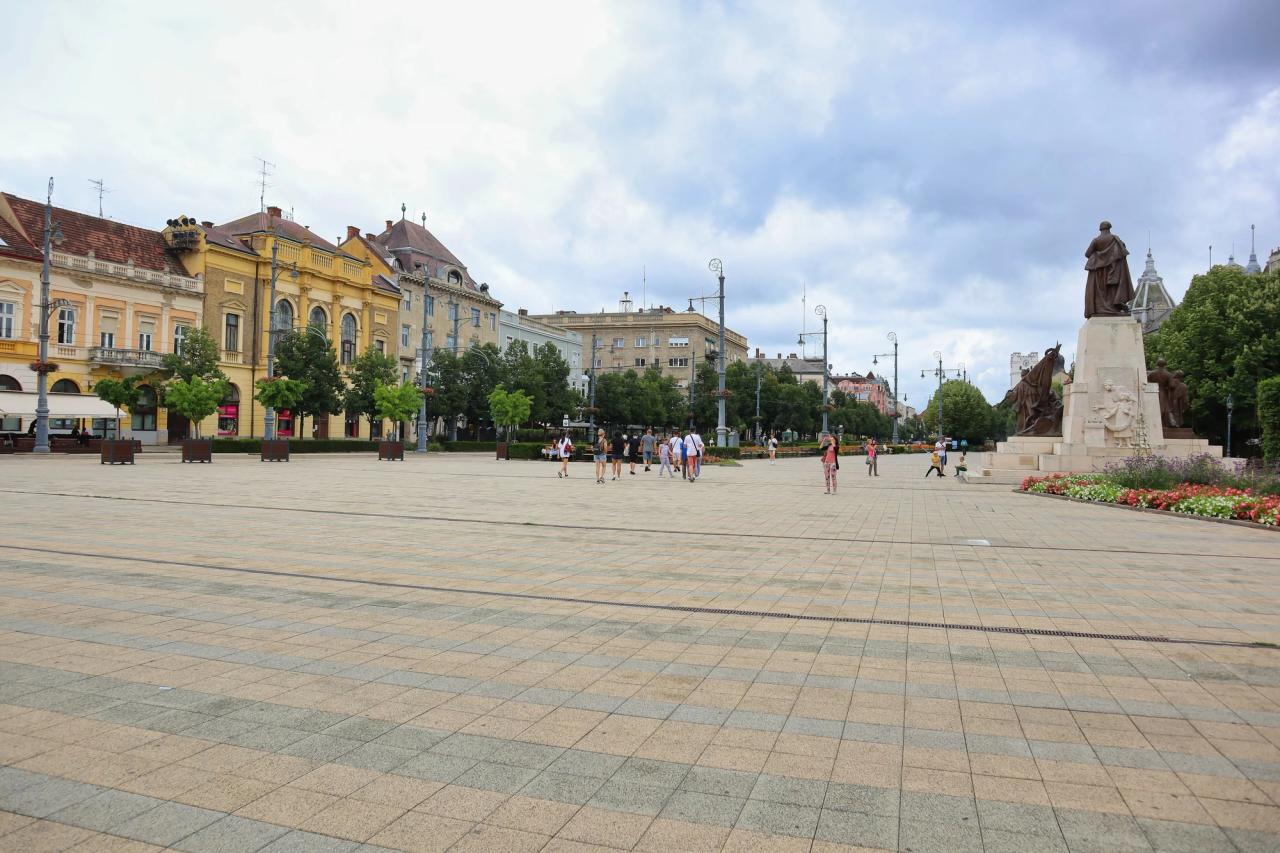

Debrecen is Hungary's second-largest city and the intellectual capital of the Great Plain. Home to the prestigious University of Debrecen, the iconic Great Reformed Church, and a growing tech sector, Debrecen attracts students, academics, and professionals looking for a calmer, more affordable alternative to Budapest. With its wide boulevards, green parks, and tight-knit community feel, Debrecen offers a high quality of life without the big-city price tag.
Often called the "Calvinist Rome," Debrecen has a proud independent streak — it was briefly Hungary's capital during the 1848 revolution. Today it balances tradition with modernity: the Reformed College still stands beside the Great Church, while BMW's new manufacturing plant signals a future rooted in advanced industry. The city's flat terrain, excellent university, and very affordable living costs make it especially popular with international students and families.
Debrecen at a Glance

- Population
- 202,000 (metro ~270,000)
- Region
- Northern Great Plain (Hajdú-Bihar county)
- Known For
- University of Debrecen, Great Reformed Church, Flower Carnival
- Average Rent (1BR)
- HUF 130,000–200,000/month (city centre)
- Average Salary
- HUF 300,000–380,000/month net
- Expat Community
- Medium-sized; strong student population from 100+ countries
- Language
- Hungarian; English spoken around the university
Why Move to Debrecen
- University hub: The University of Debrecen enrolls 30,000+ students and is one of Hungary's top institutions, attracting international academics and a cosmopolitan student body.
- Very affordable: Rent and daily costs are 25–35% lower than Budapest, stretching your budget significantly further.
- Manageable size: Everything is reachable within 20 minutes by car or public transport. No long commutes, no big-city stress.
- Growing economy: BMW's new plant and expanding IT and pharmaceutical sectors are creating skilled jobs and drawing investment.
Visa and Residence Requirements
For EU/EEA Citizens
- Right of residence: EU/EEA citizens can live and work in Hungary without a visa
- Registration required: Register your address at the local Kormányablak (government office) within 90 days of arrival
- Documents needed: Valid passport or ID card, proof of address, proof of health insurance, proof of sufficient funds
- Long-term residence: Can apply for a residence card after 5 years of continuous residence
For Non-EU Citizens
Short-Term Stays (Up to 90 Days)
- Schengen visa: Required for tourism, business, or family visits
- Duration: Up to 90 days within any 180-day period
- Application: Apply at Hungarian embassy or consulate in your home country
- Documents: Valid passport (3+ months beyond stay), travel insurance, proof of accommodation, proof of funds, return ticket
Long-Term Residence (More Than 90 Days)
National Visa (D-type):
- Purpose: Work, study, family reunification, investment
- Application: Apply at Hungarian embassy or consulate in your home country
- Processing time: Typically 30-60 days
Residence Permit:
- Application: Submit within 90 days of arrival if entering on a D-visa, or apply from abroad
- Required documents:
- Valid passport
- Proof of accommodation (rental contract or letter of invitation)
- Health insurance valid in Hungary
- Proof of sufficient funds (bank statements showing ~HUF 100,000-150,000/month)
- Clean criminal record (from home country and translated)
- Passport photos
- Purpose-specific documents (see below)
Work Permit
- Required for: All non-EU citizens seeking employment
- Application: Submitted by your Hungarian employer to the Immigration Office (OIF)
- Processing time: 30-90 days
- Duration: Typically 1-2 years, renewable
- Documents needed: Employment contract, employer's registration documents, your qualifications, proof of accommodation
- Note: You cannot start working until the permit is issued
Student Visa
- Required for: Non-EU students at University of Debrecen or other institutions
- Application: University provides acceptance letter; you apply for residence permit for study purposes
- Required documents: University acceptance letter, proof of sufficient funds (~HUF 80,000-100,000/month), proof of accommodation, health insurance
- Work rights: Students can work up to 24 hours per week during semester, full-time during breaks
Family Reunification
- For spouses, children, and parents of legal residents
- Required documents: Marriage certificate (if applicable), birth certificates, proof of relationship, proof of family member's legal status
- Processing time: 60-90 days
Residence Permit for Investment/Business
- Required for: Entrepreneurs starting a business or investors
- Minimum investment: Varies by program; business immigration requires demonstrating economic benefit
- Documents: Business plan, registration documents, proof of investment funds
General Requirements for All Non-EU Applicants
Health Insurance:
- Must be valid in Hungary for the duration of stay
- Travel insurance for short-term stays
- Comprehensive health insurance for long-term residence
Proof of Funds:
- Approximately HUF 100,000-150,000 per month for residence permit
- For students: HUF 80,000-100,000 per month
- Bank statements from the past 3-6 months
Accommodation:
- Rental contract or letter of invitation
- Property ownership documents
- Must be registered with local authorities
Language Requirements:
- Hungarian language test (A2 level) for permanent residence applications (5+ years)
- Not required for initial residence permit
Important Notes
- Processing times: Can vary significantly; apply well in advance
- Extensions: Apply at least 30 days before your permit expires
- Permanent residence: Available after 5 years of continuous legal residence (requires language test and integration exam)
- Citizenship: Available after 8 years of residence, with language and constitutional knowledge requirements
- Legal help: Consider consulting an immigration lawyer for complex cases
Where to Apply in Debrecen
- Immigration Office (OIF): Handles residence permits and extensions
- Kormányablak: For address registration and general administrative matters
- University of Debrecen International Office: Assists students with visa-related paperwork
- NAV: For tax number (adószám) applications
Useful Contacts
- Hungarian Immigration Office (OIF): https://bmbah.hu/
- Debrecen Immigration Office: Local branch handles in-person applications
- University of Debrecen International Office: +36 52 512-900
- Emergency (if visa lost/stolen): Contact your embassy immediately
Finding Housing in Debrecen
Average Rents
| Neighborhood | 1-Bedroom (HUF/month) | 3-Bedroom (HUF/month) | Character |
|---|---|---|---|
| Belváros (City Centre) | 150,000–220,000 | 280,000–400,000 | Central, walkable, shops and cafés |
| Nagyerdő | 140,000–200,000 | 260,000–380,000 | Green, upscale, near university |
| Tócóvölgy | 110,000–160,000 | 200,000–300,000 | Affordable, residential, family-oriented |
| Csapókert | 100,000–150,000 | 180,000–280,000 | Quiet, suburban, houses with gardens |
| Tégláskert | 110,000–165,000 | 200,000–310,000 | Mixed, close to university, budget-friendly |
How to Find Housing
- Ingatlan.com: The primary platform for Hungarian property listings; filter by Debrecen.
- Facebook groups: "Debrecen Albérlet" and "Expats in Debrecen" post regular listings.
- University housing office: The University of Debrecen assists international students with dormitory placement and private rentals.
- Local tip: Debrecen's rental market is less competitive than Budapest's. Negotiating rent or asking for furnished upgrades is common and often successful.
Tips for Expats
- Contracts are typically 1 year. A 1–2 month deposit is standard.
- Many landlords prefer Hungarian bank transfers — open a local account early.
- Check heating type: some older buildings use individual gas heaters rather than central heating.
- Ask about the "közös költség" (common maintenance fee) separately from rent — it can add HUF 10,000–20,000 per month.
Neighborhoods Guide
- Belváros (City Centre): The compact core around Kossuth tér and the Great Reformed Church. Walkable, lively, with the best restaurants and shops. Mid-range rent. Best for professionals and students without a car.
- Nagyerdő (Great Forest): Debrecen's green lung — home to the university campus, thermal baths, a zoo, and an amusement park. Popular with students and academics. Slightly upscale, with a resort-like feel.
- Tócóvölgy: A modern residential district west of the centre. Affordable new-build apartments, schools, and shopping centres. Great for families on a budget.
- Csapókert: Quiet suburban area in the northeast with detached houses, gardens, and a village-like feel. Lower rent, slightly farther from the centre.
- Tégláskert: Mixed residential area with both old and new housing. Close to the university and the Nagyerdő. Budget-friendly and convenient.
Cost of Living in Debrecen
Monthly Budget Breakdown
| Category | Budget Range (HUF) |
|---|---|
| Rent (1BR, centre) | 130,000–200,000 |
| Utilities (base rate) | 30,000–45,000 |
| Utilities (winter, incl. heating) | 40,000–65,000 |
| Internet | 4,500–7,000 |
| Groceries | 50,000–75,000 |
| Transport (monthly pass) | 7,800 |
| Dining out (4x/month) | 20,000–32,000 |
| Leisure/Gym | 10,000–16,000 |
| Total (spring/autumn) | 252,300–382,800 |
| Total (winter) | 262,300–402,800 |
Day-to-Day Costs
- Coffee (flat white): HUF 800–1,100
- Lunch (casual restaurant): HUF 2,000–3,500
- Monthly transport pass: HUF 7,800
- Beer (bar, 0.5L): HUF 700–1,200
- Cinema ticket: HUF 1,800–2,500
- Loaf of bread: HUF 450–700
- 1 litre of milk: HUF 320–420
- Monthly gym membership: HUF 8,000–15,000
Getting Around Debrecen
- Public transport: DKV operates buses, trolleybuses, and trams across the city. A monthly pass costs HUF 7,800. The network is efficient for a city this size, with most routes running from 5 AM to 11 PM.
- Cycling: Debrecen is flat and increasingly bike-friendly. Several cycling paths connect the centre to the Nagyerdő and outer districts. Ideal terrain for everyday cycling.
- Driving: Easy to navigate with light traffic compared to Budapest. Parking is affordable and mostly available. The city is well connected to the M35 motorway.
- Airport: Debrecen International Airport (DEB) offers seasonal and budget flights to London, Munich, Tel Aviv, and other European cities. Located 7 km from the centre.
- Intercity: Direct trains to Budapest Nyugati (2.5 h), and bus connections to the wider Great Plain region. The railway station is centrally located.
Healthcare in Debrecen
- Hospitals/Clinics: Kenézy Gyula University Hospital and the University of Debrecen Clinical Centre are the main public facilities. Private options include MedCenter Debrecen and Fürdő Medical Centre.
- English-speaking doctors: Available through the university clinic and private practices, especially near the campus area. Private consultations cost HUF 12,000–25,000.
- Pharmacies: Widely available. Patika pharmacies are found throughout the city. Several offer late-night service.
- Emergency number: 112 (general), 104 (ambulance)
Planning your move?
Tell us about your move to compare quotes from international moving companies.
Culture & Lifestyle
- Great Reformed Church (Nagytemplom): The symbol of Debrecen and the most important Protestant church in Hungary. A must-see landmark on Kossuth tér.
- Flower Carnival: Held every August 20 — Hungary's most colourful parade with elaborate flower floats, attracting visitors from across the country.
- Nagyerdei Park (Great Forest): A massive green area with thermal baths, the Aquaticum water park, a zoo, botanical garden, and running trails. Debrecen's outdoor living room.
- University culture: Student life drives the city's cultural scene — concerts, theatre, and festivals year-round. The MODEM Centre for Modern and Contemporary Art is a highlight.
Food & Dining
- Try debreceni pároskolbász (Debrecen double sausage, the city's signature dish) and hortobágyi palacsinta (savoury stuffed crêpe from the nearby Hortobágy).
- Csárda restaurants on the outskirts serve traditional Hungarian plain cuisine with generous portions.
- Budget meals: University canteens and daily lunch menus (menü) cost HUF 1,800–3,000.
- The Piac utca (Market Street) area has the highest concentration of restaurants and cafés.
Expat Community
- University of Debrecen International Office: Organises orientation events, buddy programmes, and social activities for international students and staff.
- InterNations Debrecen: Smaller but active expat network with periodic meetups.
- Language exchanges: Organised through the university and local cafés. Hungarian-English tandem is the most popular.
Nightlife and Entertainment
- Student bars: Debrecen's nightlife is centred around the student quarter near the Nagyerdő. Roncsbár, Klinika, and Mélygarázs are popular spots.
- Live music: The Kölcsey Centre and MODEM host cultural events. University concerts and parties are frequent during term time.
- Cinema: Fórum Cinema and the Art Mozi network show both mainstream and art-house films.
Working Remotely
- Coworking spaces: Debrecen has fewer coworking options than Budapest, but the Science and Technology Park and several cafés cater to remote workers.
- Internet: Reliable broadband with average speeds of 100+ Mbps. Fibre available in most districts.
- Time zone: CET (UTC+1), matching Western Europe.
Shopping in Debrecen
- Groceries: Tesco, Aldi, Lidl, and Spar are widely available. The Vásárcsarnok (Market Hall) on Vár utca sells fresh local produce.
- Shopping centres: Fórum Debrecen and Tesco Hypermarket on the outskirts cover most needs.
- Local markets: The daily market near the centre offers seasonal fruits, vegetables, and Hungarian specialities.
Job Market in Debrecen
- Main industries: Automotive (BMW), pharmaceuticals (Teva, Gedeon Richter), IT, agriculture, education.
- Major employers: University of Debrecen, BMW Group, National Instruments, IT Services Hungary, Gedeon Richter.
- Average salaries by sector:
| Sector | Average Net Monthly (HUF) |
|---|---|
| IT / Software | 400,000–650,000 |
| Automotive / Engineering | 350,000–550,000 |
| Pharma / Science | 320,000–500,000 |
| Education | 250,000–350,000 |
- Job search resources: Profession.hu, LinkedIn, Debreceni Állásportál, university career office.
Education in Debrecen
- International schools: Limited options within Debrecen itself; the Erzsébet Lovassy László Secondary School offers bilingual programmes. Budapest-based international schools may be relevant for families requiring full English curriculum.
- Universities: University of Debrecen (30,000+ students, strong in medicine, sciences, and engineering), Debrecen Reformed Theological University.
- Language schools: University language centre, Berlitz, private tutors widely available and affordable.
Language and Integration
- Hungarian is challenging for newcomers, but Debrecen's international university community means English is commonly heard on campus and in the city centre.
- Government offices typically require Hungarian — bring a translator for important appointments.
- The University of Debrecen offers subsidised Hungarian language courses for international students and staff.
Winter Living Tips
- Debrecen winters are cold and dry. Expect temperatures of -5°C to -10°C from December through February, with regular snowfall.
- Heating costs can increase utility bills by HUF 10,000–20,000 per month during winter. Check insulation quality when renting.
- The Aquaticum thermal baths in the Nagyerdő are popular year-round — a warm soak on a freezing day is a local tradition.
Moving Checklist for Debrecen
- Secure a visa or confirm EU/EEA right of residence
- Contact the University of Debrecen International Office if arriving as a student or researcher
- Browse Ingatlan.com to understand the rental market
- Arrange health insurance valid for Hungary
- Register your address at the local Kormányablak
- Apply for a TAJ card (social security number)
- Open a Hungarian bank account (OTP and Erste have branches in central Debrecen)
- Purchase a local SIM card
- Register for an adószám (tax number) at NAV
- Enroll in Hungarian language classes (the university offers affordable courses)
- Explore the Nagyerdő and find your nearest market and pharmacy
- Join a local expat or student group
Yes. The University of Debrecen is one of Hungary's most international universities with students from over 100 countries. English-taught programmes in medicine, engineering, and business are well established, and the cost of living is significantly lower than Budapest.
Debrecen is smaller, quieter, and more affordable. It lacks Budapest's nightlife and cultural density, but offers a stronger community feel, less traffic, and much cheaper rent. It suits expats who prefer a slower pace or are connected to the university or local industry.
The Hungarian Forint (HUF). Card payments are widely accepted. ATMs are plentiful — use bank-operated machines to avoid high fees.
Around the university campus and in the city centre, yes — many locals speak some English. However, for government paperwork, housing contracts, and deeper social connections, Hungarian is very helpful. The university offers free or subsidised Hungarian courses.
Winters are cold and dry, with temperatures regularly dropping to -5°C to -10°C between December and February. Snowfall is common. Budget for higher heating costs (included in utilities) during winter months.
Yes. Direct trains reach Budapest in about 2.5 hours. Debrecen Airport offers budget flights to several European cities. The M35 motorway connects Debrecen to the national highway network.
The Nagytemplom (Great Reformed Church) is the largest Protestant church in Hungary and the symbol of Debrecen. It was here in 1849 that Lajos Kossuth declared Hungary's independence from Habsburg rule. The church and its adjacent Reformed College are central to the city's identity.
Yes. Debrecen's flat terrain, green spaces (especially the Nagyerdő), affordable rent, and safe neighbourhoods make it a strong choice for families. The university also provides a stable economic and cultural base.
The Debrecen Flower Carnival is Hungary's biggest floral parade, held every August 20 (St. Stephen's Day). Elaborate floats decorated with flowers march through the city centre, accompanied by music, dance, and street performances. It draws tens of thousands of visitors annually.
You can apply for an adószám at the local NAV (tax office) branch. Bring your passport, Hungarian address card, and residence permit. Processing usually takes 1–2 weeks. The adószám is needed for employment, banking, and rental contracts.
Late spring (May–June) or early autumn (September) are ideal. Avoid deep winter (January–February) when temperatures drop to -10°C and housing viewings are less pleasant. Summer is warm and social but many services slow in August.
Sports and Recreation
- Running and cycling: Debrecen's flat terrain and the Nagyerdő's paths make it perfect for running and cycling. The Great Forest has dedicated running tracks.
- Swimming and thermal baths: The Aquaticum complex in the Nagyerdő has indoor and outdoor pools, water slides, and thermal baths. A popular family destination.
- Football: DVSC (Debreceni VSC) is the local club, playing at Nagyerdei Stadion. Match days bring the city alive.
- Fitness: Gym memberships range from HUF 7,000–14,000/month. Several gyms operate near the university and in the Belváros.
- Nature excursions: The Hortobágy National Park (UNESCO World Heritage) is 40 km away — the iconic Hungarian puszta (plain) with wild horses, grey cattle, and traditional shepherds.
Safety Tips for Expats
- Debrecen is safe overall, but lock bicycles securely — bike theft is the most common petty crime.
- Keep copies of your passport, visa, and TAJ card in a separate location from the originals.
- Register with your embassy upon arrival for emergency support.
- Save 112 (general emergency) and 104 (ambulance) in your phone.
- Use bank-operated ATMs to avoid inflated exchange rates from independent machines.
Related Guides
- [Moving to Hungary] — comprehensive country guide
- [Moving to Budapest] — Hungary's capital city
- [Moving to Szeged] — university city in the south