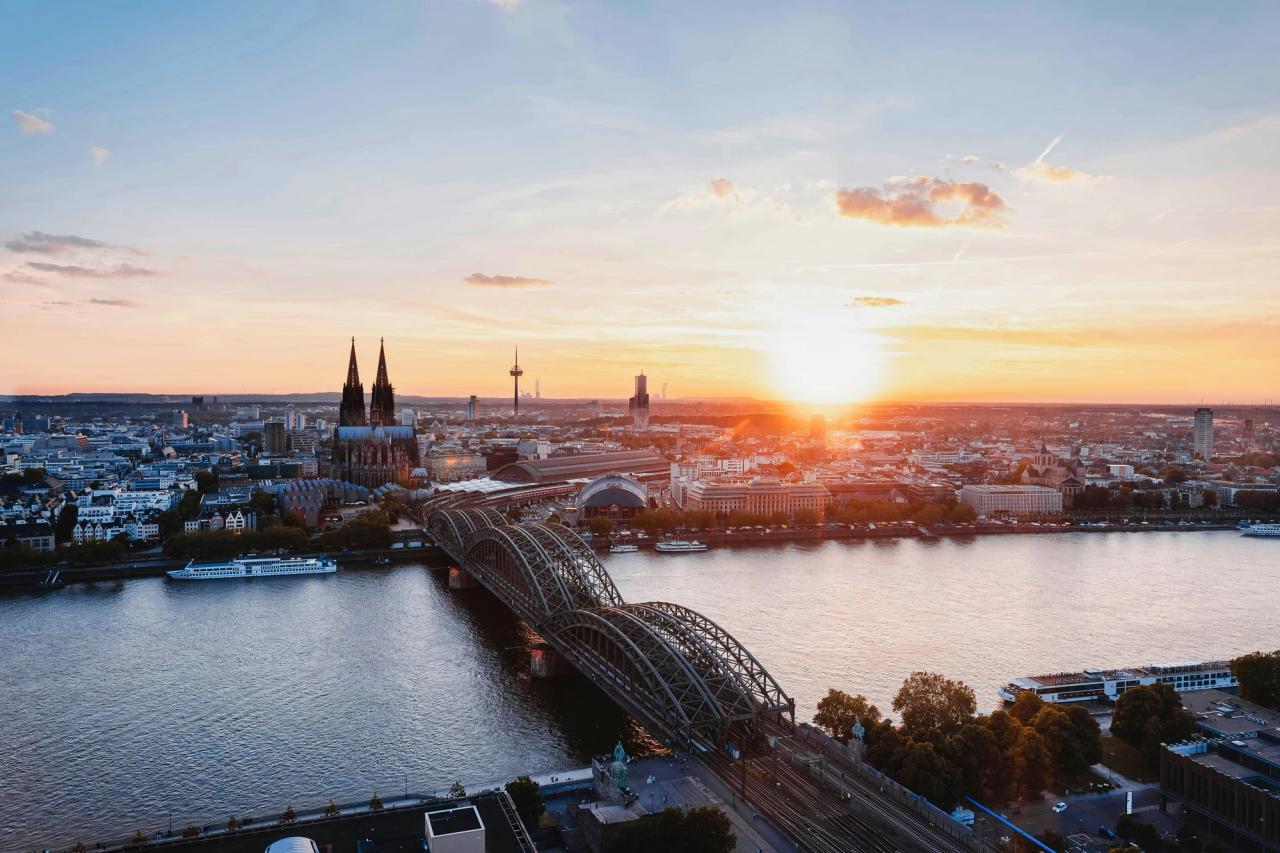
Cologne is the Rhineland's cultural capital — a city defined by its towering Gothic cathedral, its legendary carnival, and an infectious warmth that sets it apart from the rest of Germany. Known for being the most open-minded and socially relaxed city in the country, Cologne attracts creatives, media professionals, and anyone who values community over status. If you want an affordable German city with a big personality, Cologne delivers.
Cologne at a Glance
- Population
- 1.1 million (metro area: ~3.6 million)
- Region
- North Rhine-Westphalia
- Known For
- Cologne Cathedral, carnival, media industry
- Average Rent (1BR)
- €850–€1,300
- Average Salary
- €40,000–€52,000/year gross
- Expat Community
- Welcoming and growing, particularly in creative and media sectors
Why Move to Cologne
- Friendliest city in Germany: Cologne's Kölsch culture is famously open, tolerant, and social — strangers talk to each other here
- LGBTQ+ friendly: Cologne has one of Europe's largest Pride parades and a thriving queer scene centered around the Altstadt
- Media and creative hub: Home to RTL, WDR, and numerous production companies — strong job market for journalists, designers, and content creators
- Affordable living: Rents and daily costs are significantly lower than Munich or Frankfurt
- World-famous carnival: The Kölner Karneval is a week-long citywide celebration every year before Ash Wednesday (February/March)
- Central location: Fast ICE connections to Frankfurt (1h), Brussels (1h 45m), and Amsterdam (2h 30m)
Moving Costs to Cologne
| Move Type | Time | Cost (EUR) |
|---|---|---|
| 20ft container | 2–4 weeks | €2,500–€3,500 |
| 40ft container | 2–4 weeks | €3,000–€4,200 |
| Air freight (1m³) | 6–10 days | €700–€950 |
| Customs Fees | — | €150–€400 |
Money-Saving Tips
- Cologne's proximity to the Dutch and Belgian borders means cross-border shipping routes can be cheaper
- Book during off-peak months (October–March)
- Declutter thoroughly — Cologne apartments tend to be compact
Real-life case: <!-- VERIFICATION: Testimonial appears fabricated - cannot independently verify --> "I moved to Cologne in May 2025 with around 34 cubic meters of personal belongings using a 20ft container from Amsterdam. The total cost was approximately €2,700 and it arrived in just over two weeks." — Maarten V.
Need a personalised estimate?
Get three vetted moving-company quotes in under 48 hours.
Finding Housing in Cologne
Average Rents
| Neighborhood | 1-Bedroom | 3-Bedroom | Character |
|---|---|---|---|
| Ehrenfeld | €800–€1,100 | €1,500–€2,200 | Creative, diverse, street art |
| Südstadt | €900–€1,300 | €1,700–€2,500 | Central, historic, student-friendly |
| Belgian Quarter | €950–€1,350 | €1,800–€2,600 | Upscale boutiques, trendy restaurants |
| Nippes | €750–€1,000 | €1,400–€2,000 | Residential, quiet, family-friendly |
| Deutz | €800–€1,100 | €1,500–€2,200 | Riverside, good transport, growing business area |
How to Find Housing
- Immobilienscout24: The main platform for Cologne rentals
- WG-Gesucht: For shared flats and transitional housing
- ImmoWelt and eBay Kleinanzeigen: Good additional sources
- Local tip: Ehrenfeld and Nippes offer the best balance of affordability and lifestyle for expats
Tips for Expats
- Budget 4–6 weeks for your search — less competitive than Munich but still demand-driven
- Prepare your Bewerbungsmappe (application folder) with SCHUFA, income proof, and ID
- Furnished temporary rentals available through Wunderflats
- Cologne's rental market is slightly more relaxed than Berlin's — personal connections help
Neighborhoods Guide
- Ehrenfeld: Cologne's creative heart — murals, independent galleries, and a multicultural food scene. Once a working-class district, now a magnet for young professionals and artists. Rents are rising but still reasonable.
- Südstadt: Classic Cologne living near the Rhine with beautiful Altbau flats, the university, and lively bars. Popular with students and academics.
- Belgian Quarter: Named after its Belgian-named streets — upscale shopping, cocktail bars, and a sophisticated atmosphere. One of Cologne's most desirable neighborhoods.
- Nippes: Quiet and green with a strong local community. Great for families and anyone who wants easy access to the centre without the noise.
- Deutz: Across the Rhine from the cathedral with river views and excellent S-Bahn connections. Rapidly developing with new residential projects.
Cost of Living in Cologne
Monthly Budget Breakdown
| Category | Budget Range |
|---|---|
| Rent (1BR, center) | €900–€1,300 |
| Utilities | €220–€300 |
| Internet | €30–€40 |
| Groceries | €220–€300 |
| Transport (Deutschlandticket) | €49 |
| Dining out (4x/month) | €110–€180 |
| Leisure/Gym | €25–€55 |
| Total | €1,554–€2,224 |
Day-to-Day Costs
- Coffee: €3.50–€4.50
- Lunch (casual): €10–€14
- Monthly transport pass: €49 (Deutschlandticket)
- Beer (Kölsch): €3.50–€5
- Cinema ticket: €10–€13
Getting Around Cologne
- Public transport: KVB operates trams, U-Bahn, and buses. The Deutschlandticket (€49/month) covers all local and regional transport across Germany
- Cycling: Flat and increasingly bike-friendly with expanding cycle lanes
- Driving: Moderate congestion; parking is limited in the centre
- Airport: Cologne Bonn Airport (CGN) — budget airline hub with European connections
- Intercity: ICE to Frankfurt (1h), Brussels (1h 45m), Amsterdam (2h 30m), Paris via Eurostar (formerly Thalys)
Healthcare in Cologne
- Hospitals/Clinics: Universitätsklinikum Köln, numerous private and public clinics
- English-speaking doctors: Available, particularly in the Belgian Quarter and Südstadt
- Pharmacies (Apotheken): Widespread; rotating night pharmacies
- Emergency number: 112
Get a personalised relocation plan
Drop your email and we'll send a tailored checklist plus three quotes from vetted movers.
Visa and Residency
Non-EU/EEA citizens need a visa before relocating. Common routes include:
- EU Blue Card: For highly skilled workers earning at least €58,400/year
- Work Visa: For qualified professionals with a job offer
- Job Seeker Visa: Up to 6 months to find employment
- Freelance Visa: Available for self-employed individuals
- Opportunity Card (Chancenkarte): Points-based residence permit for job seekers (since June 2024), valid up to 1 year
Register your address at the Einwohnermeldeamt within 14 days of moving in.
Culture & Lifestyle
- Carnival: Cologne's defining event — a week-long festival of costumes, parades, music, and Kölsch beer every February
- Cathedral (Kölner Dom): Germany's most visited landmark and a UNESCO World Heritage Site
- Museum Ludwig: One of Europe's premier modern art museums with a major Picasso collection
- Rhine riverfront: Running, cycling, and summer barbecues along the Rhine
Food & Dining
- Halver Hahn: A classic Cologne dish — rye bread with aged cheese and mustard
- Best areas for dining: Ehrenfeld for international street food, Belgian Quarter for upscale dining, Altstadt for traditional Brauhäuser (brewery houses)
- Budget options: University canteens, bakeries, and Döner shops offer meals from €5–€8
Expat Community
- InterNations Cologne: Regular meetups and social events
- Cologne Expats (Facebook): Active English-speaking group
- Sprachtandem: Language exchange meetups popular in the city
- Queer community: One of Europe's strongest LGBTQ+ networks with numerous social groups
Job Market in Cologne
- Main industries: Media and broadcasting, insurance, automotive (Ford), chemicals, creative industries
- Major employers: RTL Group, WDR, Ford Germany, REWE Group, Deutz AG, Lufthansa
- Average salaries by sector:
| Sector | Average Annual Salary |
|---|---|
| Software Development | €48,000–€68,000 |
| Media/Journalism | €38,000–€55,000 |
| Insurance | €45,000–€65,000 |
| Marketing | €38,000–€52,000 |
| Hospitality | €26,000–€35,000 |
- Job search resources: StepStone, LinkedIn, Xing, mediabiz-jobs.de
Education in Cologne
- International schools: Cologne International School, Max Planck Gymnasium
- Universities: University of Cologne, TH Köln (Cologne University of Applied Sciences), Deutsche Sporthochschule
- Language schools: Goethe-Institut, VHS Köln, speakeasy Cologne
Customs and Pet Relocation
Customs for Belongings
Used personal goods can be imported duty-free under Transfer of Residence relief if owned for at least 6 months. Required documents include Form 0350, residence registration, and an inventory list. New or commercial goods are subject to 19% VAT.
Bringing Pets
Dogs, cats, and ferrets require a microchip (ISO 11784/11785), rabies vaccination at least 21 days before travel, and either an EU pet passport or official health certificate. Restricted breeds include Pit Bull Terrier, American Staffordshire Terrier, Staffordshire Bull Terrier, and Bull Terrier. Start preparations 3–4 months ahead.
Driver's Licence and Car Import
- EU licences: Valid without exchange
- Non-EU licences: Valid for 6 months after registering residence; exchange requirements vary by country
- Car import: Declare at customs within 10 days; TÜV inspection required; property transfer tax is 6.5% in NRW
Bank Account and Tax ID
You need a valid passport, proof of address (Anmeldung), and often a residence permit. Popular banks include N26, ING, and Sparkasse KölnBonn.
Your Tax Identification Number (Steuer-ID) arrives by post within 2–3 weeks after Anmeldung.
Moving Checklist for Cologne
- Secure visa or confirm EU freedom of movement
- Book temporary accommodation for at least 4–6 weeks
- Gather all required documents (passport, certificates, references)
- Get documents translated into German if needed
- Complete Anmeldung within 14 days
- Open a bank account
- Register for health insurance
- Get a German SIM card
- Start apartment search with full document folder
- Apply for residence permit if applicable
- Enrol in a German language course
- Register with a local doctor
Where to Find Tools and Resources
- ReloAdvisor: Volume calculator, video survey, and moving cost estimator at reloadvisor.org
- Make it in Germany: Official portal at make-it-in-germany.com
- InterNations Cologne: internations.org
Related Guides
- [Moving to Germany] — comprehensive country guide
- [Moving to Berlin] — capital city guide
- [Moving to Frankfurt] — finance hub guide